Guest Lecturing and University Links: A Legitimate but Slow Tactic
How offering genuine expertise to university courses can lead to durable .edu mentions, without gaming academic pages.
University pages carry weight with many audiences because they are associated with institutional credibility, and a mention on a course page or department blog can be a genuinely earned, durable link. This tactic is slower than most on this list, and it only works if the value you offer to students and faculty is real, not a pretext for a link.
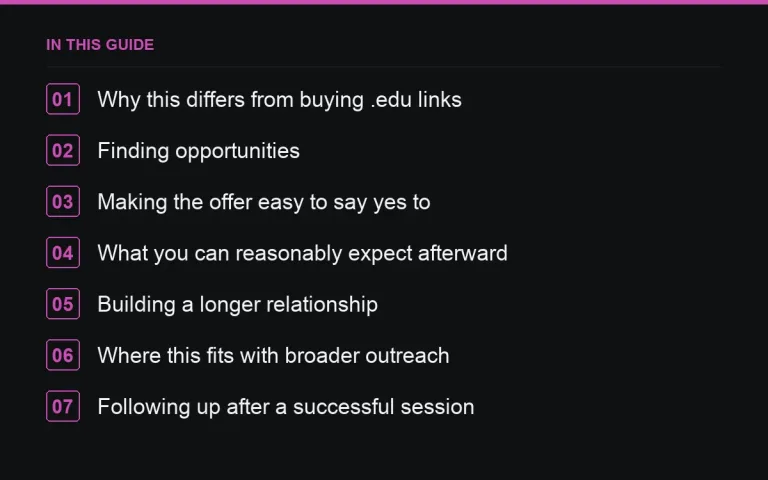
Why this differs from buying .edu links
Paying for placement on a university site, or inserting content purely to capture domain authority, is against most institutions’ policies and is easy for search engines to detect as manipulation. Guest lecturing works differently: you are offering a genuine service — real expertise delivered to real students — and any resulting mention is a natural byproduct of that relationship, not the point of it.
Finding opportunities
- Programmes directly related to your professional field — marketing, business, engineering, health sciences, and so on
- Faculty who post publicly about needing industry speakers for a course
- Alumni networks, if you or colleagues attended a relevant programme
- Local business schools or continuing-education departments open to practitioner talks
Making the offer easy to say yes to
| Makes it easy | Makes it hard |
|---|---|
| A specific, narrow topic tied to the course syllabus | A vague offer to “talk about my industry” |
| Flexible format — in person, video call, or recorded segment | Insisting on one rigid format regardless of the department’s setup |
| No cost to the institution | Requiring payment or promotional consideration |
What you can reasonably expect afterward
A mention on the course page, department newsletter, or event listing is a plausible and legitimate outcome, but it is the faculty’s decision, not something to request as a condition of speaking. Treat any resulting link as a bonus of doing something genuinely useful, not the primary goal you state to the department.
Building a longer relationship
A single guest lecture can lead to repeat invitations, mentions in alumni newsletters, or referrals to other departments and institutions if it goes well. Faculty often talk to colleagues at other schools, and a reputation as a reliable, engaging guest speaker compounds over several semesters far more than a single appearance would.
Where this fits with broader outreach
Guest lecturing sits alongside https://successtoroad.com/blog/edu-and-gov-resource-pages/ as one of the more institutional-facing tactics on this list. Both require patience and a genuine value exchange rather than a fast-turnaround pitch, and both tend to produce links that are unusually durable once secured.
Following up after a successful session
Send a brief thank-you note after the lecture, and ask whether the department would find it useful to have you back for a future term. This small gesture keeps the door open and often leads directly to a repeat invitation without you needing to pitch again from scratch.
Offering flexibility around scheduling
Academic schedules are often rigid, built around fixed class times that cannot easily move. Offer several possible dates and formats upfront rather than a single option, and be willing to work around the institution’s calendar rather than expecting them to accommodate yours, since this flexibility is often the deciding factor in whether a busy faculty member follows through on the invitation.
Approaching the right contact
Faculty coordinators, not general admissions or communications offices, are usually the right first contact for a guest lecture request. Look for the instructor of a specific, relevant course and reach out directly with a short note about your background and what you could offer their class, rather than routing the request through a general institutional inbox where it is likely to go unanswered.
Preparing content that fits an academic setting
A talk built for students needs a different register than a webinar aimed at industry peers — more foundational context, fewer assumptions about prior exposure to your specific jargon, and more room for questions. Faculty appreciate speakers who adapt to the audience rather than delivering a recycled conference talk unchanged, and this adaptability is often what earns a repeat invitation the following semester.
Recording and reusing the session
If the department is comfortable with it, ask whether the session can be recorded for their own archive or for students who could not attend live. A recording hosted on the university’s own platform, with your name and a brief bio attached, can become another durable, institution-hosted asset over time, separate from any live-event listing.
Extending the relationship beyond one course
Once you have delivered one successful session, ask the faculty member whether other courses or departments might have similar needs. A single relationship inside a university can open several additional opportunities over time if the first session goes well, since departments frequently share trusted external speakers with each other.
Where to go next
If speaking is a broader part of your outreach plan, read https://successtoroad.com/blog/webinars-and-events-links/ for the events-and-speaking angle more generally, and https://successtoroad.com/blog/link-building-checklist/ to keep this slower tactic tracked alongside faster ones. See https://successtoroad.com/blog/edu-and-gov-resource-pages/ for a related institutional-facing tactic. When you want to fill gaps with paid guest content in the meantime, https://successtoroad.com/niche/education/ on https://successtoroad.com/marketplace/ lists relevant publishers.
Frequently asked questions
Is guest lecturing a reliable source of links?
It is slow and not guaranteed, since any mention is at the department's discretion rather than something you can request. Treat it as a long-term relationship-building tactic, not a predictable link source.
Can I ask the department to link to my website in exchange for speaking?
No — conditioning a talk on receiving a link crosses into the kind of manipulative link scheme most institutions and search engines discourage. Offer the talk on its own merits.
How do I find departments open to guest speakers?
Look for faculty posting publicly about needing industry speakers, check continuing-education or executive-education programmes, and consider reaching out through alumni networks you already have access to.
Does this only work for people with formal academic credentials?
No. Many programmes value practitioner experience specifically because it complements academic teaching, so real industry expertise is often more valuable to them than an advanced degree.
Put it into practice
Filter 54,483 websites by DR, traffic, niche and price, and order with escrow — you pay only after the link is live.
Browse the marketplace