Social Media and Links: How They Relate
Social shares don't directly boost rankings. Getting your content seen by the people who write and link does.
Links on social media platforms are nofollow, and social signals like shares aren’t a direct ranking factor — no amount of retweets moves a page up the results on their own. That doesn’t make social media irrelevant to link building, though. It’s one of the best available channels for getting content in front of the specific people who write and link for a living: journalists, bloggers, editors and independent creators, most of whom are checking these platforms daily for story ideas.
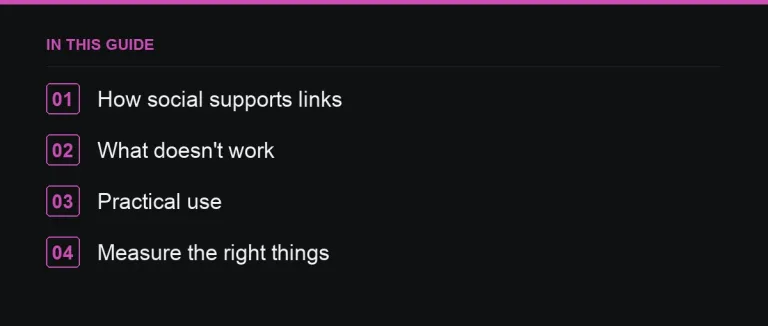
How social actually supports link building
- Distribution — content that circulates widely reaches writers who might otherwise never see it, and some proportion of them will cite what they find useful.
- Journalist relationships — many journalists are highly active on specific platforms and post source requests there directly, which is a faster route to a quote than a cold pitch — see journalist request platforms for the main places this happens.
- Community amplification — an engaged, relevant following can amplify a campaign or data release at the moment it launches, which matters because early momentum often decides whether a story gets picked up at all.
- Brand recognition — people are measurably more willing to link to and cite brands they already recognise than ones they’re encountering for the first time, and social presence is one of the cheapest ways to build that familiarity over time.
What doesn’t work, and wastes effort
- Buying followers or engagement — it inflates a vanity number while doing nothing for actual reach among real writers.
- Treating a link in a social bio or post as equivalent to an SEO link — it isn’t, and reporting it as one misleads whoever reads your results.
- Posting only your own links without ever engaging with anyone else’s content — this reads as broadcasting rather than participation, and algorithms on most platforms suppress accounts that behave this way.
Practical steps that actually move the needle
- Share data campaigns and linkable assets with real context and a summary of the finding, not just a bare link — see linkable assets that earn links on their own for what makes something worth sharing this way in the first place.
- Follow and genuinely engage with journalists and writers in your niche well before you need anything from them — replying thoughtfully to their posts over months is what makes a later pitch land differently from a stranger’s.
- Tag sources and collaborators in posts about work they contributed to; it’s a small courtesy that reliably gets reshared, extending reach for free.
- Repurpose the same underlying findings into native-format posts for each platform rather than cross-posting an identical image everywhere — a platform’s own algorithm tends to favour content built for it.
Platform differences worth knowing
| Platform tendency | What it’s useful for |
|---|---|
| Fast-moving, journalist-heavy platforms | Source requests, reactive commentary, breaking coverage |
| Professional/B2B-oriented platforms | Thought leadership, B2B journalist and analyst relationships |
| Visual/community-driven platforms | Distribution of data visualisations and campaign assets |
| Long-form video platforms | Explainer content that gets embedded elsewhere — see YouTube and video for links |
Connecting social to reactive PR
Social platforms are also where most reactive opportunities surface first — a source request, a breaking news angle, or a trending topic your expert can comment on. If you’re not already monitoring these regularly, it’s worth reading reactive PR: earning links from the news cycle alongside this, since the two channels reinforce each other directly.
Building relationships before you need them
The mistake most companies make with social media and link building is starting the relationship-building only when they have something to promote. By then, a cold pitch to a journalist you’ve never interacted with reads exactly like every other cold pitch in their inbox. Following, commenting thoughtfully on, and occasionally sharing the work of writers in your niche for months before you ever ask for anything is what makes a later pitch land differently — it’s slower, but it compounds, in much the same way a good linkable asset compounds once it starts ranking.
Setting realistic expectations
Social media won’t replace a proper outreach programme, and treating it as the whole strategy usually disappoints. Think of it as the layer that makes every other tactic in this guide work a little better: it gets your event recap seen by more people, gives your video content its first wave of viewers, and puts your statistics page in front of writers before it even ranks in search.
Measuring the right things
Judge social media by referral traffic, branded search volume, and links earned from content it helped distribute — not by likes, shares or follower counts in isolation, none of which correlate reliably with backlinks. See reporting on digital PR beyond link counts for a fuller framework, and treat social as one input into that reporting rather than a metric of its own.
Where to go next
Pair a social distribution plan with a proper outreach process — journalist outreach that gets replies covers the direct-pitch side that social engagement supports — and use a marketplace of publisher websites when a campaign needs guaranteed placements alongside the organic reach social can provide.
Frequently asked questions
Are social media links dofollow?
Links on major social platforms are nofollow.
Do social shares improve rankings?
Not directly. They help content reach people who may link to it.
Which social platform is best for link building?
The ones where journalists, writers and your industry are active, which varies by niche.
Put it into practice
Filter 54,483 websites by DR, traffic, niche and price, and order with escrow — you pay only after the link is live.
Browse the marketplace