Events, Webinars and Speaking for Links
Events create lots of pages — listings, speaker bios, recaps. Each is a natural place for a link.
Events generate content around them almost automatically: listings, speaker pages, sponsor pages, recaps and press coverage. Whether you host a webinar, sponsor a conference or simply speak at one, each of those surfaces creates a natural link opportunity from a relevant site — and unlike a lot of outreach, nobody has to be persuaded that linking to you makes sense.
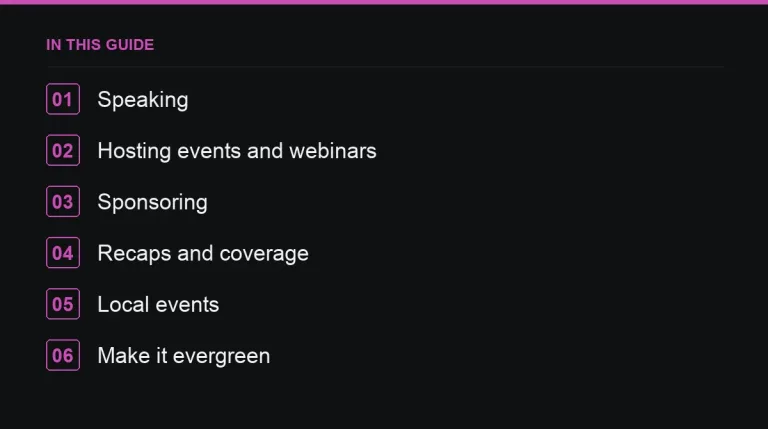
Speaking at events
Conference and meetup speaker pages usually include a short bio with a link back to the speaker’s site or company. Pick events your actual audience attends rather than the biggest name on the circuit, pitch a specific, well-scoped talk topic rather than a vague “how we do marketing”, and send organisers a tidy bio, headshot and abstract as soon as they ask — the ones who reply fastest often get the better speaking slots too.
Speaking also tends to generate secondary links: recap articles from attendees, a listing on the event’s “past speakers” archive that often survives for years, and sometimes an invitation onto a related podcast or panel.
Hosting events and webinars
- Submit the event to relevant listings sites and community calendars — most niches have a handful that get real traffic.
- Invite guest speakers wherever it fits; they routinely promote and link to events they’re part of, multiplying your reach for free.
- Partner with associations or communities that maintain their own event listings, which often outrank anything you could build yourself.
- Publish recordings, slides and a written summary on your site afterwards — attendees and speakers alike tend to link back to that page when referencing the session later.
Webinars specifically
A webinar’s landing page, its recording page, and any co-host’s promotion of it are three separate link opportunities from one piece of work. If you run webinars with partners or guest experts, ask them to link to the recording from their own site once it’s published — most will, since it’s content that reflects well on them too.
Sponsoring events
Sponsor pages at relevant conferences and meetups usually link to sponsors, sometimes for as long as the event’s site stays online. Choose events that genuinely fit your audience rather than the ones with the cheapest sponsorship tier; sponsoring purely for a link, on an event with no relevance to your business, rarely pays off and can look exactly like what it is.
Recaps and coverage
Write a genuinely useful recap of events you attend or speak at — key takeaways, links to slides, and resources mentioned during sessions. Organisers and other attendees often share and link to a recap that’s better than their own notes, and a recap published quickly, while the event is still being discussed, has a much better chance of being picked up.
Local events
Local events, workshops and meetups earn links from community sites, local news outlets and chamber-of-commerce style directories that a national campaign would never reach — see digital PR for local businesses for how those local link sources fit into a wider strategy.
Making it evergreen
Give recurring events a single, permanent URL rather than a new page each year, so links accumulate on one asset instead of resetting every twelve months — the same logic applies to any recurring content, as covered in building a newsjacking calendar. An event page with three years of accumulated links and past-speaker mentions is a far stronger asset than three separate pages with one year each.
Combining events with outreach
Events are also a natural hook for wider journalist outreach — a data point revealed during a talk, a survey run among attendees, or expert commentary gathered on the day can all become their own pitch afterwards, extending the value of one event far beyond the room it happened in.
Budgeting time against expected return
Not every event is worth the same investment. A half-day workshop you host yourself might justify weeks of preparation because you control the whole page and every speaker link; a single conference talk might justify only a well-prepared abstract and a follow-up email to the organiser. Before committing, estimate roughly how many link opportunities a given event realistically creates — a speaker page, a recap, a handful of attendee mentions — and weigh that against the time needed to prepare, travel and follow up. Treat events the same way you’d treat any other tactic in a broader plan, sitting alongside other digital PR campaign ideas rather than as a stand-alone activity that has to justify itself every time.
Following up afterwards
Most of the value from an event is lost in the days after it ends, simply because nobody follows up. Send organisers your slides and a thank-you note that makes it easy for them to link to your recap; ask co-speakers if they’d be open to a short quote or collaboration afterwards; and check back in a few weeks to see whether the listing, recording or recap you were promised actually went live. A short, polite follow-up email converts a surprising number of “we’ll link to it later” promises into actual links.
Where to go next
If your events strategy needs more structured content to point back to, look at linkable assets that earn links on their own and consider a few placements from a marketplace of publisher websites to support a major event launch.
Frequently asked questions
Do webinars help SEO?
Indirectly: listings, speaker promotion and recordings create link opportunities and useful content.
Are event sponsorship links valuable?
When the event is relevant to your audience, yes. Sponsoring only for links rarely pays.
Should recurring events have one URL?
Yes, so links build up over time rather than resetting each year.
Put it into practice
Filter 54,483 websites by DR, traffic, niche and price, and order with escrow — you pay only after the link is live.
Browse the marketplace