The Skyscraper Technique: What Works Now
'Find popular content, make it bigger, email everyone who linked to it' has been done to death. Here's the version that still works.
The skyscraper technique is a well-known link building method: find content in your niche with many links, create something better, then contact the sites linking to the original and suggest yours as an alternative or addition. It worked well when it was new, because “better” usually meant genuinely more useful. It works much less well today, when “better” has come to mean longer, and the outreach behind it is a template sent to hundreds of site owners who’ve seen the same pitch a dozen times.
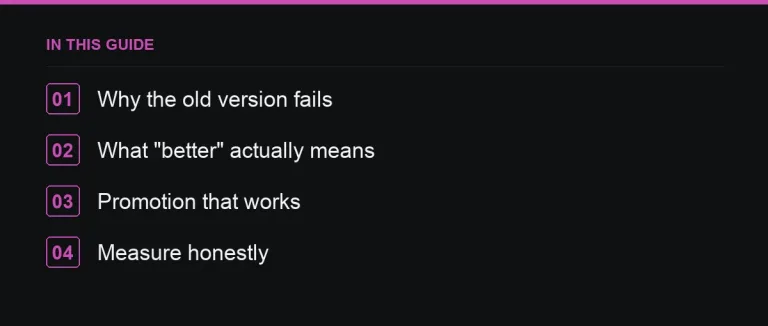
Why the old version fails
- Site owners receive constant “I made something bigger than your source” emails and ignore almost all of them on sight.
- Longer isn’t automatically better; a 10,000-word guide can be genuinely worse to use than a focused 2,000-word one that answers the question directly.
- People rarely swap out a link that’s working just because something newer exists — a working link is not a problem that needs solving from their point of view.
- Outreach volume without targeting produces a poor reply rate regardless of how good the content is.
What “better” actually means now
- New information — original data, first-hand testing, or expert input the original genuinely lacks.
- More current — the original’s facts, examples, screenshots or tool recommendations are visibly outdated.
- Easier to use — clearer structure, a working tool or calculator, or visuals that explain something the original only describes in text.
- More trustworthy — sources cited properly, a credible author, and none of the vague claims that make readers doubt the original. See E-E-A-T and links for how this affects both readers and rankings.
If you can’t name, in one sentence, what your version adds that the original doesn’t have, it isn’t a skyscraper — it’s a copy with a different byline, and prospects will treat it that way.
Building the asset properly
Start from a genuine content gap rather than an existing page you want to outrank. A good source list is the top-linked pages your competitors hold, surfaced through competitor backlink analysis: sort by referring domains and look for pages that are old, thin on data, or missing an obvious angle. Brief the piece properly before writing it — SEO content briefs covers how to specify the gap you’re filling so a writer doesn’t just produce a longer version of the same thing.
Promotion that actually works
- Prioritise prospects who link to outdated or dead versions of the resource; see broken link building for the mechanics of pitching a replacement.
- Target people currently writing about the topic, not only past linkers — they need a fresh source for new articles, and a currently-active writer is more likely to reply than someone who linked three years ago.
- Pitch what’s new, specifically: “we tested 40 tools and found X” beats “we wrote a more complete guide” every time.
- Use it for digital PR if it contains original data — see data-driven PR campaigns for turning the same asset into press coverage rather than just outreach links.
- Help it rank on its own — a handful of relevant placements can get the page into search results, where it earns links passively over time without further outreach; linkable assets covers this compounding effect.
A quick honesty check before you outreach
| Question | If the answer is no |
|---|---|
| Does the piece contain something the original doesn’t? | Don’t send skyscraper outreach yet — improve the content first |
| Would a busy editor notice the difference in 30 seconds? | Sharpen the headline and the opening paragraph |
| Are you pitching people who currently write about this topic? | Rebuild the prospect list before sending anything |
Measure honestly
Track links earned per hour of outreach, not just total links. If the ratio is poor, the content probably isn’t different enough from the original, and sending more emails won’t fix that — improving the asset will. Some publishers are also open to paying for placement of genuinely strong data-led content; browsing the marketplace by traffic and authority can surface sites worth pitching directly.
Common ways teams fool themselves
- Confusing “we added more sections” with “we added more value” — length and usefulness aren’t the same axis.
- Sending outreach before the content is actually finished, then losing prospects who checked once and moved on.
- Treating a single skyscraper asset as a permanent evergreen page instead of updating it when the topic moves on, which quietly turns your own asset into the next outdated version someone else will target.
The fix for all three is the same: slow down at the content stage and speed up at the outreach stage, not the other way round.
How this fits a broader content strategy
Skyscraper assets work best as anchor pages within a wider topic cluster rather than isolated one-off pieces. Support the main asset with related posts that link into it, keep it updated on a schedule rather than abandoning it after launch, and treat the outreach list you build for it as a reusable asset in its own right for future updates and future content on the same topic.
Where to go next
Read outreach email templates for wording that leads with what’s new rather than what’s bigger, and writing a guest post brief if the skyscraper asset is going to be pitched as contributed content rather than just linked to.
Frequently asked questions
Does the skyscraper technique still work?
It works when your content is genuinely better — new data, more current, or easier to use — and the outreach is targeted at people currently active on the topic.
Is longer content better for links?
Not in itself. Usefulness, originality and clarity matter far more than word count, and a bloated guide can perform worse than a focused one.
Who should I pitch skyscraper content to?
Sites linking to outdated or dead versions of the resource, and writers currently publishing about the topic, rather than a broad list of past linkers.
How do I know if my version is actually better?
If you can't state in one sentence what it adds that the original lacks, it probably isn't different enough to earn a link.
Put it into practice
Filter 54,483 websites by DR, traffic, niche and price, and order with escrow — you pay only after the link is live.
Browse the marketplace