Open Source Contribution as a Link Building Tactic for Dev-Facing Brands
How genuine open-source contribution and sponsorship can earn developer-facing backlinks that are hard to get any other way.
For developer tools, technical products, and B2B software companies, open source is a natural and credible link-building channel because the audience already lives in GitHub, technical blogs, and documentation sites. This only works as genuine participation — the developer community is quick to spot contributions made purely for SEO value.
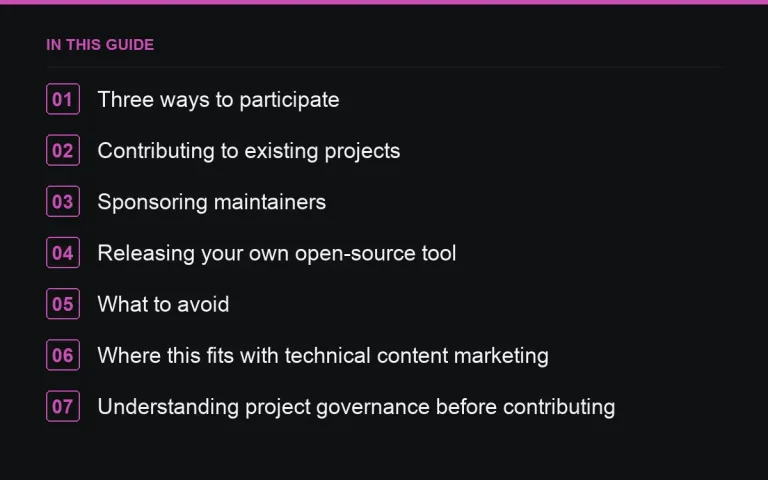
Three ways to participate
- Contributing code, documentation, or maintenance to existing projects your team already uses
- Sponsoring maintainers of projects critical to your stack through platforms built for that purpose
- Releasing your own tools or libraries as open source, with clear, useful documentation
Contributing to existing projects
README files, contributor lists, and project websites often link out to contributors’ own sites or company pages. A meaningful, accepted pull request — a real bug fix, a documentation improvement, a useful feature — is the entry point; the link is a natural byproduct of being listed as a contributor, not something you negotiate separately.
What counts as a meaningful contribution
| Meaningful | Not meaningful |
|---|---|
| Fixing a real, reported bug | A trivial typo fix submitted purely to get listed |
| Improving documentation clarity | Adding a self-promotional link inside docs |
| Adding a genuinely requested feature | Submitting low-effort changes across many repos at once |
Sponsoring maintainers
Sponsorship platforms built for open source funding often display sponsor logos and links on project pages or the maintainer’s own profile. This is one of the more straightforward routes: it is transparent, it supports work you genuinely rely on, and the resulting link is disclosed as sponsorship rather than disguised as editorial content.
Releasing your own open-source tool
- Solve a real, narrow problem your own team has faced, rather than building a tool purely to attract stars
- Write documentation good enough that other projects reference it in their own guides
- Engage with issues and pull requests consistently — an abandoned repo stops attracting links quickly
A well-maintained tool gets referenced in other projects’ documentation, blog posts comparing similar tools, and “awesome list” style curated directories, each of which is a plausible source of a durable link.
What to avoid
Do not submit low-value pull requests across many repositories purely to appear in contributor lists — maintainers notice this pattern quickly, and it damages your reputation in a community that talks to itself constantly. Avoid disguising a marketing link as a documentation contribution.
Where this fits with technical content marketing
Open source participation pairs well with technical blog content and with https://successtoroad.com/blog/link-building-for-mobile-apps/ or https://successtoroad.com/blog/link-building-for-marketplaces/ if your product serves developers building those kinds of products. It is a slower channel but produces some of the most durable, high-trust links available to a technical brand.
Understanding project governance before contributing
Different open-source projects have very different governance models — some are run by a single maintainer with limited bandwidth to review contributions, others by a formal foundation with a structured review process. Understanding this before submitting a contribution helps set realistic expectations for response time and the level of scrutiny your pull request will receive.
Choosing which projects to prioritise
Focus your contribution effort on projects your own team genuinely depends on, rather than picking popular projects purely because of their visibility. Contributions to tools you use daily tend to be more substantial and sustained, since your team already has the context and motivation to keep improving them, which produces stronger, more credible involvement than a scattershot approach across unrelated projects.
Writing technical blog posts about your own contributions
When your team makes a substantial contribution to a project, a short technical write-up explaining the problem and the fix can itself attract links from developers researching the same issue later. This works especially well for genuinely tricky bugs or performance improvements, where a clear explanation of the root cause has lasting reference value independent of the pull request itself.
Participating in project discussions, not just code
Answering questions in a project’s issue tracker or discussion forum, even without submitting code, is a legitimate way to build reputation in a community over time. Consistently helpful, technically sound answers get noticed by maintainers and other contributors, and this reputation frequently precedes and supports any later, more substantial contribution you make.
Being realistic about timeline and volume
Open source contribution as a link tactic works on a much longer and less predictable timeline than most items on this list. A single quarter of contribution activity is unlikely to move the needle meaningfully; sustained, genuine participation over a year or more is what tends to build the reputation and relationships that eventually translate into links, mentions, and referrals.
Where to go next
If your team already writes technical content, read https://successtoroad.com/blog/content-that-earns-links/ for how to package it for maximum reach, and revisit https://successtoroad.com/blog/link-building-checklist/ to track this alongside faster tactics. See https://successtoroad.com/blog/link-building-for-mobile-apps/ and https://successtoroad.com/blog/link-building-for-marketplaces/ if your product serves developers building those kinds of products. Explore https://successtoroad.com/niche/programming/ and https://successtoroad.com/niche/software-development/ on https://successtoroad.com/marketplace/ for developer-focused publishers.
Frequently asked questions
Do I need to be a developer myself to use this tactic?
Someone on your team does, since genuine contribution requires real technical work. This tactic fits companies with an engineering team already using or adjacent to relevant open-source projects.
Is sponsoring a maintainer the same as buying a link?
No — sponsorship is disclosed support for ongoing work, and any resulting link acknowledgement is transparent about being a sponsorship, unlike a paid link disguised as editorial content.
How long does it take to build a reputation in an open-source community?
It varies by project and community norms, but meaningful reputation generally builds over many contributions across months, not from a single pull request.
What happens if I release a tool and then stop maintaining it?
An abandoned repository stops attracting new links and can eventually be forked or replaced by an actively maintained alternative, so factor ongoing maintenance into the decision to open source anything.
Put it into practice
Filter 54,483 websites by DR, traffic, niche and price, and order with escrow — you pay only after the link is live.
Browse the marketplace