Link Building for Small Businesses: A Practical Plan
Small businesses don't need a link building department. They need a short list of the right actions.
Small business owners have limited time and budgets, and most link building advice assumes neither is a constraint. This plan focuses on the handful of actions that produce most of the results for a small business, laid out over a first quarter and then as an ongoing routine.
Why most advice doesn’t fit
Guides written for agencies and in-house SEO teams assume a monthly retainer, a content team and time for outreach campaigns. A small business owner running link building alongside everything else needs a shorter list, ordered by return, that fits into an hour or two a week rather than a full-time job.
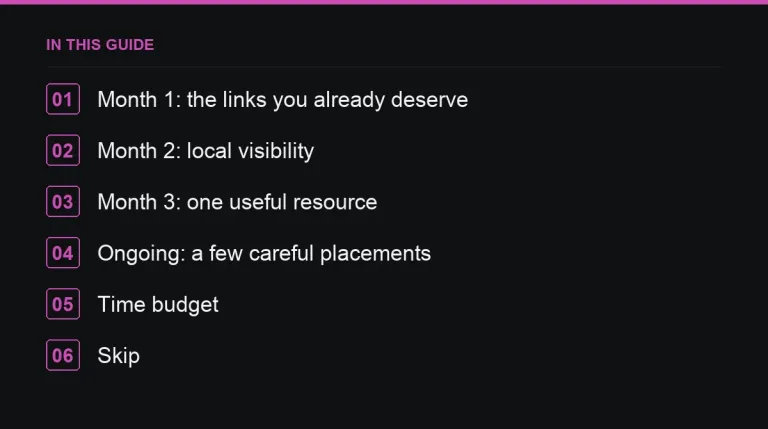
Month 1: the links you already deserve
Before spending anything, claim the links your business is already entitled to but probably hasn’t collected.
- Google Business Profile and major local directories, with consistent name, address and phone details across all of them (which directory submissions are still worth it).
- Suppliers, partners, trade associations and any membership bodies that list businesses like yours (partner and supplier links).
- Testimonials for the tools and services you already use and would recommend (testimonial link building).
Month 2: local visibility
- A local sponsorship or community involvement you’d take part in anyway — a sports team, a school event, a charity fundraiser.
- A pitch to local press about something genuinely newsworthy: a milestone, a hire, a local angle on your industry.
- Chamber of commerce and local business association listings, which double as citations and links.
See local SEO link building and the wider guide for local service businesses for more detail on both.
Month 3: one useful resource
Write the guide your customers most often ask about — pricing explained, a buying checklist, a how-to for a problem you solve every week. Make it the best answer available online for that specific question, rather than a generic overview (linkable assets). This single page does double duty: it converts visitors and gives other sites something worth linking to.
Ongoing: a few careful placements
If budget allows, one or two relevant placements a month supporting that resource and your key service pages is enough for a small business — chosen carefully rather than in bulk (how to evaluate a guest post site before you pay). The marketplace lets you filter by niche and location so you’re not sifting through irrelevant sites.
A simple time budget
| Activity | Time per month |
|---|---|
| Claiming and updating listings | 1–2 hours (one-off, then occasional checks) |
| Local outreach and press pitches | 1–2 hours |
| Writing or updating the core resource | 2–3 hours, spread over the quarter |
| Vetting and ordering placements | 1 hour |
Consistency beats bursts: a small amount of steady effort compounds faster than one intense month followed by silence (link velocity).
What to skip entirely
- Bulk link packages and mass directory blasts.
- Link exchange emails offering to “swap links” (reciprocal links and where the line is).
- Anything promising “page one in 30 days” — realistic timelines are longer (how long backlinks take to work).
What to expect in return
None of this produces overnight ranking jumps, and it shouldn’t be expected to. What it does is build a foundation of legitimate, relevant links that a search engine has no reason to discount, plus a small amount of local visibility and referral traffic along the way. Judge progress over a couple of quarters, not a couple of weeks (how long backlinks take to work).
If you outgrow the DIY plan
As the business grows, the same plan scales: more target pages, a slightly higher placement budget, maybe help from a freelancer or a small agency for the parts that take the most time (link building for SEO freelancers). The principles don’t change — relevance, real traffic, a genuinely useful resource — only the volume does.
Delegating without losing quality
Once time becomes the real constraint rather than money, hiring a freelancer or a small agency to run this plan is often the next step, not jumping straight to a large retainer. Whoever you bring in should be able to explain each action in plain terms and show you exactly which sites and pages they’re working with — the same transparency you’d want from doing it yourself (how to choose a link building agency).
A simple decision guide
- No budget at all yet? Focus entirely on Month 1 and Month 2 actions.
- A little budget, no time? Consider a freelancer to run the plan for a few hours a month.
- Some budget and some time? Run the plan yourself and add a couple of marketplace placements a month.
Where to go next
Once the basics are in place, use the fuller link building checklist to keep track, and check current standards against common link building mistakes before you spend on placements.
Frequently asked questions
How much should a small business spend on links?
Start with free relationship and local links, then add a small, consistent budget for careful placements if needed.
How much time does small business link building take?
An hour or two a week is enough for a consistent plan.
What's the first thing a small business should do?
Complete your business profile and get listed by suppliers, partners and associations.
Put it into practice
Filter 54,483 websites by DR, traffic, niche and price, and order with escrow — you pay only after the link is live.
Browse the marketplace