Expert Sourcing for Links: How to Get Quoted Without a Platform Subscription
A practical approach to becoming a go-to expert source for journalists and earning links from it.
Journalist request platforms are useful, but they are also crowded: a single request can pull in dozens of pitches within an hour, and most of them get ignored. Expert sourcing done well is less about winning a race to reply first and more about building a reputation that makes writers come to you directly. This post covers how to set that up without paying for a subscription tool.
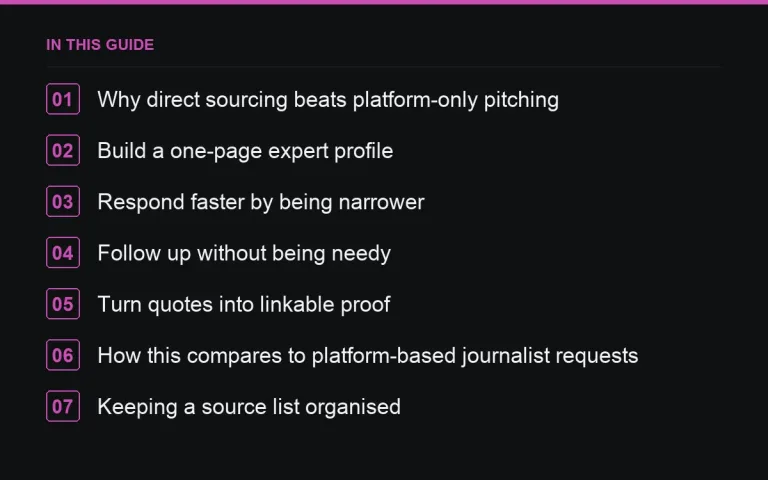
Why direct sourcing beats platform-only pitching
When a writer finds you through a platform request, you are one of many. When a writer finds you because a colleague mentioned you, because they read a comment you left, or because your name came up in a previous piece, you are already pre-qualified. That shortcut is what direct sourcing tries to create deliberately rather than leaving to chance.
Where writers actually look
- Bylines and quoted-expert sections of competitor coverage in your niche
- Podcast guest lists and conference speaker pages
- LinkedIn posts that get genuine discussion, not just likes
- Niche Slack and Discord communities where journalists lurk
Build a one-page expert profile
Before you pitch anyone, have a short page ready that states your specific expertise, your credentials, and two or three past quotes with links to where they ran. This does double duty: it is something you can send in thirty seconds when a writer asks “can you tell me more about your background,” and it is itself a page that can rank and attract inbound requests over time. Keep it factual — no invented credentials, no exaggerated titles.
Respond faster by being narrower
The experts who get quoted repeatedly are rarely the ones who claim to comment on everything. They pick two or three tight specialities and respond only to requests inside that lane, with a genuinely useful two- or three-sentence answer rather than a paragraph that needs editing down. Writers reuse sources who make their job easier, and a tight, quotable answer is easier to slot into a draft than a long one.
What a usable quote looks like
| Weak | Usable |
|---|---|
| “This is a really important topic and there’s a lot to consider.” | “The mistake I see most often is X, and it usually costs teams Y.” |
| General background with no specific claim | One concrete recommendation plus the reasoning behind it |
Follow up without being needy
If a writer used your quote, thank them briefly and do not ask for anything in the same message — no “can you also link to my site,” no “can you tag me everywhere.” A short, gracious note is what gets you remembered for the next piece. If the piece went live without a link to your site, a polite note asking whether a link back would be appropriate is fine once, not repeatedly.
Turn quotes into linkable proof
Every time you are quoted somewhere reputable, log the placement, the outlet, and the date. Over a few months this becomes a media page that itself earns links — other writers see it and treat you as vetted. It also gives you leverage: a source who has three solid placements is far easier for a new writer to say yes to than one with none.
Common mistakes
- Pitching the same generic bio to every request regardless of topic
- Sending a 300-word answer when the writer asked for a soundbite
- Never checking whether the story actually ran
- Treating every response as owed a link, which makes writers wary of using you again
How this compares to platform-based journalist requests
Platforms are still worth checking daily for https://successtoroad.com/blog/journalist-request-platforms/, but they work best alongside direct relationships, not instead of them. If you are new to sourcing, start on the platforms to learn what a usable pitch looks like, then use that skill to approach writers directly once you have a track record. See also https://successtoroad.com/blog/podcast-guesting-for-links/ for a similar relationship-first approach applied to audio.
Keeping a source list organised
Once you start being quoted regularly, track who wrote about you, what publication it appeared in, and roughly when. A simple spreadsheet is enough: outlet name, writer name, date, topic, and whether a link was included. This lets you spot patterns — which topics get you quoted most often, which writers reuse you, and which outlets never link even when they quote accurately. That pattern recognition is what tells you where to spend more time and where to stop pitching.
Handling requests outside your speciality
You will occasionally get a request that is close to your area but not quite right. Rather than stretching your credibility to answer anyway, it is usually better to decline briefly and, if you genuinely know someone better suited, offer to connect the writer with that person. Writers remember sources who protect their credibility this way, and the colleague you refer often returns the favour later. This kind of small trust-building compounds over a surprising number of pitches, in a way that a single overreaching answer does not.
What to do when a placement never appears
Many journalist requests do not result in a published piece at all — the story gets killed, reshaped, or the writer moves on. Do not chase a writer for status updates on a story that may never run; it reads as impatient and rarely changes the outcome. Instead, treat every pitch as a small bet with a real chance of no return, and focus your energy on the volume and quality of pitches rather than any single outcome.
Where to go next
Expert sourcing works best as one lane in a broader plan rather than a strategy on its own. Pair it with https://successtoroad.com/blog/outreach-email-templates/ for the pitches themselves, revisit https://successtoroad.com/blog/link-building-checklist/ before each new push, and if you would rather buy placements directly than build relationships one writer at a time, browse https://successtoroad.com/marketplace/ for publishers that accept contributed expert commentary.
Frequently asked questions
Do I need to pay for a journalist request platform to do this?
No. Direct sourcing relies on relationships and a strong personal profile rather than a subscription. Platforms can help you learn the format, but ongoing success comes from writers remembering and re-using you.
How specific should my expertise claim be?
Narrower than feels comfortable. A source who says 'I comment on payroll compliance for small manufacturers' gets used more than one who says 'I comment on business topics,' because the narrower claim reads as credible.
Should I always ask for a link when quoted?
Ask once, politely, if the piece omits it. Repeated requests make writers reluctant to use you again, since they will associate your name with extra admin rather than a clean quote.
How long does it take to become a regular source?
It varies by niche and how active you are in the spaces writers frequent, but most people see it build gradually over months rather than after a single pitch.
Put it into practice
Filter 54,483 websites by DR, traffic, niche and price, and order with escrow — you pay only after the link is live.
Browse the marketplace