Scholarship Link Building: Why It Mostly Backfires
Creating a 'scholarship' to get links from university sites was popular for years. Here's why it's now a bad idea.
Scholarship link building meant creating a small scholarship, often with an essay requirement, and asking universities to list it on their financial aid pages — with a link back to the sponsoring business. It spread widely for a simple reason: education sites carry a lot of trust and authority, and a .edu link was seen as valuable. It also became one of the most recognisable, and most penalised, link schemes on the open web, and understanding why is more useful than the tactic ever was.
How the tactic worked
A business with no connection to education would fund a small award — often a few hundred dollars, sometimes never paid at all — attach an essay requirement loosely related to the business’s industry, and email university financial aid offices asking to be added to their scholarship listing pages, always with a specific anchor text request. Agencies ran this at scale for years, sending near-identical emails to hundreds of universities, and for a while it worked, because universities had no reason to say no.
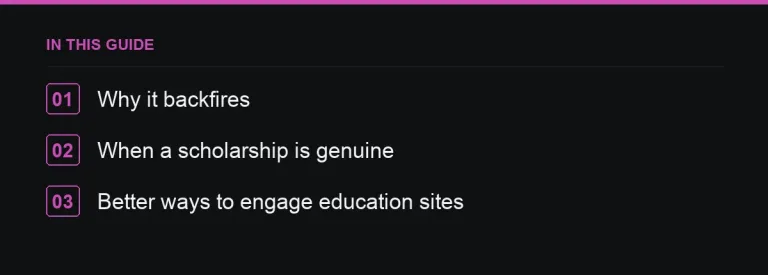
Why it backfires now
- It’s an obvious pattern — businesses with no connection to education suddenly offering small scholarships, all linked from the same kind of university page, with the same kind of anchor text. Search engines and university staff both learned to spot it.
- Many universities removed or stopped accepting such listings after being flooded with requests, and some now publish explicit policies refusing scholarship-for-link exchanges outright.
- It can look like a link scheme, because the scholarship exists to generate the link rather than the link being a side effect of a genuine scholarship.
- Some programmes never paid out or quietly disappeared after the link was secured, which damaged trust in the tactic and in every business associated with it.
When a scholarship is genuine
If your organisation genuinely funds education in your field — a meaningful award, properly administered, judged on real criteria, awarded publicly and publicised regardless of whether a link follows — it can attract coverage and links naturally, the same way any other real-world activity does. The honest test is whether you’d still run it with absolutely no link attached. If the answer is no, the programme exists for SEO, not education, and it will eventually be treated that way by universities and search engines alike.
Better ways to engage education sites
- Publish free, genuinely useful resources for students and teachers — see link building for education sites for the kinds of content that actually get adopted by schools and universities.
- Offer guest lectures, workshops or careers events that give students something real, rather than a listing page entry.
- Set up research collaborations or internships with departments relevant to your industry — these tend to produce natural mentions on university news pages, which carry far more weight than a financial-aid directory listing ever did.
- Run resource-page outreach for relevant tools and guides that a university library or careers page would want to reference anyway — see resource page link building.
What this means for your wider strategy
Scholarship link building is a useful cautionary case for any tactic that promises “guaranteed” authoritative links: if a tactic works by exploiting a gap in someone else’s process rather than by being genuinely useful to them, that gap eventually closes, and the links built through it become a liability rather than an asset. The same lesson applies to other list-based tactics — see link building agency red flags for other patterns worth watching for when evaluating a tactic or a vendor.
If you’re auditing an existing backlink profile and find old scholarship links, treat them the way you would any other manipulative pattern: assess whether they’re still live, whether the anchor text is a risk, and whether removal or disavow makes sense as part of a wider in-house or agency cleanup, the kind of work covered in link building for SEO freelancers.
How to evaluate any “guaranteed education link” offer
Agencies and freelancers occasionally still pitch scholarship link building, sometimes under a different name, as a guaranteed way to get .edu links. Ask direct questions before agreeing to anything: who judges the award, is it publicised anywhere the agency doesn’t control, would the university list it without a link requirement, and what happens to the funds if nobody claims the award. A vendor who can’t answer these clearly is likely reselling the same scheme to dozens of clients at once, which is exactly the pattern universities have gotten better at detecting.
The long-term cost of shortcuts like this
Beyond the immediate risk of a penalty or a rejected disavow, tactics like scholarship link building waste something harder to recover: the credibility of your outreach going forward. Once a university financial-aid office has been burned by one fake scholarship pitch, it becomes far more sceptical of the next genuine collaboration request from any business in your position. Building a reputation as a company that engages with education sites honestly pays off well beyond the links it produces directly.
Where to go next
For a broader view of what education-sector link building can look like when it’s done for the right reasons, read link building for education sites, and pair any outreach you do with a properly built linkable asset rather than a scholarship page. When you need placements outright, a curated marketplace of publisher websites is a more transparent route than any scheme built around exploiting trust.
Frequently asked questions
Is scholarship link building against Google's guidelines?
A scholarship created mainly to obtain links fits the pattern of a link scheme. Genuine scholarships are a different matter.
Do universities still list business scholarships?
Many stopped or became very selective after being flooded with link-driven scholarships.
How else can I get links from education sites?
Useful resources, guest lectures, careers events and research collaborations.
Put it into practice
Filter 54,483 websites by DR, traffic, niche and price, and order with escrow — you pay only after the link is live.
Browse the marketplace