How to Sell Guest Posts on Your Website Responsibly
Selling placements can fund a website. Selling them carelessly can sink it. Here's how publishers do it sustainably.
For many independent publishers, sponsored content is a meaningful source of income. Done responsibly, it can coexist with a healthy site and a loyal readership. Done carelessly, it turns a publication into a link farm and erodes the traffic that made placements valuable in the first place. This guide sets out the practical rules that let a site sell guest posts for years rather than burn through its authority in a season.
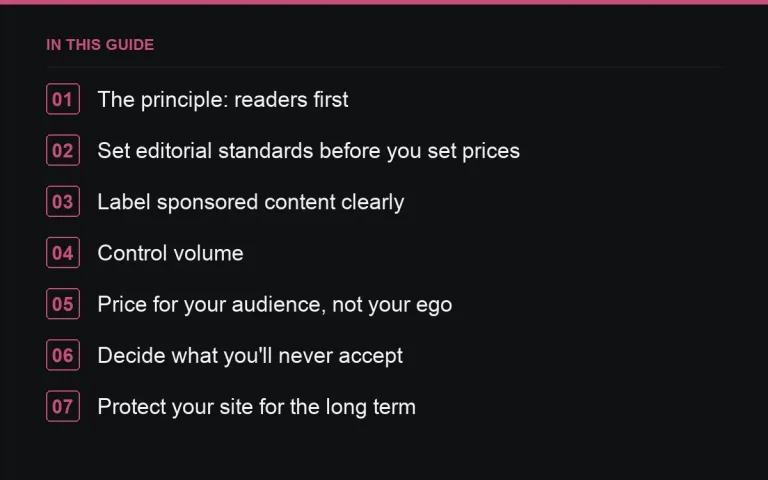
The principle: readers first
Your site’s value to buyers comes from your audience and your standing with search engines. Both depend on readers trusting what you publish. Every decision below protects that relationship. If a rule ever forces a choice between a sale and reader trust, reader trust wins, because it is the asset the sale depends on.
Set editorial standards before you set prices
Publishers who write their standards down, before the first enquiry arrives, spend far less time negotiating and reject bad orders faster. At minimum, decide on:
- Relevance. Accept only topics that fit your site. A cooking blog shouldn’t publish crypto guides just because the fee is attractive.
- Quality. Sponsored posts should meet the same bar as your own articles — same depth, same tone, same editing.
- Accuracy. Fact-check claims, especially in health, finance and legal topics, where a wrong statement carries real risk.
- Link limits. One or two contextual links per post, placed naturally in the body rather than stacked in an author bio.
- Prohibited categories. Decide up front what you won’t accept: gambling, adult content, unregulated supplements, and anything else outside your audience’s interests.
Put these in writing and treat them as non-negotiable (how to write guidelines buyers respect). A public, specific policy also filters out low-quality enquiries before they reach your inbox.
Label sponsored content clearly
Disclose sponsored posts to readers, and follow search engines’ guidance on marking paid links with a sponsored or nofollow attribute (what the link attributes mean and when to use each). Advertising rules in many countries also require disclosure for paid content, regardless of whether it appears on a blog or in a magazine. Being upfront protects you with readers, regulators and search engines at the same time — there is no version of hiding sponsored posts that is worth the risk.
Control volume
A site where sponsored posts outnumber editorial content stops being a publication and starts looking like a link shop, to readers and to algorithms alike. Keep a healthy ratio and keep publishing your own content on a steady schedule. Volume is also one of the first things careful buyers check when vetting a site before ordering (the red flags buyers look for), so restraint here is also good marketing.
A simple monthly checklist
| Question | Why it matters |
|---|---|
| What share of this month’s posts were sponsored? | Keeps editorial content the visible majority |
| Did every sponsored post pass the same review as an editorial one? | Protects quality and reader trust |
| Are all sponsored links correctly labelled? | Protects you with search engines and regulators |
| Did you decline anything, and why? | Confirms your standards are actually being applied |
Price for your audience, not your ego
Price based on real traffic and the quality of your audience, not an authority score you found in a free tool. Selective publishers can charge more and accept fewer posts, which is usually a better trade than publishing constantly at a low rate (a fuller pricing method). Buyers who understand the market read a very low price as a warning sign, not a bargain.
Decide what you’ll never accept
Beyond your prohibited categories, some individual orders should be declined regardless of the fee offered: content written to mislead readers, requests to remove or alter existing editorial content for money, and buyers who ask you to hide that a post is sponsored. None of these are worth the long-term cost, and a firm “no” to this kind of request is one of the clearest signals of a serious, sustainable publisher (guest posts versus niche edits, and where each fits).
Protect your site for the long term
Monitor your traffic after any change to your sponsored content policy, and review old sponsored posts periodically rather than assuming a post approved two years ago still meets your standards (a full checklist for protecting your rankings while selling placements). Sites change hands, link destinations decay, and a policy that was fine in the past may need tightening as your audience grows.
Where to go next
If you’re setting this up for the first time, start with your guidelines document, then decide your pricing, then put both in front of buyers. You can list your websites on Digital PR with your own prices and rules, decline any order that doesn’t fit your standards, and get paid through escrow once the buyer approves the live URL. Every listing is reviewed before it goes live, and you can browse how other sites in the general niche marketplace present their terms for ideas on structuring your own.
All guides for publishers
- A Practical Fact-Checking Process for Guest Posts
- A Submission Checklist to Give Guest Authors
- Balancing Sponsored and Editorial Content on Your Site
- Building an Editorial Calendar That Includes Paid Posts
- Building an Email List From Your Guest Post Traffic
- Disclosure and Labelling Rules for Sponsored Posts
- Editing Sponsored Content to Match Your House Style
- Getting Author Pages and Bylines Right for Guest Posts
- Growing Your Site’s Authority Year Over Year
- Handling Difficult Guest Post Buyers
- Handling Link Change Requests After a Post Is Live
- Handling Post and Link Removal Requests
- How Link Buyers Evaluate Your Website
- How Publishers Get More (and Better) Guest Post Orders
- How Publishers Should Price Link Insertions
- How to Decline Off-Topic Guest Post Briefs Politely
- How to Price Guest Posts on Your Site
- Image and Copyright Rules Every Publisher Needs
- Improving Traffic and Authority the Legitimate Way
- Improving Your Site’s Quality (the Metrics Will Follow)
- Legal Basics Every Publisher Selling Placements Should Know
- Listing Your Website on a Link Marketplace
- Maintaining Topical Focus When Accepting Guest Posts
- Monetising a Website Beyond Sponsored Posts
- Protecting Site Speed While Accepting Guest Content
- Protecting Your Site’s Rankings While Selling Placements
- Publisher SEO Hygiene for Sites Selling Placements
- Recruiting Editors as Your Guest Post Volume Grows
- Responding to Reviews and Feedback as a Publisher
- Running a Multi-Author Blog Without Losing Consistency
- SEO Basics for Publishers Who Sell Placements
- Setting Turnaround Expectations Buyers Will Actually Trust
- Site Security Basics for Publishers Accepting Uploads
- The Guest Post Order Lifecycle From the Publisher’s Side
- The Publisher Analytics That Actually Matter
- Using Order Messaging Effectively as a Publisher
- Verifying Buyers and Avoiding Scams as a Publisher
- When Publishers Should Offer a Refund on a Guest Post Order
- Working With Agencies as a Publisher
- Writing Contributor Guidelines That Save You Time
- Writing Editorial Guidelines Buyers Respect
Frequently asked questions
Is it allowed to sell guest posts?
Selling sponsored content is legal and common. Search engines ask that paid links be marked appropriately, and advertising rules in many countries require disclosure to readers.
How many sponsored posts should I publish?
Few enough that your site remains primarily editorial. There's no fixed ratio, but a site dominated by sponsored posts loses value with readers and search engines alike.
Can I refuse orders after agreeing a price?
Yes, and you should if the content or destination doesn't meet your standards once you see the draft. A short, professional explanation protects the relationship even when you decline.
Should every sponsored post carry the same disclosure?
Yes. Consistency matters more than the exact wording. Readers and regulators both expect sponsored content to be identifiable at a glance, not buried in fine print.
Put it into practice
Filter 54,483 websites by DR, traffic, niche and price, and order with escrow — you pay only after the link is live.
Browse the marketplace