Growing Your Site’s Authority Year Over Year
Authority growth is best judged across years, not months, and requires patience most short-term dashboards do not encourage.

Monthly analytics dashboards encourage short-term reactions that do not match how site authority actually builds. Real, durable growth in a site’s standing within its niche tends to show up clearly only across a year or more, which means the right way to track and manage it looks different from day-to-day operational monitoring.
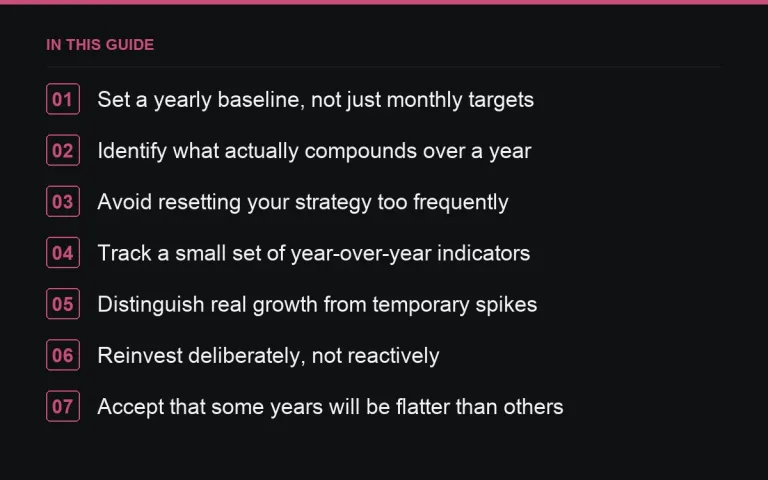
Set a yearly baseline, not just monthly targets
At the start of each year, record a clear baseline: overall traffic trend, your standing across the metrics buyers actually check (see https://successtoroad.com/blog/how-buyers-evaluate-your-site/), and your general topical footprint. Compare against this baseline at year-end rather than judging every month against the previous one, which tends to overreact to normal short-term noise.
Identify what actually compounds over a year
Some efforts pay off within weeks; others only show real value after sustained repetition. Consistent publishing cadence, accumulated topical depth (see https://successtoroad.com/blog/maintaining-topical-focus/), and a growing base of returning readers via https://successtoroad.com/blog/building-an-email-list-from-guest-traffic/ are all examples of the second kind — individually small each month, but meaningfully different after a year of consistency.
Avoid resetting your strategy too frequently
A common failure mode is abandoning a strategy after two or three months because results are not yet visible, then starting a different approach that also gets abandoned before it has time to compound. If you have set a deliberate, defensible strategy — solid technical hygiene, consistent editorial standards, disciplined sponsored content balance — give it a genuine year before concluding it is not working.
Track a small set of year-over-year indicators
- Overall traffic trend compared to the same period last year, not just last month
- Growth in your returning-reader base, not just total visits
- Consistency of your sponsored-to-editorial ratio across the year, referencing https://successtoroad.com/blog/balancing-sponsored-and-editorial-content/
- Any change in how buyers evaluate or price your site’s placements over time
Distinguish real growth from temporary spikes
A single viral guest post or a short-term traffic spike from an external event is not the same as durable authority growth, even though it can look similar on a monthly chart. Judge growth against your sustained baseline trend rather than against any single high point, since chasing a repeat of a one-off spike often leads to strategy decisions that do not generalize.
Reinvest deliberately, not reactively
As authority genuinely grows, reinvest in the areas that contributed most — whether that is deeper coverage in your strongest topic area, additional editorial capacity per https://successtoroad.com/blog/recruiting-editors/, or continued technical investment per https://successtoroad.com/blog/publisher-seo-hygiene-checklist/ — rather than spreading limited resources thin across every possible improvement at once.
Accept that some years will be flatter than others
Not every year produces visible growth, even with sound fundamentals in place. Broader shifts outside your control affect every publisher to some degree. A flat year with fundamentals intact is a very different situation from a declining year with fundamentals slipping, and the year-over-year view is what actually lets you tell the two apart.
Let genuine year-over-year growth reflect in your listing
As your site’s authority grows across a year, revisit how it is represented and priced wherever it is listed for placements, including on https://successtoroad.com/marketplace/. Publishers who track growth carefully but never update their listing accordingly end up leaving value on the table simply through inattention rather than any real limitation of the site itself.
Keep a simple year-end note for future reference
At the end of each year, write a short note summarizing what changed, what you tried, and what genuinely seemed to help versus what did not move the needle. This does not need to be elaborate, but it becomes a valuable reference the following year when you are deciding where to focus again, since memory alone tends to blur the details of what actually happened across twelve months of gradual change.
Keep the broader team aligned on the long view
Anyone involved in commissioning content, editing, or handling buyer relationships benefits from understanding that authority growth is a multi-year project, not a monthly scorecard. This shared understanding makes it easier to hold steady on sound practices during an inevitable flat stretch, rather than reacting with a sudden change in direction that a single quarter’s numbers might otherwise prompt.
Revisit your yearly baseline honestly, even when the news is mixed
It is tempting to focus a year-end review only on the metrics that improved and quietly skip over the ones that did not. A more useful review looks at the full picture, including the areas that stayed flat or slipped, since these are often exactly where next year’s effort should concentrate. Publishers who only track their wins tend to repeat the same blind spots year after year, simply because nothing in their review process ever surfaces them clearly enough to prompt a change.
Treat competitor awareness as context, not a scoreboard
It is reasonable to have a general sense of how comparable sites in your niche are performing, whether by browsing their content directly or noting how they are positioned when listed alongside you through https://successtoroad.com/marketplace/. Use this only as loose context for your own planning, rather than as a scoreboard to react to every time a competitor appears to be moving faster, since short-term comparisons rarely reflect the full multi-year picture that actually matters for durable authority.
Where to go next
Read https://successtoroad.com/blog/improving-traffic-authority-legitimately/ for the day-to-day practices that feed this longer-term view, and https://successtoroad.com/blog/publisher-analytics-that-matter/ for the specific metrics worth tracking as part of your yearly comparison.
Frequently asked questions
Why is authority growth better judged over a year than a month?
Durable growth compounds slowly through consistent practices like publishing cadence and topical depth, which rarely show a clear signal in any single month's data compared to a full year of comparison.
How long should we give a deliberate strategy before deciding it is not working?
A genuine year is a reasonable minimum for practices meant to compound, such as consistent editorial standards or technical hygiene, since these rarely show clear results within just a couple of months.
How do we tell a real growth trend apart from a temporary spike?
Compare it against your sustained baseline trend rather than treating a single high point as the new normal. A one-off viral post or event-driven spike rarely repeats and should not drive strategy on its own.
Is a flat year always a sign something is wrong?
Not necessarily. A flat year with your fundamentals still intact is very different from a declining year with fundamentals slipping, and a year-over-year view is what lets you distinguish between the two.
Put it into practice
Filter 54,483 websites by DR, traffic, niche and price, and order with escrow — you pay only after the link is live.
Browse the marketplace