The Guest Post Order Lifecycle From the Publisher’s Side
Understanding the full order lifecycle helps publishers spot where their own process usually breaks down.

Publishers who handle guest post orders informally often lose track of which stage a given order is actually in, especially once volume grows. Mapping the full lifecycle explicitly — not just “review then publish” — makes it easier to see where delays, disputes, and quality issues actually originate.
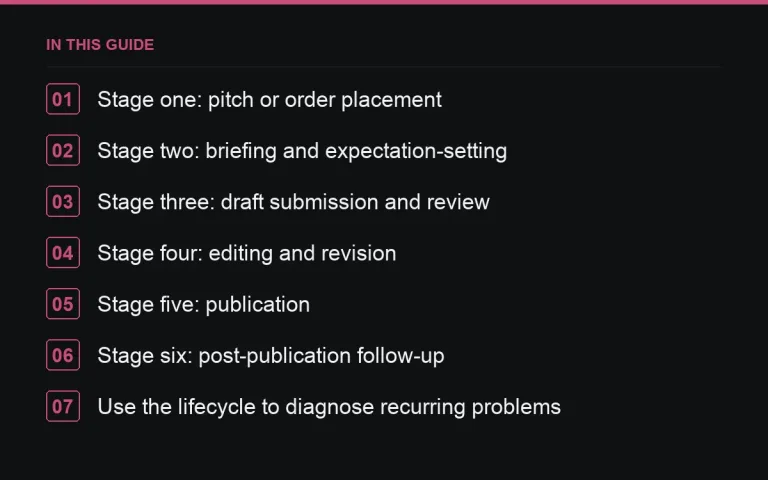
Stage one: pitch or order placement
Whether a buyer pitches directly or places an order through https://successtoroad.com/marketplace/, this stage is where your topical fit and initial quality bar get applied first, ideally before much work has been done on either side. A fast, clear response here — accept, decline, or request more detail — sets the tone for everything that follows, and connects directly to https://successtoroad.com/blog/declining-off-topic-briefs-politely/ when the answer is no.
Stage two: briefing and expectation-setting
Once an order is accepted, clarify scope, turnaround, and any specific requirements before the contributor starts writing. Orders that skip this stage — moving straight from acceptance to waiting for a draft — are where most later disputes originate, since neither side has a clear shared reference point for what was actually agreed.
Stage three: draft submission and review
This is where your https://successtoroad.com/blog/submission-checklist-for-guest-authors/ and https://successtoroad.com/blog/fact-checking-guest-posts/ process apply. Track how long this stage actually takes against your stated https://successtoroad.com/blog/setting-turnaround-expectations/, since this is usually the stage most vulnerable to slipping under workload pressure.
Stage four: editing and revision
Whether editing happens in-house or is sent back to the contributor for changes, this stage benefits from the structured approach in https://successtoroad.com/blog/editing-sponsored-content-to-house-style/. Set a clear limit on revision rounds included in the original order, so this stage does not expand indefinitely.
Stage five: publication
Confirm the live URL, correct formatting, and working links before considering the order complete. For marketplace orders with escrow, this is typically the point that triggers buyer approval and fund release, so accuracy here matters beyond just the content itself.
Stage six: post-publication follow-up
Orders do not end at publication. Link change requests (see https://successtoroad.com/blog/handling-link-change-requests/), removal requests (see https://successtoroad.com/blog/handling-removal-requests/), and occasional review or refund conversations all happen after the fact, sometimes months later. Treat this as a defined final stage of the lifecycle rather than an unplanned exception whenever it happens.
| Stage | Main risk if skipped or rushed |
|---|---|
| Pitch or order placement | Accepting off-topic or low-fit orders |
| Briefing | Mismatched expectations, later disputes |
| Draft review | Missed factual or quality issues |
| Editing and revision | Inconsistent voice, open-ended revision cycles |
| Publication | Broken links or formatting at the moment escrow releases |
| Post-publication follow-up | Unhandled disputes and change requests |
Use the lifecycle to diagnose recurring problems
When something goes wrong repeatedly, identify which specific stage it traces back to rather than treating each incident as isolated. A pattern of disputes, for instance, often traces back to a weak briefing stage rather than to the editing or publication stage where the dispute actually surfaces.
Map the lifecycle to your marketplace’s own process
If most of your orders arrive through https://successtoroad.com/marketplace/, your internal stages should align with the platform’s own order states, including whatever escrow or approval step precedes fund release. Keeping your internal process synchronized with the platform’s process, rather than running a parallel, separate workflow, reduces the chance of an order slipping through a gap between the two.
Give each stage a rough owner, even on a small team
Even a one- or two-person operation benefits from knowing, roughly, who is responsible for moving an order from one stage to the next. Without this, orders can sit in an ambiguous middle state where each person assumes the other is handling it, which is a common and entirely avoidable source of delay.
Review a handful of completed orders in full periodically
Rather than only reviewing orders when something goes wrong, periodically pick a few completed orders at random and walk through the full lifecycle from pitch to post-publication follow-up. This surfaces small inefficiencies that never rise to the level of an actual complaint but still cost time or create low-grade friction across many orders when added up.
Use the lifecycle view when training someone new
Explaining the full lifecycle to a new editor or assistant gives them a mental map of where their specific task fits into the bigger picture, rather than teaching them a single isolated step in a process they cannot otherwise see. This context tends to produce better judgment calls on ambiguous situations than narrow, task-specific training alone.
Keep the lifecycle documentation short enough to actually use
A lifecycle map that takes an hour to read will not get referenced in the middle of a busy week. Keep the documented version to a single page, with links out to the more detailed guidelines for each specific stage, so it functions as a quick orientation tool rather than a document nobody has time to revisit.
Where to go next
Read https://successtoroad.com/blog/using-order-messaging-effectively/ for how communication ties every stage together, and https://successtoroad.com/blog/editorial-calendar-with-paid-posts/ for scheduling the lifecycle across multiple simultaneous orders.
Frequently asked questions
Which stage of the order lifecycle causes the most disputes?
Briefing and expectation-setting is a common source, since orders that skip a clear scope conversation before drafting starts often leave both sides with different assumptions about what was agreed.
Does the order lifecycle end at publication?
No. Post-publication follow-up, including link change requests, removal requests, and occasional refund conversations, is a real and sometimes lengthy final stage that deserves its own process rather than being treated as an exception.
How can we use the lifecycle to fix recurring problems?
Trace a recurring issue back to the specific stage it actually originates from, rather than treating each instance as an isolated incident. This often reveals the true fix is earlier in the process than where the problem becomes visible.
Should revision rounds be limited at a specific lifecycle stage?
Yes, set a clear limit at the editing and revision stage as part of the original order terms, so this stage has a defined end rather than expanding indefinitely.
Put it into practice
Filter 54,483 websites by DR, traffic, niche and price, and order with escrow — you pay only after the link is live.
Browse the marketplace