Publisher SEO Hygiene for Sites Selling Placements
A handful of recurring technical checks keep a site's SEO foundation solid enough to support the value of the placements it sells.

Publishers selling guest post placements have a direct incentive to keep their site’s underlying technical health solid, since that health is part of what buyers are actually paying for. This is not a comprehensive SEO strategy, just the recurring hygiene checks worth building into a regular routine.
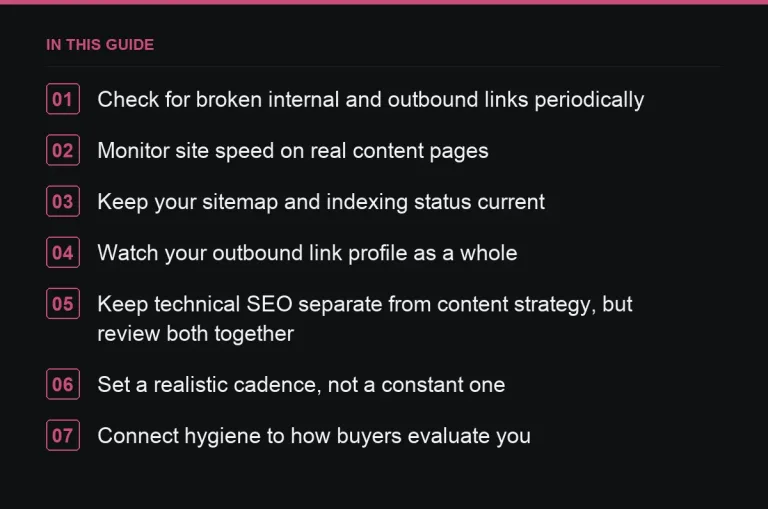
Check for broken internal and outbound links periodically
Accumulated broken links, often from old guest posts pointing to destinations that no longer exist, degrade both user experience and how thoroughly a site’s authority can flow through its own internal structure. A periodic crawl, even quarterly, catches this before it becomes a large backlog, connecting directly to your https://successtoroad.com/blog/handling-link-change-requests/ process.
Monitor site speed on real content pages
As covered in https://successtoroad.com/blog/protecting-your-site-speed/, guest content is a common source of slow-loading pages due to unoptimized media. Include actual published guest and sponsored posts in your speed checks, not just your homepage or template pages.
Keep your sitemap and indexing status current
A guest post that never gets properly indexed delivers less value to everyone, including the buyer who paid for it. Periodically confirm your sitemap reflects recently published content and check for any pages accidentally excluded from indexing, which happens more often than expected on sites with frequent CMS or plugin updates.
Watch your outbound link profile as a whole
A site that has accepted a high volume of guest posts over time can end up with an outbound link profile skewed toward low-relevance or low-quality destinations if acceptance standards were loose in the past. Periodically sample your outbound links and assess whether the overall pattern still reflects your current, tighter standards from https://successtoroad.com/blog/maintaining-topical-focus/.
- Crawl for broken links quarterly, both internal and outbound
- Test site speed on a sample of real, published guest content pages
- Confirm your sitemap and indexing status are current
- Periodically audit your overall outbound link profile for relevance and quality drift
- Check that mobile rendering of guest posts matches desktop, since contributor-submitted images and embeds can behave differently across devices
Keep technical SEO separate from content strategy, but review both together
Technical hygiene and content quality reinforce each other rather than operating independently. A well-written guest post on a slow, poorly indexed page underperforms, just as a technically clean site with thin, off-topic content underperforms for different reasons. Review both together, ideally as part of the same periodic check.
Set a realistic cadence, not a constant one
Most of these checks do not need to be continuous. A quarterly review covers the majority of what actually changes meaningfully on most sites, freeing you to spend regular time on editorial quality and buyer relationships rather than constant technical monitoring.
Connect hygiene to how buyers evaluate you
Buyers browsing a marketplace listing, including through https://successtoroad.com/top-publishers/ or the full https://successtoroad.com/marketplace/, often check technical health signals as part of deciding whether to order, alongside the considerations in https://successtoroad.com/blog/how-buyers-evaluate-your-site/. Consistent hygiene is part of what keeps your listing competitive over time, not just a one-time setup task.
Keep a simple recurring checklist rather than relying on memory
Write your quarterly hygiene checks down as an actual checklist, with a date for the last time each item was reviewed. This is a small amount of overhead that prevents any single check from quietly slipping for two or three quarters simply because no single person remembered whose job it was.
Do not confuse hygiene with a growth strategy
These checks maintain the foundation your content sits on; they are not, on their own, a way to grow traffic or authority. Treat hygiene as the baseline that lets your actual growth efforts — covered in https://successtoroad.com/blog/improving-traffic-authority-legitimately/ — perform as well as they otherwise could, rather than expecting the hygiene work itself to move the needle directly.
Assign hygiene checks to a specific recurring calendar slot
A quarterly task with no fixed date tends to drift indefinitely as other priorities take precedence. Put the review on an actual recurring calendar entry, ideally tied to a natural checkpoint like the start of a new quarter, so it happens reliably rather than only when someone happens to remember it during a slower week.
Keep a written record of what each review found
A hygiene check that produces no written output is easy to forget ever happened, and it becomes hard to tell whether a recurring issue is actually recurring or simply being noticed again for the first time. Keep a short dated note after each review listing what was checked, what was found, and what was fixed, even if the format is nothing more than a few lines in a shared document. Over a year or two, this record becomes genuinely useful for spotting whether a particular type of problem, such as broken links from a specific old batch of guest posts, keeps resurfacing despite being fixed each time, which usually points to a root cause worth addressing directly rather than continuing to patch the symptom.
Loop hygiene findings back into your acceptance process
If a quarterly review repeatedly finds the same category of issue traceable to guest or sponsored content specifically, feed that finding back into your submission checklist and contributor guidelines rather than treating each review as an isolated cleanup task. A hygiene process that only cleans up after problems, without ever adjusting the intake process that creates them, ends up repeating the same work indefinitely instead of gradually reducing how much cleanup is needed each quarter.
Where to go next
Read https://successtoroad.com/blog/improving-traffic-authority-legitimately/ for how this hygiene supports longer-term growth, and https://successtoroad.com/blog/growing-authority-year-over-year/ for tracking progress across a longer horizon.
Frequently asked questions
How often should we check for broken links on our site?
Quarterly is a reasonable cadence for most sites, though a higher-volume publisher accepting many guest posts might benefit from checking more frequently.
Why does outbound link quality matter for a site that sells placements?
A skewed outbound profile from past loose acceptance standards can affect how a site is perceived both by search engines and by buyers evaluating the site's overall quality before ordering.
Should site speed checks include actual guest content pages, not just the homepage?
Yes. Guest and sponsored posts are a common source of unoptimized media that a homepage-only speed check would completely miss.
Is technical SEO hygiene something we set up once, or an ongoing task?
Ongoing, though not necessarily continuous. A realistic quarterly review cadence catches most of what changes meaningfully without requiring constant monitoring.
Put it into practice
Filter 54,483 websites by DR, traffic, niche and price, and order with escrow — you pay only after the link is live.
Browse the marketplace