Image and Copyright Rules Every Publisher Needs
A clear image policy prevents copyright disputes before they happen, not after a post is already live.

Image disputes are one of the more avoidable headaches in running a site that accepts outside content. A contributor drops in a photo they found through a search engine, it turns out to be licensed or watermarked, and months later you get a takedown notice or an invoice from a stock agency. A clear image policy, enforced before publishing rather than after, prevents almost all of this.
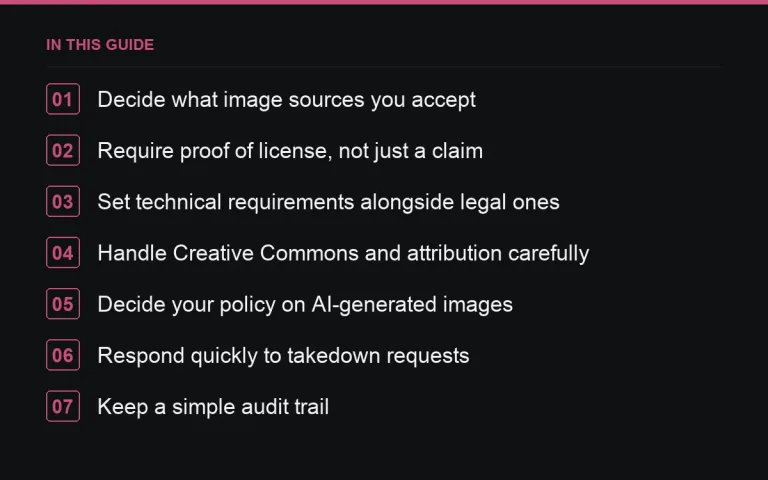
Decide what image sources you accept
State plainly in your https://successtoroad.com/blog/writing-contributor-guidelines/ which sources are acceptable: contributor’s own original photography, images they hold a paid license for, or specific stock libraries you trust. Reject anything a contributor cannot show proof of rights for, no matter how relevant the image looks.
Require proof of license, not just a claim
“I have the rights to this” is not proof. Ask for the license confirmation itself — a download receipt from a stock site, a note that it is the contributor’s own photo, or a Creative Commons attribution with the source link. Keep this proof filed alongside the post, especially for orders that came through https://successtoroad.com/marketplace/, so you have a record if a dispute arises later.
Set technical requirements alongside legal ones
- Minimum and maximum file size and dimensions
- Accepted formats (typically JPG, PNG, WebP)
- Whether alt text is required and who writes it
- Whether contributor headshots for author bios follow the same rules
Technical requirements matter for site performance too — oversized images from contributors are a common, avoidable hit to https://successtoroad.com/blog/protecting-your-site-speed/.
Handle Creative Commons and attribution carefully
Not all Creative Commons licenses allow commercial use, and sponsored content counts as commercial use even when the image itself is just illustrative. Check the specific license variant rather than assuming “Creative Commons” is a blanket green light, and always include the attribution the license requires directly on the page if that is a condition of use.
Decide your policy on AI-generated images
AI image generation raises its own uncertainty around ownership and downstream rights depending on the tool used. Rather than trying to track every provider’s terms, the simplest approach is to require the same proof-of-rights standard you apply to any other image, and to disclose clearly if an image was AI-generated where that matters to your audience or your own editorial standards.
Respond quickly to takedown requests
If someone contacts you claiming an image on a guest post infringes their rights, do not argue first and investigate later. Temporarily remove or swap the image while you verify the claim, and follow up with the contributor who supplied it. A fast, cooperative response resolves most disputes without escalation; a defensive one rarely does. This connects to your broader approach in https://successtoroad.com/blog/handling-removal-requests/.
Keep a simple audit trail
For every published guest or sponsored post, note where each image came from and what proof of license you hold. This does not need to be elaborate — a spreadsheet row per post is enough — but it turns a potential scramble during a dispute into a two-minute lookup.
Apply the same standard to buyer-supplied brand assets
Sponsored posts sold through https://successtoroad.com/marketplace/ sometimes arrive with a buyer’s own logo or product photography attached. Do not assume a buyer automatically has the right to use every asset they send, particularly product photography that may belong to a manufacturer or a separate agency. Ask the same license question you would ask any other contributor, even when the request comes from the party paying for the placement.
Set expectations for image count and placement together
Beyond licensing, decide where images are allowed to sit in a post — after the introduction, breaking up long sections, never directly beside a paid link — so contributors are not guessing at placement any more than they are guessing at licensing. A consistent visual layout across your site reinforces the same editorial coherence covered in https://successtoroad.com/blog/editing-sponsored-content-to-house-style/.
Document your policy somewhere contributors will actually read it
A copyright policy buried in a rarely visited terms page will not stop a contributor from submitting a convenient image found through a search engine. Put the core rule directly in your submission instructions, in plain language: no image without proof of rights, no exceptions. Repetition in the place contributors are actually looking does more than a thorough policy nobody opens.
Keep a small library of pre-approved images for common topics
If your site covers a recurring set of themes, building a small internal library of properly licensed, generic images that editors can drop into a post saves contributors from sourcing an image at all in cases where nothing highly specific is needed. This also gives you a reliable fallback when a contributor’s own image fails your licensing check late in the review process, without delaying publication while a replacement is sourced from scratch.
Where to go next
Pair your image policy with your https://successtoroad.com/blog/fact-checking-guest-posts/ process and your https://successtoroad.com/blog/editorial-guidelines-for-publishers/ so contributors see one consistent set of standards rather than scattered rules across different pages.
Frequently asked questions
Can we accept any image a contributor sends us?
No. Require proof of rights — either the contributor's own photography, a paid stock license, or properly attributed Creative Commons content that permits commercial use.
What if we discover a copyright issue after a post is already live?
Remove or swap the image promptly while you investigate, rather than leaving it up during a dispute. A quick, cooperative response is the best way to avoid further escalation.
Do author bio headshots need the same licensing proof as in-article images?
Yes. A headshot is still an image used on your site, and the same proof-of-rights standard should apply, particularly if the contributor did not take the photo themselves.
Are AI-generated images safe to accept from contributors?
Treat them the same as any other image: require proof the contributor has the right to use it, and disclose that it is AI-generated if that matters to your readers or your editorial policy.
Put it into practice
Filter 54,483 websites by DR, traffic, niche and price, and order with escrow — you pay only after the link is live.
Browse the marketplace