A Practical Fact-Checking Process for Guest Posts
A short, repeatable fact-checking pass catches most avoidable errors before a guest post goes live.
Fact-checking every claim in every guest post to academic standards is not realistic for most publishers, and it does not need to be. A short, consistent pass focused on the claims most likely to embarrass your site or mislead readers catches the majority of problems without adding hours to your review time.
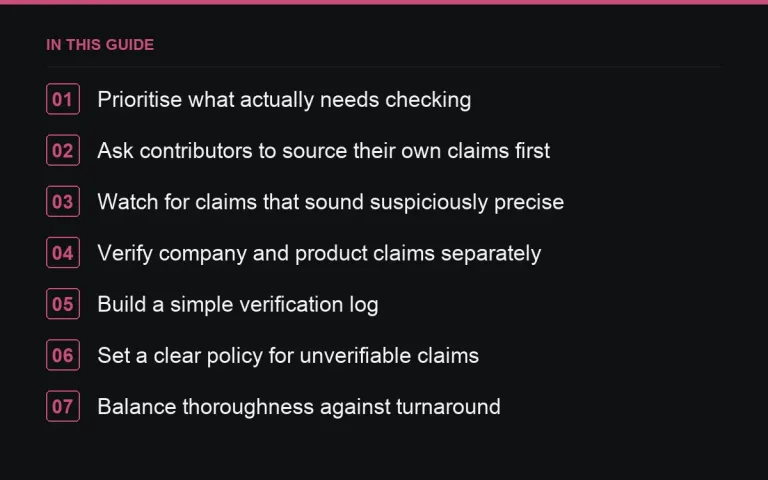
Prioritise what actually needs checking
Not every sentence carries equal risk. Focus checking effort on: any specific number or statistic, any claim about a named company or product, any legal or medical statement, and any claim that would be damaging if wrong. General opinion and how-to advice carries far less risk and can be reviewed for clarity rather than verified line by line.
Ask contributors to source their own claims first
Your https://successtoroad.com/blog/submission-checklist-for-guest-authors/ should already ask contributors to confirm they can produce a source for any statistic. When you receive a draft with unsupported numbers, send it back before editing rather than trying to verify or remove the claim yourself — this puts the burden of proof where it belongs and trains contributors to source claims before submitting in future.
Watch for claims that sound suspiciously precise
Numbers like “37% of marketers” or “increases conversions by 4x” without a named source are a common pattern in low-effort guest content, sometimes generated rather than researched. Treat any oddly specific, unsourced statistic as a flag requiring either a source or removal. This is also where AI-assisted drafts most often go wrong, since generated text tends to produce plausible-looking numbers with no real basis.
Verify company and product claims separately
If a guest post mentions a specific company, tool, or competitor by name — especially in a comparison or claim about pricing or features — check that the claim is current and accurate. Outdated or incorrect claims about named companies create legal exposure and reader distrust that a vague unsourced statistic usually does not.
Build a simple verification log
- List each factual claim requiring a check
- Note the source the contributor or editor used
- Mark it verified, removed, or rephrased as opinion
- Keep the log with the order record if the post came through https://successtoroad.com/marketplace/
This log takes minutes per post and gives you a defensible record if a claim is challenged after publication.
Set a clear policy for unverifiable claims
When a contributor cannot produce a source, do not simply soften the wording and hope it reads as defensible. Either remove the specific number and replace it with a general, honest statement, or decline the section entirely. Publishers who let unverifiable numbers slide “just this once” tend to see the same pattern repeat.
Balance thoroughness against turnaround
Set an internal time budget for fact-checking per post — ten to fifteen minutes for a typical guest post is realistic for most sites. If a draft needs far more than that to verify, it is often a sign the piece needs a heavier rewrite anyway, which ties back into your https://successtoroad.com/blog/editing-sponsored-content-to-house-style/ process and your stated https://successtoroad.com/blog/setting-turnaround-expectations/.
Apply extra scrutiny to comparison and ranking content
Posts that rank or compare products, services, or companies carry more risk than general how-to content, since a factual error here can look like an endorsement or a slight against a named competitor. Give this category of guest post a slightly longer verification pass, and where the piece touches a regulated area such as finance or health, treat any claim that sounds like advice rather than general information with particular caution.
Keep contributors informed about why a claim was flagged
When you send a draft back over an unverifiable claim, explain specifically what needs sourcing rather than issuing a blanket “please fact-check this.” A contributor who understands exactly which sentence triggered the flag learns faster for future submissions, and it reduces the chance of the same category of issue recurring across their next few pieces for your site.
Do not outsource judgment entirely to a search result
Finding a webpage that repeats the same statistic a contributor cited is not the same as verifying it. Many unsourced numbers circulate widely simply because one site copied another without checking the original claim. Where possible, trace a statistic back toward its original source rather than accepting the first search result that appears to confirm it, particularly for anything central to the post’s argument.
Apply extra care to AI-assisted drafts
A growing share of guest post drafts are written with some degree of AI assistance, and this shifts the kind of fact-checking risk you should expect. Generated text sometimes produces confident, specific-sounding claims with no real source behind them at all, which is a different failure mode than a human writer misremembering a real statistic. Treat any draft you suspect was AI-assisted with the same scrutiny you would give a first-time contributor whose reliability you have not yet established, regardless of how polished the writing itself reads.
Where to go next
Fact-checking works best alongside solid https://successtoroad.com/blog/writing-contributor-guidelines/ that set expectations upfront, and a clear https://successtoroad.com/blog/image-and-copyright-rules/ policy so visual content gets the same scrutiny as text claims. Buyers browsing https://successtoroad.com/marketplace/ for a placement generally value sites known for careful review over sites known for fast, unchecked publishing.
Frequently asked questions
How long should fact-checking take per guest post?
Ten to fifteen minutes is realistic for a typical guest post focused on the highest-risk claims. If it consistently takes much longer, the draft likely needs a broader rewrite rather than just a fact-check.
Who should be responsible for sourcing claims, the contributor or the editor?
The contributor should source their own claims first, ideally confirmed through your submission checklist. The editor's job is to verify, not to research from scratch.
What should we do with a claim we cannot verify either way?
Remove the specific figure and rephrase as a general, honest statement, or ask the contributor for a source before proceeding. Publishing an unverifiable specific claim is rarely worth the risk.
Does fact-checking apply to sponsored posts the same way as unpaid guest posts?
Yes, arguably more so, since sponsored content often carries commercial claims about a product or service that need at least as much scrutiny as an ordinary guest post.
Put it into practice
Filter 54,483 websites by DR, traffic, niche and price, and order with escrow — you pay only after the link is live.
Browse the marketplace