Disclosure and Labelling Rules for Sponsored Posts
Clear, consistent disclosure protects reader trust and is simpler to maintain than deciding case by case.
Readers are more tolerant of sponsored content than publishers often assume, provided it is clearly labelled and reasonably useful. What erodes trust is not the presence of paid content but the appearance of hiding it. A consistent disclosure and labelling policy, applied the same way every time, solves this with far less friction than deciding on a post-by-post basis.
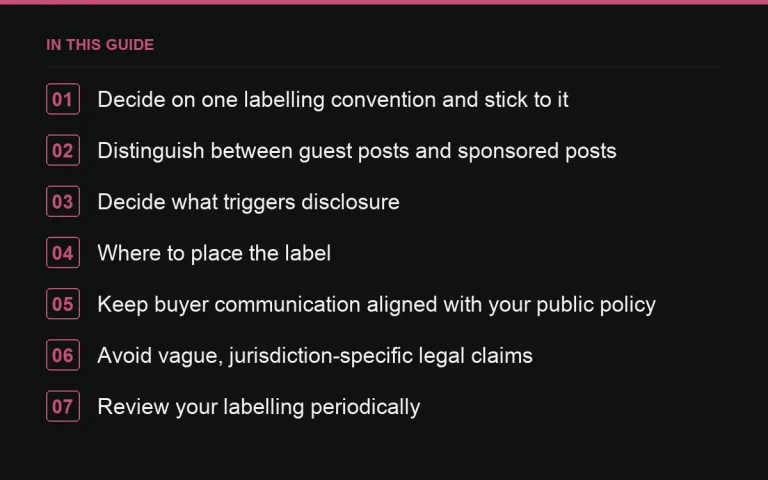
Decide on one labelling convention and stick to it
Pick a clear, visible label — “Sponsored,” “Paid Partnership,” or “Guest Contribution” — and apply it identically across every qualifying post: same placement, same wording, same visual treatment. Inconsistent labelling (sometimes at the top, sometimes buried in the bio, sometimes skipped) is what actually damages credibility, far more than the labelling itself.
Distinguish between guest posts and sponsored posts
These are not the same thing and your labels should say so. A guest post might be unpaid and purely editorial; a sponsored post involves payment or a commercial relationship, whether via direct sponsorship or a placement sold through https://successtoroad.com/marketplace/. Readers benefit from knowing which category applies, and so do you — it keeps your own records straight when reviewing your https://successtoroad.com/blog/balancing-sponsored-and-editorial-content/ mix.
Decide what triggers disclosure
Set an internal rule for when disclosure is required: any post where payment changed hands, any post written by or on behalf of a company being featured, and any post with a paid link placement even inside otherwise editorial content. When in doubt, disclose — the downside of over-disclosing is minimal compared to the downside of a reader or platform flagging a piece as deceptive.
Where to place the label
- Directly above the headline or immediately below it, not just in a footer
- In the author bio if the piece is a guest contribution from a brand representative
- In the page’s metadata or category tag, so it is machine-readable as well as visible
Avoid placing the only disclosure inside a tooltip, a collapsed accordion, or tiny grey text at the very bottom of the page — these technically disclose but functionally hide.
Keep buyer communication aligned with your public policy
If you sell placements through https://successtoroad.com/become-a-seller/, tell buyers upfront exactly how their post will be labelled before they order, not after. This avoids a common source of disputes where a buyer expected an unlabelled, fully editorial-looking placement and receives a clearly marked sponsored post instead.
Avoid vague, jurisdiction-specific legal claims
Disclosure requirements vary by country and platform, and a blog post is not the place to give jurisdiction-specific legal guidance. Set a policy that is clearly transparent and reasonably conservative, and treat questions about your specific legal obligations as a matter for your own legal counsel rather than something to resolve from general guidance alone — see also https://successtoroad.com/blog/legal-basics-for-publishers/ for the boundaries of what general guidance can responsibly cover.
Review your labelling periodically
Site redesigns quietly break disclosure placement more often than publishers expect — a label that displayed clearly in your old theme might get squeezed out or hidden in a new one. Check a sample of live sponsored posts after any template change to confirm labels are still visible.
Explain your policy on category and tag pages too
Disclosure should not stop at the individual post. If a category page lists sponsored and editorial content side by side, consider a small indicator in the listing itself, not just on the full article. A reader browsing a category page filtered under https://successtoroad.com/niche/finance/ or https://successtoroad.com/niche/technology/ on your own site benefits from the same clarity they would get once they click through, rather than discovering the sponsorship only after opening the piece.
Train every editor to apply the label the same way
If more than one person publishes on your site, inconsistent labelling between editors is just as damaging as no labelling at all, since readers eventually notice that some sponsored posts are marked and others are not. Make the labelling step a mandatory, checked part of your publishing workflow, not something left to individual editor discretion.
Revisit old posts when your policy changes
If you tighten or change your labelling convention, decide whether to retroactively update older sponsored posts published under a previous, looser standard. Leaving old posts inconsistent with your current policy is a common gap that only becomes visible when a reader or a platform happens to compare an old post against a recent one.
Answer buyer pushback on labelling with a clear rationale
A buyer occasionally asks whether a post can be published without any sponsored label, sometimes framing this as a request for a more natural-looking placement. Explain plainly that consistent disclosure protects the credibility of every placement on your site, including theirs, rather than treating it as a negotiable extra. Publishers who hold this line consistently tend to attract buyers who value the placement’s durability over a slightly higher-looking editorial disguise that carries more long-term risk.
Where to go next
Read https://successtoroad.com/blog/balancing-sponsored-and-editorial-content/ next to think through how much of your site should carry paid labels at all, and https://successtoroad.com/blog/editing-sponsored-content-to-house-style/ for how labelling interacts with the edited voice of the piece itself.
Frequently asked questions
What is the difference between a guest post and a sponsored post label?
A guest post label typically indicates unpaid, contributed editorial content, while a sponsored label indicates a paid or commercial relationship. Using the wrong one, even unintentionally, misleads readers about the nature of the content.
Where should sponsored post disclosure appear on the page?
Directly above or below the headline, visible without scrolling or clicking anything. Footer-only or tooltip-only disclosure is easy for readers to miss and undermines the point of labelling at all.
Should buyers know how their post will be labelled before ordering?
Yes. State your labelling policy clearly before an order is placed so there is no dispute later about how the content will appear once published.
Do we need a lawyer to confirm our disclosure policy is compliant?
For anything beyond general transparency practices, yes. Disclosure rules vary by region and platform, and this guide covers general best practice rather than jurisdiction-specific legal advice.
Put it into practice
Filter 54,483 websites by DR, traffic, niche and price, and order with escrow — you pay only after the link is live.
Browse the marketplace