When Publishers Should Offer a Refund on a Guest Post Order
A consistent refund policy, applied the same way every time, resolves more disputes than deciding case by case.

Refund decisions feel high-stakes in the moment, but most of them become easy once you have a written policy to point to. The publishers who struggle most with refunds are the ones deciding fresh, under pressure, every time a buyer complains — rather than applying a standard they set calmly in advance.
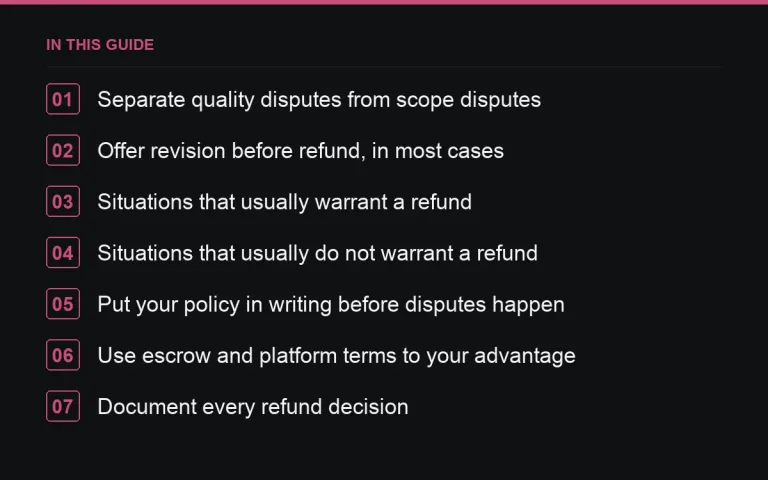
Separate quality disputes from scope disputes
A refund conversation usually starts with one of two complaints: the delivered post does not meet the agreed quality standard, or the buyer’s expectations were different from what was actually ordered. These deserve different responses. A genuine quality shortfall — missed brief, factual errors, poor execution — is grounds for a revision first and a refund if the revision does not fix it. A scope misunderstanding, where the buyer wanted something never actually agreed to, is usually resolved by clarifying terms rather than refunding.
Offer revision before refund, in most cases
Unless the order has clearly failed in a way no revision can fix — the post was never published, or was removed for a policy violation — default to offering a revision first. This resolves the majority of complaints at lower cost than a refund and gives the buyer a chance to get what they actually paid for. Tie this into your standard https://successtoroad.com/blog/the-order-lifecycle-from-the-publishers-side/ process so revision is a normal step, not a special favor.
Situations that usually warrant a refund
- The post was never published within the agreed timeframe and the buyer no longer wants it
- The published post was removed shortly after due to a legitimate rights or accuracy issue on your side
- The delivered content substantially failed to match the agreed brief, and a reasonable revision attempt did not fix it
- A marketplace’s escrow terms (such as those on https://successtoroad.com/marketplace/, where funds release only when the buyer approves the live URL) require it under the platform’s own rules
Situations that usually do not warrant a refund
A buyer changing their mind about a topic they specifically requested, a buyer unhappy with normal editorial changes made under your stated house style policy, or a buyer requesting removal long after publication for reasons unrelated to quality generally fall outside refund territory, provided your original terms were clear.
Put your policy in writing before disputes happen
State your refund conditions on your https://successtoroad.com/become-a-seller/ page or standard order terms, not just in your head. A buyer who reads “refunds are considered if a post is not delivered within the agreed window, following one revision attempt” before ordering is far less likely to escalate an emotional dispute than one hearing your policy for the first time mid-complaint.
Use escrow and platform terms to your advantage
If you accept orders through a marketplace with built-in escrow, the platform’s release conditions often do a lot of the refund-policy work for you. Understand exactly what triggers a release or a hold on your marketplace so you are not contradicting platform rules with your own separate policy.
Document every refund decision
Keep a short record of what was refunded, why, and what the buyer originally ordered. Beyond protecting you in a future dispute, this record over time tells you whether refunds cluster around a particular type of order, which often points to a gap in your https://successtoroad.com/blog/writing-contributor-guidelines/ or briefing process worth fixing at the source.
Consider partial refunds for partial shortfalls
Not every dispute is fully one-sided. If an order was delivered but fell short in one specific, limited way — a missed secondary requirement rather than a total failure to meet the brief — a partial refund can resolve the situation fairly without treating the whole order as void. This middle option is often underused compared to the binary choice of a full refund or none at all.
Set refund policy expectations differently for niche placements
Some niches carry inherently higher buyer expectations around durability and visibility, and it is worth thinking through whether your standard refund window makes sense across all of them, from a broad https://successtoroad.com/niche/business/ listing to a narrower one like https://successtoroad.com/niche/finance/. A one-size policy is easier to manage, but be honest with yourself about whether it genuinely fits every category you sell into.
Separate the refund decision from the relationship decision
Refunding an order does not have to mean ending the relationship with that buyer, and declining a refund does not have to mean the relationship is over either. Keep the two decisions distinct in your own thinking: whether this specific order warrants a refund, and separately, whether you want to continue working with this buyer going forward. Conflating them tends to produce worse decisions on both fronts.
Review your refund rate as a health indicator, not just a cost
A rising refund rate over several months is a signal worth investigating on its own, separate from any individual case. It often traces back to a specific stage of your process — an overloaded review queue, unclear briefing, or a slipping quality standard — rather than to a run of unusually difficult buyers, and treating it as a process question rather than a run of bad luck leads to a more durable fix.
Where to go next
Read https://successtoroad.com/blog/handling-difficult-buyers/ for the interpersonal side of refund conversations, and https://successtoroad.com/blog/verifying-buyers-and-avoiding-scams/ for cases where a refund request is actually part of an attempted scam.
Frequently asked questions
Should we always offer a revision before considering a refund?
In most cases, yes. A revision resolves the majority of complaints at lower cost and gives the buyer a real chance to get what they ordered, reserving refunds for cases a revision cannot fix.
What situations clearly do not warrant a refund?
A buyer changing their mind about a topic they specifically requested, or objecting to normal house-style editing that was disclosed upfront, generally do not warrant a refund if your original terms were clear.
How does marketplace escrow affect our refund decisions?
Escrow terms, such as funds releasing only when a buyer approves the live URL, often set clear conditions that do much of the refund-policy work for you. Understand these before setting a separate internal policy that might conflict.
Why should we document refund decisions even after they are resolved?
A record over time reveals patterns, such as refunds clustering around a specific order type, which often points to a fixable gap in your guidelines or briefing process rather than a one-off issue.
Put it into practice
Filter 54,483 websites by DR, traffic, niche and price, and order with escrow — you pay only after the link is live.
Browse the marketplace