Writing Contributor Guidelines That Save You Time
Clear contributor guidelines cut down on back-and-forth and attract better-fitting guest content.
Contributor guidelines are the single cheapest editorial tool a publisher has. A well-written page answers the questions every contributor asks before they ask them, which means fewer rushed emails, fewer off-brief drafts, and a shorter path from pitch to publish. If you accept paid guest posts through a marketplace, the guidelines double as a filter: buyers self-select into the topics and formats you actually want.
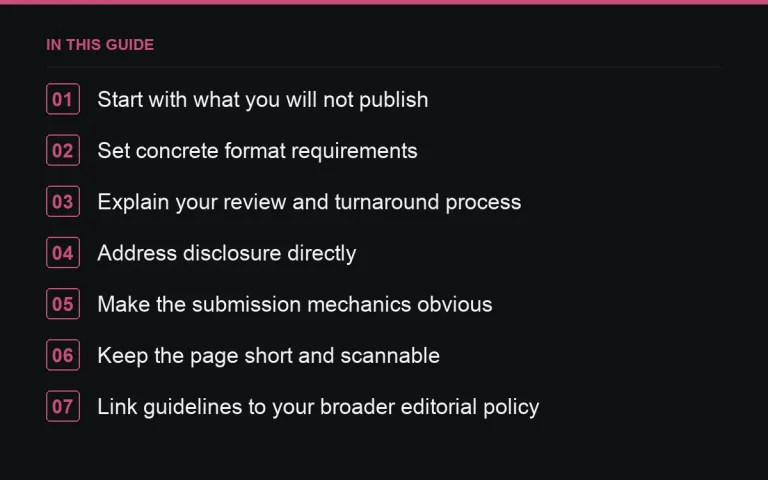
Start with what you will not publish
Most guidelines lead with what contributors can write about. It is more useful to lead with exclusions, because that is what saves editing time. List the topics you never cover, the tone you reject (overtly promotional, listicle spam, thin AI-generated filler), and any subject areas that create legal or reputational risk for your site. Contributors who read this section and still pitch you a bad fit have told you something useful about themselves.
Set concrete format requirements
Vague requests like “well-researched and engaging” produce vague drafts. Replace them with numbers and structure rules:
- Word count range (and whether you count the FAQ or byline against it)
- Minimum and maximum number of outbound links, and whether they must be relevant, not competitor pages, and not exact-match anchor spam
- Required structure: intro, subheadings every 200-300 words, a closing section
- Image policy: whether you accept submitted images, what licensing you require, and sizing
- Byline and author bio length limits
If you sell placements through https://successtoroad.com/become-a-seller/, keep your public guidelines consistent with what you tell buyers privately. Nothing erodes trust faster than a guideline page promising one thing and an editor enforcing another.
Explain your review and turnaround process
Tell contributors how long review takes, whether you send edits back for revision or edit in-house, and what happens if a draft misses the brief entirely. This single paragraph prevents most “any update?” emails. If you batch review on set days of the week, say so — see our notes on https://successtoroad.com/blog/setting-turnaround-expectations/ for how to phrase realistic timelines without overpromising.
Address disclosure directly
If you accept sponsored or paid content, your guidelines should state your labelling policy plainly rather than leaving contributors to guess. This is separate from your legal disclosure obligations (see https://successtoroad.com/blog/disclosure-and-labelling-sponsored-posts/) but the two should never contradict each other on the page.
Make the submission mechanics obvious
Contributors abandon pitches over friction as often as over rejection. Spell out the exact submission method (form, email, or through https://successtoroad.com/marketplace/ order messaging for marketplace buyers), acceptable file formats, and what a complete submission includes — draft text, images with license proof, author bio, and any disclosure statement. A short checklist embedded directly in the guidelines reduces incomplete submissions dramatically; we cover the buyer-facing version of this in https://successtoroad.com/blog/submission-checklist-for-guest-authors/.
Keep the page short and scannable
Guidelines longer than a printed page get skimmed, not read. Use a table for the hard requirements and reserve prose for the two or three things you most want contributors to understand — usually tone, exclusions, and turnaround. Revisit the page twice a year; if your editors keep repeating the same correction in feedback emails, that correction belongs in the guidelines, not just in your head.
Link guidelines to your broader editorial policy
Contributor guidelines work best as one piece of a wider editorial framework that also covers house style (see https://successtoroad.com/blog/editing-sponsored-content-to-house-style/) and how you balance paid content against organic editorial (see https://successtoroad.com/blog/balancing-sponsored-and-editorial-content/). Treat the guidelines page as the public-facing summary of decisions you have already made internally, not as the place you make them for the first time.
Write for the contributor who has never pitched you before
Existing contributors already know your quirks; a first-time pitcher does not. Write the page with that person in mind. Explain, in plain terms, what a good pitch to your site looks like versus a weak one, and give a short real example of a topic that would be accepted and one that would not. Vague reassurance like “we welcome all great ideas” tells a new contributor nothing useful; a specific example does the filtering work for you before they even start writing.
Cover niche or industry-specific requirements explicitly
If your site sells placements across specific verticals through a marketplace, note any category-specific expectations directly in the guidelines rather than leaving contributors to guess. A site listed under https://successtoroad.com/niche/marketing/ or https://successtoroad.com/niche/technology/ may reasonably expect a different depth of technical detail than a general lifestyle blog, and stating this upfront avoids drafts that are technically fine but pitched at the wrong level for your actual audience.
Test the guidelines with a real contributor before publishing them
Before finalising a new or revised guidelines page, send it to one trusted contributor and ask them to follow it exactly for their next submission. Watching where they hesitate or ask a clarifying question tells you more about gaps in the document than a purely internal review ever will, and it costs you almost nothing beyond a single submission cycle.
Where to go next
If you are still building your editorial process from scratch, start with https://successtoroad.com/blog/editorial-guidelines-for-publishers/ for the broader policy, then use this guide to turn it into a page contributors can actually follow. For publishers new to accepting paid placements, https://successtoroad.com/blog/sell-guest-posts-on-your-site/ covers the wider workflow guidelines fit into, and https://successtoroad.com/marketplace/ shows how buyers browse sites before they ever reach your guidelines page.
Frequently asked questions
Should contributor guidelines be public or sent privately?
Public pages filter pitches before they arrive and reduce email volume, which is why most publishers post them openly. Reserve private notes for buyer-specific pricing or order details that do not belong on a public page.
How often should we update contributor guidelines?
Review them twice a year or whenever you notice the same mistake recurring across several submissions. Guidelines that go stale stop matching your actual editorial standards and contributors notice the mismatch.
Do paid marketplace orders need separate guidelines from unpaid pitches?
The core content standards should be identical, but paid orders typically need extra detail on turnaround, revision rounds, and disclosure that unpaid contributors do not need to see.
What is the biggest mistake publishers make in their guidelines?
Writing guidelines that describe an ideal contributor process rather than the one editors actually enforce. Inconsistency between the page and real editorial decisions is the fastest way to lose contributor trust.
Put it into practice
Filter 54,483 websites by DR, traffic, niche and price, and order with escrow — you pay only after the link is live.
Browse the marketplace