Responding to Reviews and Feedback as a Publisher
A calm, specific response to a review does more for your reputation than the review itself, good or bad.

Reviews on a marketplace listing carry more weight than a single social media comment because buyers evaluating your site treat them as a direct signal of what working with you is actually like. How you respond, not just what the review says, becomes part of that signal.
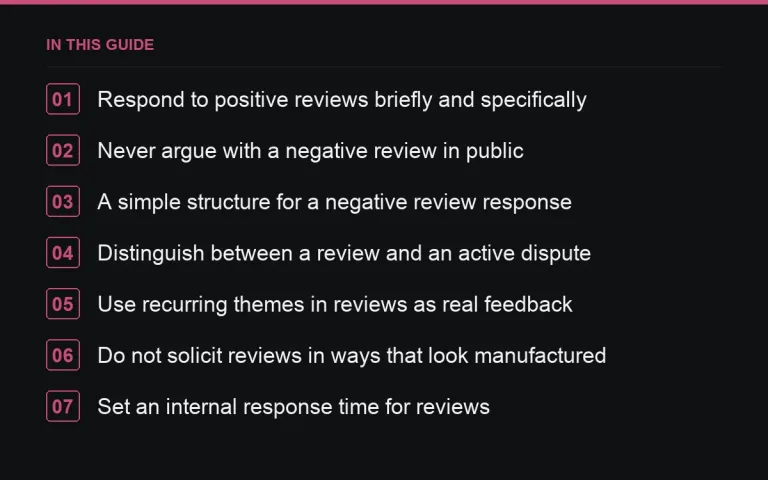
Respond to positive reviews briefly and specifically
A short, genuine thank-you that references something specific about the order performs better than a generic “thanks for the kind words.” It signals to future buyers browsing your listing on https://successtoroad.com/top-publishers/ that reviews reflect real, individual interactions rather than being ignored or auto-replied to.
Never argue with a negative review in public
Even when a negative review is unfair or factually wrong, an argumentative public response damages your reputation more than the original review did. Readers of a review thread generally side with whoever responds calmly, regardless of who was technically right. Address facts you can correct, briefly and without defensiveness, then move any real resolution to a private channel.
A simple structure for a negative review response
- Acknowledge the buyer’s experience without conceding points you dispute
- Correct any factual inaccuracy briefly, without a lengthy defense
- Offer to resolve the specific issue through direct contact or order messaging
- Keep the tone even if the review itself was not
This keeps the public response short while making clear to future buyers that you take feedback seriously and handle it professionally.
Distinguish between a review and an active dispute
If a negative review accompanies an unresolved order dispute, resolve the dispute through your normal process first — see https://successtoroad.com/blog/when-to-refund/ and https://successtoroad.com/blog/handling-difficult-buyers/ — rather than treating the public review response as the venue for that resolution. A buyer who feels genuinely resolved privately will often update or remove a negative review on their own; a buyer who feels publicly argued with rarely does.
Use recurring themes in reviews as real feedback
A single harsh review might be an outlier. Three reviews mentioning the same specific issue — slow turnaround, inconsistent editing, unclear communication — is a pattern worth acting on directly, not just responding to individually. Feed this back into your actual process, whether that is https://successtoroad.com/blog/setting-turnaround-expectations/ or your https://successtoroad.com/blog/using-order-messaging-effectively/ practices.
Do not solicit reviews in ways that look manufactured
Asking satisfied buyers for a review is reasonable and common. Offering incentives specifically for positive reviews, or only asking buyers you are confident were happy while ignoring everyone else, tends to produce a review profile that reads as inflated and can undermine trust once buyers notice the pattern.
Set an internal response time for reviews
A negative review that sits unanswered for weeks looks worse than one answered within a few days, even if the eventual response is identical. Treat review responses with the same urgency you would apply to a real buyer complaint arriving through order messaging.
Remember reviews are read by future buyers, not just the reviewer
Every response you write on a listing visible through https://successtoroad.com/marketplace/ is really being read by the next buyer deciding whether to place an order with you, not primarily by the person who left the review. Write with that wider audience in mind: calm, specific, and focused on demonstrating that you handle feedback professionally, since that is what actually influences future orders.
Track your review trend over time, not just individual reviews
A single average rating number hides useful detail. Look at whether your reviews are trending up or down over recent months, and whether recent reviews mention different issues than older ones. A shifting pattern is often a better signal of a process change worth investigating than any single review taken in isolation.
Do not chase a perfect record
A small number of negative reviews alongside mostly positive ones often reads as more credible to buyers than an entirely flawless record, which can look curated or unrealistic. Focus your energy on responding well and fixing genuine recurring issues rather than treating every single negative review as an emergency requiring a perfect outcome.
Bring reviews into your regular team discussions
Rather than reacting to reviews only as they appear, set a short recurring point in your team’s regular check-in to look at recent feedback together. This keeps everyone, not just whoever happens to respond publicly, aware of what buyers are actually experiencing, and it distributes the responsibility for improvement across the team rather than leaving it entirely with whoever manages the listing.
Follow up privately after resolving a public complaint
Once a negative review’s underlying issue has genuinely been resolved, a short private follow-up asking whether the buyer would consider revisiting their review costs little and occasionally works, provided it is genuine rather than pressuring. Never offer anything in exchange for a changed review, since this crosses into manipulating the review system rather than simply following up on a resolved concern.
Where to go next
Read https://successtoroad.com/blog/handling-difficult-buyers/ for the underlying interpersonal skills that prevent many negative reviews in the first place, and https://successtoroad.com/blog/getting-more-guest-post-orders/ for how a strong review profile feeds into future order volume.
Frequently asked questions
Should we respond publicly to every review, positive and negative?
A brief, specific reply to positive reviews is good practice, and negative reviews should always get a calm, professional response rather than being ignored.
Is it okay to dispute facts in a negative review publicly?
You can correct a clear factual inaccuracy briefly, but avoid a lengthy public argument. Move any real resolution to a private channel rather than litigating the dispute in the review thread.
What should we do if the same complaint shows up in multiple reviews?
Treat it as a real pattern worth fixing in your actual process, not just something to respond to politely each time it appears.
Is it acceptable to ask satisfied buyers for reviews?
Yes, this is common and reasonable. Avoid incentivizing positive reviews specifically or selectively asking only buyers you expect to be happy, since this produces a review profile that can look manufactured.
Put it into practice
Filter 54,483 websites by DR, traffic, niche and price, and order with escrow — you pay only after the link is live.
Browse the marketplace