Writing Editorial Guidelines Buyers Respect
Clear guidelines save you hours of back-and-forth, filter out bad orders and signal to good buyers that your site is worth it.
Guidelines tell buyers what you’ll publish and how. Good ones reduce revisions, avoid disputes and quietly filter out the orders you don’t want before they ever reach your inbox. They also signal quality: serious buyers actively prefer publishers with clear, specific standards over sites that will “consider anything”.
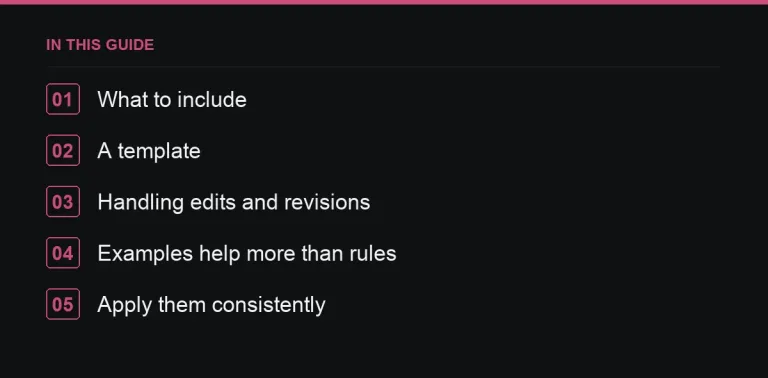
What to include
Accepted topics
List the categories you publish in, and be specific. “Home improvement, gardening, sustainable living” is useful to a buyer deciding whether to pitch you; “most topics” tells them nothing and invites off-topic submissions you’ll have to reject.
Quality bar
- Minimum length and the expected depth of coverage.
- Original content only, not published elsewhere first.
- Sources required for statistics and factual claims.
- Your position on AI-assisted drafting and what level of human editing you expect before submission.
Link rules
- Maximum number of links and where they’re allowed to appear in the body.
- Anchor text expectations — natural, descriptive phrasing rather than exact-match keywords stacked together.
- The link attribute you apply to sponsored content, and why (what the attributes mean).
Prohibited content
State clearly what you don’t accept: gambling, adult content, weapons, unregulated health products, and anything else outside your standards. A specific list here is worth more than a vague “nothing inappropriate”.
Disclosure
Explain how sponsored content is labelled on your site, so buyers know what a reader will see.
Process
- Turnaround time from submission to publication.
- Number of revisions included in the price.
- Whether you edit supplied articles yourself, and how heavily.
- How long posts stay live once published.
A template to adapt
Rather than a single paragraph of prose, most buyers find a short structured list easier to scan before they pitch you:
- We publish: state your topics precisely, not a general category.
- Length: a word range, with a note on headings and at least one practical example expected.
- Originality: unpublished, original content; sources required for any data cited.
- Links: a maximum number of contextual links, descriptive anchors, and the attribute applied to sponsored links.
- We don’t accept: your specific exclusion list, named rather than implied.
- Disclosure: how sponsored posts are labelled on the page.
- Turnaround: a number of days, with a set number of revisions included in the price.
- Permanence: whether posts stay live permanently or for a stated period, and what happens after that period ends.
Publishing this list as a standing page rather than emailing it out each time also means it’s easy to update once and have every future enquiry reference the current version.
Handling edits and revisions
Say up front how much you’ll edit supplied articles. Many publishers reserve the right to adjust formatting, headings and sentences for clarity, but not to change the meaning or remove the agreed link without asking first. If an article needs substantial rework, return it with specific notes rather than rewriting it silently — it keeps the relationship clear and keeps the buyer accountable for what carries their link (selling guest posts responsibly).
Examples help more than rules
Link to two or three published posts that represent the standard you expect from a submission. Buyers and their writers understand “write like this” faster than they absorb a list of abstract requirements, and showing examples reduces first-draft rejections considerably.
Set your rules against real orders
Guidelines only protect you if you enforce them consistently, including against orders that would have paid well but don’t fit (the red flags worth declining over). Consistency, more than the wording itself, is what keeps your site’s placements valuable over time (protecting your rankings while you sell them), and it feeds directly into how you set prices (pricing guest posts on your site).
Common mistakes worth avoiding
A few patterns show up repeatedly in publisher guidelines that don’t hold up in practice. Guidelines that are too long to read in full get skimmed and ignored, so keep the working version short and put detail in a linked page if you need it. Guidelines that contradict your actual behaviour — a stated “no gambling” policy next to a live gambling-niche sponsored post — undermine every other rule you’ve written, since buyers who spot the exception assume everything is negotiable. And guidelines written once and never revisited tend to fall behind as your audience and standards change, so treat the document as something to update, not a one-time task.
What good guidelines save you
The real payoff of a clear, enforced set of guidelines isn’t just fewer rejected drafts. It’s fewer disputes over payment when a post doesn’t get approved, fewer awkward conversations about removing a link months later, and a reputation among buyers as a publisher who is straightforward to work with. That reputation compounds: buyers who had a good experience come back, and they mention you to others in the same space.
Apply them consistently
Decline orders that don’t fit, even when it costs a sale. It’s what separates a publisher with real standards from a site that will publish anything for the right fee.
Where to go next
Add your guidelines to each website’s description and publishing rules when you list it on Digital PR; buyers see them before ordering, which cuts down on mismatched requests. You can also check how listings in the marketplace present their own rules for inspiration.
Frequently asked questions
Should guidelines be public?
Yes. Public guidelines save time on both sides and attract buyers whose content already fits your standards, before they ever submit anything.
Can I change guidelines later?
Yes, but apply changes to new orders rather than ones already accepted, to keep the relationship fair.
Should I allow AI-written submissions?
That's your call to make. State your position clearly, along with what level of human editing and fact-checking you expect regardless of how a draft was produced.
How specific should the prohibited list be?
As specific as you can make it. A vague exclusion invites arguments; a named list of categories rarely does.
Put it into practice
Filter 54,483 websites by DR, traffic, niche and price, and order with escrow — you pay only after the link is live.
Browse the marketplace