How to Price Guest Posts on Your Site
Price too low and you attract the wrong buyers. Price for your real audience and you can publish less and earn more.

Many publishers set prices by copying other listings or picking a number based on a domain authority score. Both approaches undervalue sites with real audiences and overvalue sites without them. Buyers who know what they’re doing increasingly look past the metrics on the surface, so a pricing method built on your actual audience serves you better in negotiations and in the long run.
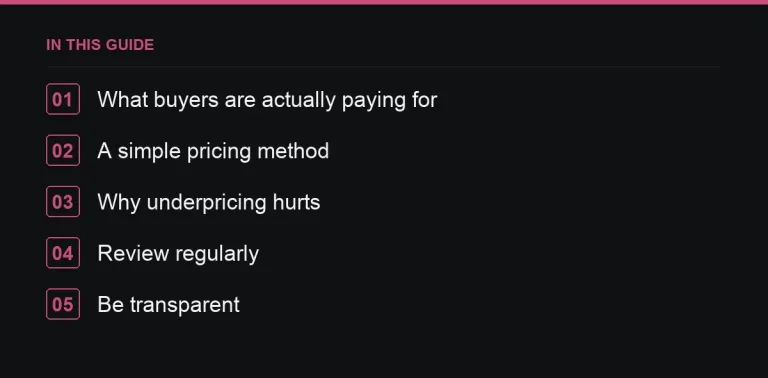
What buyers are actually paying for
- Your audience — real organic traffic in a defined niche and market, not just a number on a metrics tool.
- Relevance — how well your topic and readership match the buyer’s product or service.
- Your standards — editorial quality and selectivity, since a site that rejects most orders is implicitly saying its remaining placements are worth more.
- Extras — writing, homepage placement, promotion to your newsletter or social channels, and turnaround speed.
Authority metrics still play a role in buyers’ filters when they’re scanning hundreds of sites, but experienced buyers increasingly look at traffic and relevance first once they’ve shortlisted a site (why traffic matters more than it used to).
A simple pricing method
- Find comparable sites in your niche with similar traffic and quality, and note the range they charge, not just one data point.
- Adjust for your niche. Finance, legal, health and software topics tend to command higher prices because the buyers in those spaces have bigger budgets and fewer sites to choose from.
- Adjust for selectivity. If you accept a small share of the enquiries you get, price higher; scarcity is a legitimate input.
- Price extras separately: writing, homepage features, extra links, expedited turnaround. Bundling everything into one number makes it harder for buyers to compare and for you to upsell.
- Offer a link insertion price for existing articles if you accept them, usually lower than a new post since it involves less editorial work (guest posts versus niche edits).
Illustrative pricing structure
| Item | How to think about it |
|---|---|
| Base guest post | Reflects traffic, niche and your acceptance rate |
| Writing included | Priced as an add-on, since it’s extra editorial time |
| Homepage or featured placement | Priced above a standard post; visibility is worth more |
| Link insertion into an existing article | Usually cheaper than a new post |
| Rush turnaround | A modest premium, if you offer it at all |
Why underpricing hurts more than it helps
Very low prices attract a high volume of low-quality orders, often in risky niches you’d normally decline. That increases your workload, degrades your content mix, and makes the buyers who vet carefully suspicious rather than interested — a price that looks too good tends to read as a site with no standards (how buyers read a publisher’s prices).
Review your rates on a schedule
Revisit prices every few months rather than leaving them static for years:
- If traffic has grown, raise prices to match.
- If you’re turning away many orders at your current rate, that’s a clear signal you can raise prices without losing volume you actually want.
- If orders dried up, check whether traffic fell before assuming the price is the problem.
Publishers who never review pricing tend to drift out of step with their own growth, either leaving money on the table or pricing themselves out without noticing.
Be transparent about what’s included
State clearly what buyers get: word count, number of links, link attribute, whether writing is included, turnaround time, and how long the post stays live. Clear terms reduce disputes after the fact and attract serious buyers who read a well-specified listing as a sign of a well-run site (writing guidelines that pair well with clear pricing).
How buyers actually compare listings
A buyer scanning a marketplace rarely picks the cheapest option outright. They read the price alongside your traffic, your niche fit and how specific your listing terms are, then decide whether the combination looks like good value. Two sites with near-identical traffic can justify very different prices if one has vague terms and a slow reply rate and the other spells out exactly what’s included and turns orders around quickly. If you’re unsure how your price compares, look at a handful of listings in your own niche and note not just the number but how much detail sits behind it.
Negotiating without undercutting yourself
Some buyers will ask for a discount, especially on repeat or bulk orders. A modest volume discount for a buyer ordering across several of your sites, or for a long-term arrangement, is reasonable. A one-off request to halve your price for a single post usually isn’t worth granting — it resets the buyer’s expectation for every future order and signals that your listed price was never the real price. If you want to offer flexibility, build it into a stated bulk rate rather than negotiating case by case.
Protecting the value you’re charging for
None of this pricing work matters if the underlying site loses traffic or gets flagged for careless link selling. Keep your standards and your monetisation aligned (protecting your rankings while selling placements), and treat pricing as one part of a wider policy rather than a number set in isolation (selling guest posts responsibly).
Where to go next
On Digital PR you set your own guest post and link insertion prices per website, and can change them any time from your seller account. Browse how sites in your niche are priced in the business or technology marketplace before you finalise your own rates, and list your site once you’re ready.
Frequently asked questions
Should I price by domain authority?
Domain authority is one input buyers filter on, but pricing by real traffic and niche relevance reflects your actual value to a buyer far better.
Should writing be included in the price?
Offer it as an option rather than bundling it in. Some buyers want to supply their own article; others prefer your writers and will pay extra for it.
How often should I change my prices?
Review every few months, especially after a significant change in traffic, and don't be afraid to raise prices if you're declining a large share of enquiries.
Is a lower price ever the right call?
Occasionally, if you're newer and building a track record. Keep it temporary and raise prices as soon as your traffic and reputation justify it.
Put it into practice
Filter 54,483 websites by DR, traffic, niche and price, and order with escrow — you pay only after the link is live.
Browse the marketplace