Balancing Sponsored and Editorial Content on Your Site
There is no universal ratio, but there are clear warning signs when sponsored content has crowded out everything else.

Publishers who monetize through guest posts eventually face the same question: how much sponsored content is too much? There is no fixed ratio that works for every site, but there are observable signals that tell you whether your balance is drifting in the wrong direction, and practical ways to correct it without giving up the revenue.
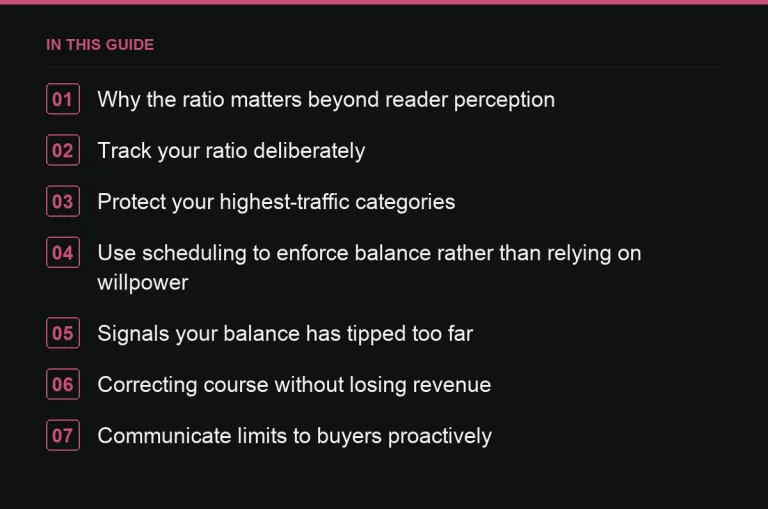
Why the ratio matters beyond reader perception
A site that is visibly dominated by sponsored posts affects more than reader trust. Search engines and readers alike form an impression of what a site is “about” from its recent content. If every new post in a category is a paid placement, that category starts to read as a marketplace rather than a publication, which can affect both engagement and how the site performs in search over time — see https://successtoroad.com/blog/publisher-seo-hygiene-checklist/ for more on this.
Track your ratio deliberately
Most publishers do not actually know their sponsored-to-editorial ratio until they count it. Do this quarterly: count posts published by category over the last three months and mark each as sponsored, guest (unpaid), or staff-written. If any category is running above roughly half sponsored, treat that as a signal to either slow acceptance in that category or increase your own editorial output there.
Protect your highest-traffic categories
Not all parts of a site carry equal weight. Your best-performing categories and cornerstone pages are where reader trust matters most, so consider applying stricter sponsored content limits there than on lower-traffic sections. This also protects the categories most likely to drive your organic https://successtoroad.com/blog/improving-traffic-authority-legitimately/ efforts.
Use scheduling to enforce balance rather than relying on willpower
The easiest way to maintain a ratio is structural: build it into your https://successtoroad.com/blog/editorial-calendar-with-paid-posts/ rather than deciding case by case whether “just one more” sponsored post is fine. If your calendar reserves fixed slots for staff or unpaid editorial content each month, the ratio maintains itself without requiring you to say no to individual buyers on the fly.
Signals your balance has tipped too far
- Recent posts in a category are entirely bylined by outside contributors or brands
- Comments or social replies increasingly ask “is this an ad?”
- Engagement metrics (time on page, return visits) are declining in your most sponsored-heavy sections
- Your own editorial team has not published original reporting in that category for months
Correcting course without losing revenue
If you need to rebalance, the fastest lever is raising acceptance standards rather than turning away all paid content — being more selective about topical fit (see https://successtoroad.com/blog/maintaining-topical-focus/) naturally reduces volume while keeping the placements that fit best. A second lever is spacing: publish sponsored posts at a steady, lower cadence rather than in bursts, which keeps any single week from looking saturated.
Communicate limits to buyers proactively
If you cap sponsored posts per category per month, say so on your https://successtoroad.com/become-a-seller/ page or in buyer communication. Buyers who understand there is a queue or a selectivity standard tend to submit better-fitting briefs than buyers who assume any topic will be accepted.
Compare your ratio against similar sites on the marketplace
Browsing https://successtoroad.com/marketplace/ for sites in your own niche gives you a rough sense of how other publishers of a similar size and audience balance sponsored and editorial content. This is not about copying another site’s exact ratio, but it can highlight if your own site has drifted noticeably further toward sponsored volume than comparable listings, which is worth investigating even if your own metrics look fine in isolation.
Involve your editorial team in the ratio conversation
Whoever writes or commissions your unpaid editorial content should know the current sponsored ratio, not just whoever approves paid orders. A shared awareness across both sides of the team makes it more likely that a slipping ratio gets corrected proactively through extra staff-written pieces, rather than being noticed only during a periodic count.
Remember that readers judge balance intuitively, not numerically
Readers rarely count sponsored posts against editorial ones the way you might in a spreadsheet; they form an impression from what they see in a normal browsing session. A ratio that looks fine in your quarterly count can still feel off if sponsored posts happen to cluster on your homepage or in your most-shared category during a given week, so check the visible mix, not just the underlying numbers.
Give your best editorial content the most prominent placement
Beyond the ratio itself, where content sits on your site shapes how balanced it feels. Reserve your homepage’s top placement and your most prominent newsletter slot for your strongest editorial work more often than not, and let sponsored posts sit slightly further back in the browsing path. This does not reduce the value delivered to a paying buyer, since the post is still fully live and indexed, but it keeps the first impression of your site anchored in original content.
Where to go next
Read https://successtoroad.com/blog/disclosure-and-labelling-sponsored-posts/ for how labelling interacts with this balance, and https://successtoroad.com/blog/monetizing-a-blog-beyond-sponsored-posts/ for revenue options that reduce your reliance on guest post volume altogether.
Frequently asked questions
Is there an ideal ratio of sponsored to editorial content?
No universal number works for every site. What matters is that no single category becomes dominated by paid placements to the point that readers or search engines stop recognizing it as genuinely editorial.
How often should we review our sponsored content ratio?
Quarterly is a practical cadence for most sites. It is frequent enough to catch drift before it becomes a pattern, without adding unnecessary overhead to your editorial workflow.
Should some categories have stricter sponsored content limits than others?
Yes. Your highest-traffic or reputation-defining categories generally benefit from tighter limits than smaller, less central sections of the site.
What is the easiest way to fix an imbalance without losing all sponsored revenue?
Raise your topical fit standards rather than pausing acceptance entirely, and spread sponsored posts evenly across an editorial calendar instead of publishing them in clusters.
Put it into practice
Filter 54,483 websites by DR, traffic, niche and price, and order with escrow — you pay only after the link is live.
Browse the marketplace