How to Decline Off-Topic Guest Post Briefs Politely
A clear, respectful decline keeps the door open for a better-fitting pitch later instead of ending the relationship entirely.

Declining a pitch is a routine part of running a site that accepts guest content, but how you decline shapes whether a buyer comes back with a better-fitting idea or writes you off entirely. A short, specific, respectful no does more for your site’s reputation than either a vague rejection or an over-explained one.
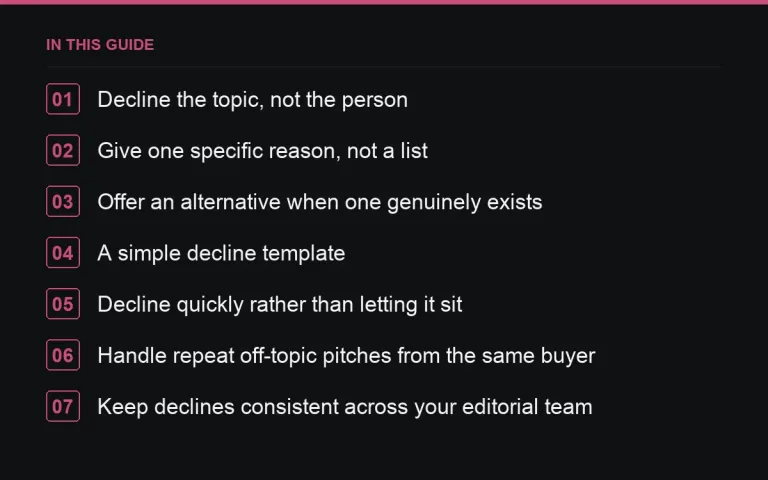
Decline the topic, not the person
Frame every rejection around fit, not quality. “This doesn’t match our current editorial scope” is honest and non-personal, whereas silence or a generic “not interested” leaves the buyer guessing whether the problem was the topic, the writing, or something else entirely. Clarity here reduces the chance of a frustrated buyer submitting the same brief again with minor cosmetic changes.
Give one specific reason, not a list
A single clear reason is more useful to a buyer than an exhaustive list of everything wrong with the pitch. If the core issue is topical fit, say that and stop there — see https://successtoroad.com/blog/maintaining-topical-focus/ for how to define fit precisely enough to state it confidently. Piling on secondary criticisms tends to read as justification rather than help.
Offer an alternative when one genuinely exists
If the buyer’s brief could work with a different angle, or fits a different category on your site, say so. This turns a decline into a redirect rather than a dead end, and it is the single most effective way to retain a buyer relationship after a rejection. Only offer this when it is genuinely true — a redirect offered just to soften the blow, with no real intention of accepting the revised pitch, wastes everyone’s time.
A simple decline template
“Thanks for the pitch on [topic]. It’s well outside the scope we cover on [site], which is focused on [scope], so it’s not a fit for us right now. If you have something closer to [specific example], we’d be glad to take a look.” This template works whether the pitch arrived by email or through https://successtoroad.com/marketplace/ order messaging, with minor adjustments for tone.
Decline quickly rather than letting it sit
A pitch that sits unanswered for weeks before a rejection is worse for the relationship than a quick no. Buyers reasonably read silence as either disorganization or disinterest, and a late decline after they have already planned around your site wastes their time more than a prompt one would have. Set an internal turnaround target for declines specifically, separate from your normal review timeline — see https://successtoroad.com/blog/setting-turnaround-expectations/.
Handle repeat off-topic pitches from the same buyer
If a buyer submits multiple off-topic briefs despite clear guidelines, a direct conversation is more useful than repeated individual declines. Point them to your scope statement and ask what led them to this particular pitch — sometimes this reveals a genuine misunderstanding about your site that is worth correcting once rather than repeatedly.
Keep declines consistent across your editorial team
If more than one person reviews pitches, inconsistent decline reasoning across editors creates confusion and can look arbitrary to buyers comparing notes. A shared, short list of common decline reasons — topical mismatch, quality below threshold, capacity for the month already full — keeps messaging consistent regardless of who responds.
Decline marketplace orders through the same professional lens
Orders placed through https://successtoroad.com/marketplace/ still deserve the same careful, specific decline message as a direct email pitch, even though the transactional nature of a marketplace order can tempt editors toward a colder, more automated-sounding response. A buyer who placed a paid order and receives a generic, unexplained rejection is far more likely to escalate than one who receives the same short, specific explanation you would give a free pitch.
Use declines as a feedback loop for your own guidelines
If you notice the same type of off-topic pitch arriving repeatedly, treat it as a signal that your public scope statement is not communicating clearly enough, rather than only a signal about that particular buyer. Adjusting your guidelines to close the gap reduces the volume of declines you need to send in the first place.
Keep a short library of decline messages for common cases
Rather than writing a fresh decline from scratch each time, keep two or three tested templates for the most common reasons you decline pitches, and adapt them slightly to the specific pitch rather than sending something that reads as fully generic. This saves editor time without sacrificing the specificity that makes a decline useful to the person receiving it.
Recognise when a decline is really a pricing conversation in disguise
Occasionally a pitch is close to your scope but not quite the level of quality or fit you would normally accept at your standard rate. Rather than an outright decline, some publishers offer a path forward at a different acceptance bar, explained honestly rather than left ambiguous. This is optional and not appropriate for every situation, but it is worth considering before defaulting to a flat no for a borderline case that is genuinely close.
Where to go next
Read https://successtoroad.com/blog/writing-contributor-guidelines/ to reduce how often off-topic pitches arrive in the first place, and https://successtoroad.com/blog/handling-difficult-buyers/ for cases where a decline turns into a dispute.
Frequently asked questions
What is the most important thing to include in a decline message?
One clear, specific reason for the rejection. A vague or overly generic decline leaves the buyer unsure what to change, which increases the chance of another mismatched pitch.
Should I offer an alternative topic when declining a pitch?
Only if a genuine alternative exists. Offering a redirect you do not actually intend to accept just to soften the rejection tends to waste time for both sides.
How quickly should off-topic pitches be declined?
As quickly as your review process allows, ideally faster than your standard review timeline since a decline needs less deliberation than an acceptance.
What if the same buyer keeps submitting off-topic pitches?
Have a direct conversation pointing them to your stated scope rather than repeating the same decline message each time. It often reveals a misunderstanding worth correcting once.
Put it into practice
Filter 54,483 websites by DR, traffic, niche and price, and order with escrow — you pay only after the link is live.
Browse the marketplace