Maintaining Topical Focus When Accepting Guest Posts
A site that accepts guest posts on anything eventually stands for nothing in particular, to readers or search engines.

The appeal of accepting guest posts on almost any topic is obvious: more accepted pitches means more revenue. The cost is less obvious until it has already happened — a site that publishes everything gradually loses whatever topical identity made it valuable to readers, advertisers, and search engines in the first place.
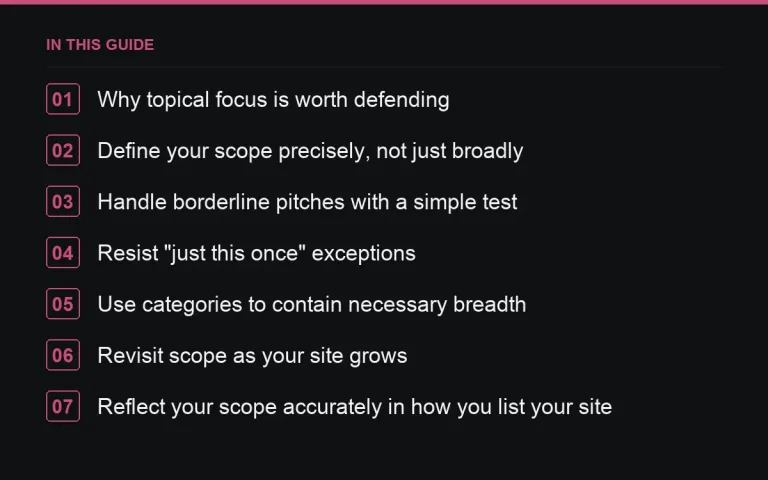
Why topical focus is worth defending
Sites with a clear topical identity tend to build stronger relevance signals over time within their niche, which affects both organic performance and how buyers evaluate the site when placing orders (see https://successtoroad.com/blog/how-buyers-evaluate-your-site/). A site listed under a specific https://successtoroad.com/niche/technology/ or https://successtoroad.com/niche/health/ category on a marketplace loses credibility in that niche if a third of its recent content is unrelated.
Define your scope precisely, not just broadly
“We cover marketing” is too broad to enforce consistently. Write a scope statement specific enough that you can actually apply it: which sub-topics you cover, which adjacent topics you occasionally allow, and which topics never fit regardless of quality. This scope statement belongs alongside your https://successtoroad.com/blog/writing-contributor-guidelines/.
Handle borderline pitches with a simple test
When a pitch sits at the edge of your scope, ask: would this article make sense to a reader who found it while browsing your site’s usual content, without needing extra context about why it is there? If the honest answer is no, decline it regardless of how well-written the draft is. Quality does not compensate for a fundamental topical mismatch.
Resist “just this once” exceptions
A single off-topic post rarely damages a site. The pattern that damages a site is a string of one-off exceptions, each individually justified, that collectively dilute the scope over months. If you find yourself making frequent exceptions, that is a signal to either formally broaden your stated scope or tighten your acceptance process, not to keep making ad hoc calls.
Use categories to contain necessary breadth
Some publishers legitimately need broader coverage than a single niche — a general business site, for instance. In that case, use clear on-site categories or tags so readers and buyers can navigate to the specific area relevant to them, rather than presenting all content as equally central to the site’s identity. This also helps if you list on a marketplace across multiple https://successtoroad.com/niche/business/ or https://successtoroad.com/niche/marketing/ tags.
Revisit scope as your site grows
A site’s natural scope can legitimately expand over time as its audience and authority grow — this is different from scope creep driven by short-term guest post revenue. The distinction is intentionality: an expansion you planned and can articulate versus one that happened by accumulation of exceptions.
Reflect your scope accurately in how you list your site
If your site is listed for sale under a specific https://successtoroad.com/niche/health/ or https://successtoroad.com/niche/travelling/ category on a marketplace, keep the category selection honest to what your content actually covers, not what you wish it covered or what might command a higher price. A buyer who orders expecting genuine niche authority and finds a site with thin, scattered coverage in that area is far more likely to dispute the order or leave a poor review than one whose expectations matched the listing.
Use scope to guide, not just to reject
A well-defined scope is as useful for actively soliciting the right pitches as it is for declining the wrong ones. When you have gaps in your content calendar, reach out to contributors who write well within your actual scope rather than accepting whichever pitch happens to arrive first. This keeps your topical identity strengthening over time rather than merely staying static through rejection alone.
Recognise scope drift before it shows up in analytics
By the time a loss of topical focus is visible in your traffic or engagement numbers, the drift has often been building for months. A faster warning sign is simply reading your last ten published posts back to back and asking whether they would make sense together on a single page to a new visitor. If they read like several unrelated sites stitched together, that is worth acting on immediately rather than waiting for the numbers to confirm it.
Explain your scope decision in terms a buyer will respect
When a buyer’s brief falls outside your scope, framing the decline around protecting your site’s specific value in its niche tends to land better than a vague reference to “editorial policy.” A buyer who understands that narrow focus is precisely what makes your placements valuable in the first place is more likely to come back later with a better-fitting pitch than one who reads the decline as arbitrary gatekeeping.
| Signal | What it suggests |
|---|---|
| Occasional adjacent-topic post that fits your audience | Healthy, planned breadth |
| Frequent unrelated posts justified individually | Scope creep driven by acceptance pressure |
| Readers or buyers asking “what is this site actually about?” | Focus has already been lost |
Where to go next
Pair this with https://successtoroad.com/blog/declining-off-topic-briefs-politely/ for the practical mechanics of saying no, and https://successtoroad.com/blog/balancing-sponsored-and-editorial-content/ for the related question of how much of your scope should be paid versus organic.
Frequently asked questions
How specific should our stated topical scope be?
Specific enough that you can apply a consistent yes-or-no test to a borderline pitch. A vague scope like 'we cover marketing' does not give you or contributors enough to work with.
Is it ever okay to publish an off-topic guest post?
Occasionally, if it is a deliberate, planned exception rather than part of a recurring pattern. The risk is not one exception but an accumulation of individually justified ones.
How do I know if my site has already lost topical focus?
A practical test is whether readers or buyers regularly ask what your site is actually about, or whether recent posts in a category no longer resemble each other in subject matter.
Can a site legitimately broaden its scope over time?
Yes, provided the broadening is intentional and you can articulate why, as opposed to scope drifting because individual off-topic pitches kept getting accepted.
Put it into practice
Filter 54,483 websites by DR, traffic, niche and price, and order with escrow — you pay only after the link is live.
Browse the marketplace