Getting Author Pages and Bylines Right for Guest Posts
Consistent, well-structured author pages build trust with readers and give guest contributors a reason to keep pitching you.
Author pages and bylines are often an afterthought in a publisher’s workflow, handled inconsistently post by post. Done well, they build reader trust and give contributors a real incentive to write for your site again. Done carelessly, they become a quiet source of both SEO clutter and disputes over what a contributor was promised.
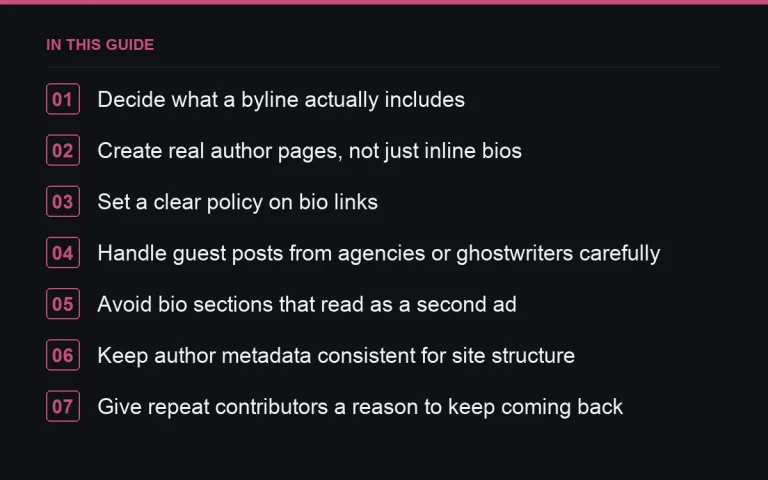
Decide what a byline actually includes
Set a fixed structure: contributor name, a short bio of a set length (30-50 words is typical), and a limited number of links — often just one to the contributor’s site or profile. Publishing this structure consistently, rather than negotiating it fresh for every submission, saves time and keeps your site looking coherent. State the limit clearly in your https://successtoroad.com/blog/writing-contributor-guidelines/.
Create real author pages, not just inline bios
A dedicated author page that lists a contributor’s published posts on your site serves two purposes: it gives regular contributors a reason to keep writing for you (their body of work is visible and attributable), and it gives readers a way to find more from a writer they liked. For sites with many one-off contributors, this does not need to be elaborate — a simple archive page per author is enough.
Set a clear policy on bio links
Decide whether bio links follow the same nofollow or sponsored attribute rules as in-article links for paid placements, and apply that decision consistently. Buyers ordering through https://successtoroad.com/marketplace/ should know this upfront as part of the order terms, since expectations about bio links are a common source of post-publication disputes.
Handle guest posts from agencies or ghostwriters carefully
When a post is submitted on behalf of a client by an agency, decide who the byline actually credits — the agency, the client, or a named individual writer — before publication, not after a dispute arises. This is worth spelling out specifically if you regularly work with agencies, covered further in https://successtoroad.com/blog/working-with-agencies-as-a-publisher/.
Avoid bio sections that read as a second ad
A bio with three separate promotional links and a sales pitch undermines the editorial feel of the article above it. Keep bios factual and brief — who the person is, what they do, one link — rather than allowing them to become a second advertisement stapled to the end of the post.
| Element | Typical limit |
|---|---|
| Bio length | 30-50 words |
| Bio links | One, occasionally two for long-standing contributors |
| Author page | Lists all posts by that contributor on your site |
Keep author metadata consistent for site structure
Consistent author attribution helps both readers and search engines understand which content on your site is staff-written versus contributed, which supports the broader picture covered in https://successtoroad.com/blog/balancing-sponsored-and-editorial-content/. Sloppy or missing author metadata makes this distinction harder to see at a glance.
Give repeat contributors a reason to keep coming back
A contributor whose author page shows a growing, visible body of work on your site has a tangible reason to keep pitching you rather than a competing publication, especially one they can point to when marketing their own services. This is a low-cost way to retain your best recurring contributors without needing to pay them more for each individual piece.
Consider how bylines look across niches and languages
If your site publishes across multiple https://successtoroad.com/niche/business/ or https://successtoroad.com/language/english/ sections, keep byline formatting consistent across all of them, even where the contributor pool differs by section. A visitor moving between categories should recognise the same structure and trust signals regardless of which part of the site they are reading.
Decide how bylines interact with removed or updated content
If a post is later removed under your https://successtoroad.com/blog/handling-removal-requests/ process, decide whether the contributor’s author page should still list it or quietly drop it once the post is gone. Leaving a dead link on an author page creates a small but avoidable inconsistency, and it is easy to overlook unless removal and byline maintenance are handled as part of the same checklist.
Keep byline formatting simple to maintain at scale
As contributor count grows, an overly customised byline format for each individual author becomes difficult to keep consistent. A single, simple template applied uniformly is easier to maintain correctly across dozens of contributors than a flexible format that looks slightly different every time.
Use author pages to reinforce your topical focus
An author page that clearly groups a contributor’s posts by topic subtly reinforces your site’s overall scope to any visitor browsing it, since it shows depth within your niche rather than a scattered mix. This is a small, largely passive benefit compared to your primary editorial decisions on scope, but it compounds the same way the rest of your topical focus efforts do over time.
Do not neglect this for sponsored content specifically
It is easy to treat byline and author page setup as a lower priority for a one-off sponsored placement than for a regular contributor. Apply the same basic standard regardless, since a sloppy or missing byline on a sponsored post is one of the more visible signs to a careful reader that a placement was handled less carefully than the rest of the site.
Where to go next
Read https://successtoroad.com/blog/disclosure-and-labelling-sponsored-posts/ for how byline and sponsorship labelling interact, and https://successtoroad.com/blog/running-a-multi-author-blog/ for author page management at larger scale.
Frequently asked questions
How long should a contributor bio be?
Thirty to fifty words is typical for most sites. Longer bios start to compete with the article itself and often end up reading as an additional advertisement.
How many links should a bio include?
One is standard for most guest contributors. Occasionally two links are reasonable for long-standing or particularly valuable contributors, but this should be a deliberate exception, not the default.
Do we need a full author page for one-off contributors?
A simple archive page listing their posts is enough even for occasional contributors. It does not need to be elaborate, just consistent across your site.
Who gets the byline when an agency submits a post for a client?
Decide this before publishing, not after. Some sites credit the agency, others the client, others a named individual writer — pick one approach and apply it consistently.
Put it into practice
Filter 54,483 websites by DR, traffic, niche and price, and order with escrow — you pay only after the link is live.
Browse the marketplace