Handling Link Change Requests After a Post Is Live
Not every link change request deserves the same answer; a clear internal policy makes each decision fast and consistent.
Link change requests arrive for all kinds of reasons: a buyer’s target page moved, a company rebranded, a link stopped serving its purpose, or a buyer simply changed their mind about the anchor text months after publication. Publishers who handle these case by case each time spend more energy on the decision than the request usually warrants. A clear internal policy fixes this.
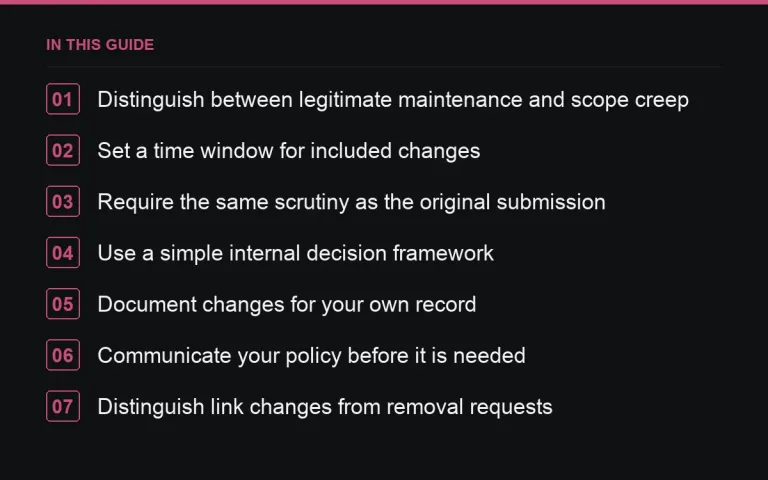
Distinguish between legitimate maintenance and scope creep
A request to update a link because the destination URL now returns a 404 is maintenance — it is in everyone’s interest to fix it. A request to swap the link to an entirely different, unrelated site months after publication is a different kind of request and does not carry the same obligation. Separate these two categories explicitly in your policy rather than treating every request the same way.
Set a time window for included changes
Many publishers offer free minor link updates within a set window after publication — 30 to 90 days is common — covering things like a broken destination URL or a small anchor text correction. After that window, treat further changes as a new, small paid service rather than an open-ended obligation, and say so clearly in your terms when the order is placed.
Require the same scrutiny as the original submission
A link change request is still a link change, and it deserves the same relevance and quality check you would apply to a new submission. Do not wave through a swap to an unrelated or lower-quality destination just because it arrives as an “edit” rather than a new order. This protects your site the same way your original review process does.
Use a simple internal decision framework
- Is the destination URL broken or clearly outdated? Fix promptly, at no charge, within your policy window.
- Is the requested change small (anchor text tweak, not a destination swap)? Handle it quickly, possibly at no charge within the window.
- Is the requested change a full destination swap to a different domain? Treat this as a new placement request subject to your normal review and, likely, a fee.
- Is the request coming long after your stated window with no clear justification? Point to your policy and offer a paid option if you are willing to accommodate it anyway.
Document changes for your own record
Keep a simple log of link changes made after publication, especially for posts that came through https://successtoroad.com/marketplace/ orders, noting what changed and why. This protects you if a buyer later disputes what was agreed, and it gives you visibility into whether certain buyers request changes unusually often.
Communicate your policy before it is needed
State your link change policy at the time of order, not only when a request actually arrives. Buyers who know upfront that changes after 60 days incur a fee are far less likely to push back when that policy is applied, compared to buyers hearing about it for the first time mid-request.
Distinguish link changes from removal requests
A request to swap or update a link is a different situation from a request to remove the post or link entirely, which carries its own considerations around refunds and reputational risk — covered separately in https://successtoroad.com/blog/handling-removal-requests/ and https://successtoroad.com/blog/when-to-refund/.
Consider a paid maintenance tier for ongoing link management
Some publishers offer buyers an optional paid tier that includes periodic link health checks and a set number of future changes beyond the standard free window. This works well for buyers with a large existing footprint of placements across https://successtoroad.com/marketplace/ who want assurance that their links stay live and accurate without submitting a fresh dispute every time something changes on their end.
Keep your policy the same across niches and order sizes
It can be tempting to bend your link change policy for a large buyer or a high-value order, but inconsistency here creates more friction long term than it solves in the moment. Apply the same window and review standard whether the order came through a general https://successtoroad.com/niche/business/ category or a smaller, less common niche.
Distinguish anchor text changes from destination changes explicitly
Buyers sometimes describe a request loosely as “update the link” when they mean anything from adjusting the visible anchor text to swapping the destination entirely. Ask a clarifying question before making the change if the request is ambiguous, since the two carry very different levels of review and risk, and acting on an assumption rather than a confirmed request is a common source of avoidable disputes.
Track how often each buyer requests changes
A buyer who requests frequent link changes across multiple orders is worth a direct, friendly conversation about what is driving the pattern. Sometimes it reflects a genuinely fast-changing business on their end; occasionally it reflects a buyer using your site as a flexible placeholder rather than a stable, durable placement, which is a different kind of relationship than most publishers intend to offer.
Where to go next
Read https://successtoroad.com/blog/the-order-lifecycle-from-the-publishers-side/ for how link change requests typically fit chronologically after an order closes, and https://successtoroad.com/blog/using-order-messaging-effectively/ for keeping these requests documented properly.
Frequently asked questions
Should we always accommodate a request to change a link after publication?
No. Distinguish between legitimate maintenance, such as fixing a broken URL, and a full destination swap requested well after publication, which deserves a different response, often a fee or a decline.
How long should our free link update window be?
Thirty to ninety days is common among publishers, though the exact window is up to you. What matters most is stating it clearly at the time of order.
Does a link change request need the same review as a new submission?
Yes. A swap to an unrelated or lower-quality destination should get the same scrutiny you would apply to any new placement request, not an automatic pass.
Should we charge for link changes requested after our policy window?
Many publishers do, treating it as a small paid service rather than an open-ended free obligation. This is reasonable as long as the policy was communicated at the time of the original order.
Put it into practice
Filter 54,483 websites by DR, traffic, niche and price, and order with escrow — you pay only after the link is live.
Browse the marketplace