Editing Sponsored Content to Match Your House Style
Sponsored posts should read like your site wrote them, not like an outside pitch dropped in unedited.
Readers do not distinguish between your staff-written content and a sponsored post unless the writing quality suddenly drops. Editing every paid placement to house style protects the reading experience and, over time, protects the value of the placements themselves — a site that reads inconsistently trains its audience to skim past anything that looks off-brand.
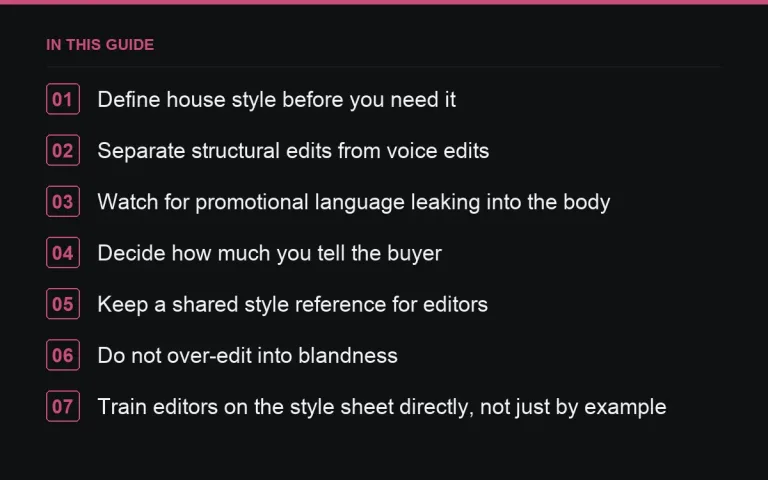
Define house style before you need it
House style is more than a tone note. Write down your preferred sentence length, whether you use Oxford commas, how you format numbers and dates, your heading capitalization rule, and how you handle brand names and product mentions. Contributors will not guess this correctly on their own, so the same document that holds your https://successtoroad.com/blog/writing-contributor-guidelines/ should link out to a one-page style sheet.
Separate structural edits from voice edits
When editing a sponsored draft, work in two passes. First fix structure: heading hierarchy, paragraph length, whether the piece actually answers the reader’s question in the opening lines. Second, adjust voice: word choice, sentence rhythm, and removing any phrasing that reads as ad copy rather than editorial. Doing both at once tends to produce edits that fix one problem while introducing another.
Watch for promotional language leaking into the body
Sponsored content briefs often arrive full of superlatives — “leading,” “best-in-class,” “revolutionary.” Strip these unless they are directly attributable and defensible, and push promotional framing into the author bio or a clearly marked call-to-action instead of scattering it through the body. This keeps the article itself readable and keeps you within the spirit of your https://successtoroad.com/blog/disclosure-and-labelling-sponsored-posts/ policy.
Decide how much you tell the buyer
Some publishers send a marked-up version showing every change; others simply publish the edited version and note in the order message that house style edits were applied. Either is defensible, but pick one approach and apply it consistently. Buyers ordering through https://successtoroad.com/marketplace/ generally respond well to a short note explaining that edits were stylistic, not content changes, since this heads off disputes before they start.
Keep a shared style reference for editors
If more than one person edits for your site, small inconsistencies compound quickly — one editor allows first person, another does not. A shared reference document, even a simple table of “do this / not this” examples, keeps output consistent regardless of which editor a piece lands with. This matters more as you scale toward https://successtoroad.com/blog/running-a-multi-author-blog/.
| Check | What to look for |
|---|---|
| Voice | No first-person plural claims (“we are the best”) outside the bio |
| Structure | Headings every 250-300 words, no orphaned single-sentence sections |
| Links | Anchor text reads naturally, not exact-match keyword stuffing |
| Formatting | Consistent number formatting, date style, and capitalization |
Do not over-edit into blandness
House style should smooth rough edges, not erase every trace of the original author’s voice. A sponsored post that reads exactly like every other post on your site, sentence for sentence, starts to feel mechanical. Aim for consistency in mechanics and tone, while leaving room for the contributor’s actual argument and examples to come through.
Train editors on the style sheet directly, not just by example
Handing a new editor a folder of previously edited posts and asking them to “match the style” produces inconsistent results, because it is easy to copy the wrong lesson from an example. Walk new editors through the actual style sheet line by line, and have them edit a sample draft you can compare directly against how an experienced editor would have handled the same piece before they take on live sponsored orders unsupervised.
Apply the same rigor across niches and languages
If your site accepts sponsored content across different https://successtoroad.com/niche/business/ or https://successtoroad.com/niche/health/ categories, or in more than one https://successtoroad.com/language/english/ variant, house style edits should still apply the same underlying principles even where vocabulary or tone shifts by topic. A finance-focused sponsored post and a lifestyle one can both read as clearly “your site” without sounding identical to each other.
Keep a running file of common fixes
Certain corrections come up again and again across different contributors: a habit of starting too many sentences with “In conclusion,” an overuse of a specific buzzword, or a tendency to bury the main point in the third paragraph instead of the first. Rather than fixing each instance from scratch, keep a short running file of these recurring patterns with a one-line fix for each. New editors ramp up faster with this file than they do reading through a stack of old edited drafts trying to infer the same lessons.
Give feedback that improves future submissions, not just this one
When you send edits back to a contributor, or simply publish the edited version without a revision round, consider adding one short line about the most significant house style change you made and why. Contributors who understand the reasoning behind a style rule tend to internalise it for their next submission, which gradually reduces the amount of editing their drafts need over time. Contributors who never see this reasoning tend to repeat the same corrections indefinitely, which costs your editorial team more effort in the long run than the small extra time spent explaining once.
Where to go next
Once your editing process is solid, pair it with a https://successtoroad.com/blog/fact-checking-guest-posts/ pass before publishing, and revisit https://successtoroad.com/blog/maintaining-topical-focus/ to make sure the edited piece still fits your site’s overall scope.
Frequently asked questions
Should we tell buyers exactly what we changed in their sponsored post?
A brief note that edits were made for house style and readability is usually enough. Full tracked changes are optional and mainly useful if a buyer specifically asks or if changes were substantial.
How much editing is too much for a paid placement?
If the edited piece no longer reflects the contributor's original argument or examples, you have gone too far. Aim to fix mechanics and tone while preserving the substance the buyer paid to publish.
Can we charge extra for heavy editing?
Some publishers do, particularly when a draft needs substantial rewriting to meet house style. State this in your guidelines or pricing page so buyers know upfront rather than being surprised after submission.
What if a buyer insists we publish their draft unedited?
You can explain that house style consistency is part of what protects the placement's value on your site, and offer to show the specific changes. If they still refuse necessary edits, you are within your rights to decline the order.
Put it into practice
Filter 54,483 websites by DR, traffic, niche and price, and order with escrow — you pay only after the link is live.
Browse the marketplace