Handling Post and Link Removal Requests
Removal requests need a consistent, documented process, not an ad hoc decision made under pressure each time.
Removal requests come from different places: a buyer who no longer wants the placement, a third party claiming the content is inaccurate or infringing, or occasionally a legal notice. Each deserves a different response, and having a clear internal process in advance means you are not improvising a decision under pressure when one arrives.
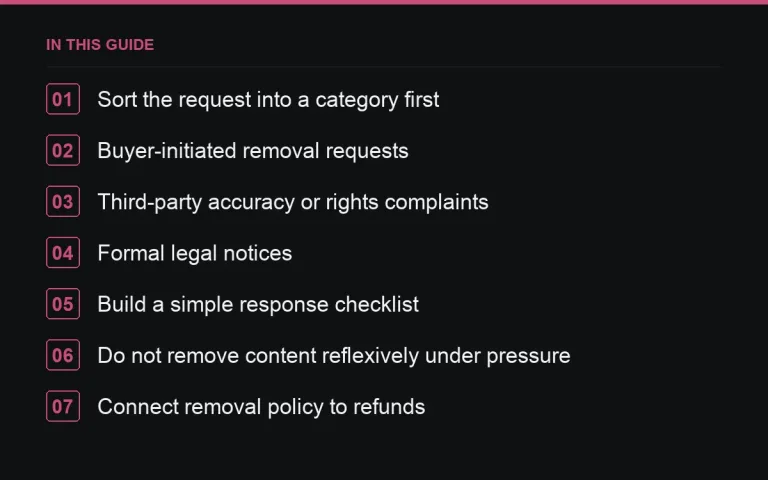
Sort the request into a category first
Before responding, identify what kind of request this is: a buyer-initiated request to remove a paid placement, a third-party complaint about accuracy or rights (see https://successtoroad.com/blog/fact-checking-guest-posts/ and https://successtoroad.com/blog/image-and-copyright-rules/), or a formal legal notice. Each category has a different appropriate speed and process, and treating them identically either wastes time on low-stakes requests or under-responds to genuinely urgent ones.
Buyer-initiated removal requests
If a buyer who purchased a placement through https://successtoroad.com/marketplace/ simply wants it taken down, refer to the terms agreed at order time. Some publishers include removal as a paid service after a certain window, similar to their approach to https://successtoroad.com/blog/handling-link-change-requests/; others do not offer removal at all once a post has been live past a short window, since removing paid content undermines the durability buyers were paying for.
Third-party accuracy or rights complaints
Take these seriously and respond quickly, even if you believe the complaint is unfounded. A fast, professional acknowledgment while you investigate is far better for your site’s reputation than silence or a defensive dismissal. If the complaint has merit — a factual error, an image rights issue — correct or remove the specific problem rather than the whole post where possible.
Formal legal notices
Treat any formal legal notice, such as a takedown request citing specific legal grounds, as requiring prompt attention and, where the matter is not straightforward, your own legal counsel. This guide covers general process, not jurisdiction-specific legal advice — see https://successtoroad.com/blog/legal-basics-for-publishers/ for the boundary between general practice and legal advice you should get from a professional.
Build a simple response checklist
- Acknowledge the request within a set time, even if the resolution takes longer
- Identify which category the request falls into
- Check your original order terms if the post was a paid placement
- Document the request and your response, including dates
- Decide on removal, correction, or decline, and communicate the decision clearly
Do not remove content reflexively under pressure
Not every removal request is legitimate. Some are attempts by competitors or unrelated parties to get content taken down without real grounds. Verify the requester’s relationship to the content before acting, particularly for buyer-initiated requests claiming to represent a company that did not actually place the original order.
Connect removal policy to refunds
A removal request from a paying buyer often raises the separate question of whether any refund is owed. These are related but distinct decisions — see https://successtoroad.com/blog/when-to-refund/ for how to think through the financial side separately from the content decision itself.
Keep your policy visible to buyers upfront
State your removal policy, including any time window and fees, on your https://successtoroad.com/become-a-seller/ page or in your standard order terms. Buyers who understand the policy before ordering are far less likely to escalate a disagreement when a removal request is declined later.
Consider the effect of removal on your site’s own history
Frequent removals, even for legitimate reasons, leave a growing number of dead URLs and broken internal links across your site over time. Track removals the same way you would track any other content change, and periodically check that removed posts are not still linked from elsewhere on your site, tying back into the hygiene practices in https://successtoroad.com/blog/publisher-seo-hygiene-checklist/.
Explain removal outcomes clearly, even when you decline
When you decide not to remove content, explain the specific reason rather than a flat no. Buyers browsing https://successtoroad.com/marketplace/ generally respect a clearly reasoned decline more than they respect an unexplained refusal, and a clear explanation reduces the odds of the disagreement turning into a public dispute or a negative review.
Separate emotional urgency from actual severity
A removal request delivered with strong language or urgency is not automatically more serious than a calmly worded one. Assess the actual substance of the request separately from its tone, and resist the instinct to fast-track a demanding request over a polite one simply because it feels more pressing in the moment.
Review your removal history for patterns worth fixing upstream
If a particular type of content or a particular contributor consistently generates removal requests, that pattern is more useful than any single incident on its own. It often points back to a gap earlier in your process, whether that is insufficiently rigorous fact-checking, a licensing check that is not being enforced consistently, or a topical fit standard that has slipped. Fixing the upstream cause reduces future removal requests far more effectively than handling each one well individually.
Where to go next
Read https://successtoroad.com/blog/when-to-refund/ next for the financial side of these decisions, and https://successtoroad.com/blog/responding-to-reviews/ for handling public feedback that sometimes accompanies a removal dispute.
Frequently asked questions
Should we always remove a post if the buyer who paid for it asks?
Not necessarily. Refer to the terms agreed at order time — some publishers offer removal as a paid service within a window, others do not offer it at all once a post has been live for a while.
How quickly should we respond to a third-party complaint about a guest post?
Acknowledge it quickly, even if full resolution takes longer. A fast, professional response protects your reputation regardless of whether the complaint ultimately has merit.
What should we do if we receive a formal legal notice about a post?
Treat it as requiring prompt attention and, if the matter is not straightforward, consult your own legal counsel rather than relying on general guidance to resolve it.
How do we avoid removing content based on a bad-faith request?
Verify the requester's actual relationship to the content and the original order before acting, particularly when someone claims to represent a company that did not place the placement themselves.
Put it into practice
Filter 54,483 websites by DR, traffic, niche and price, and order with escrow — you pay only after the link is live.
Browse the marketplace