Anchor Text: A Complete Guide to Getting It Right
Everything you need to plan, write and audit anchor text without tripping an algorithmic filter.
Anchor text is the clickable words that carry a link, and it is one of the few link signals a site owner controls directly. Get the mix wrong and you can flag a page as manipulated; get it right and the link reads as something a real editor would have written anyway. This guide walks through the main anchor types, how to blend them, and where the rest of this series goes deeper on individual questions.
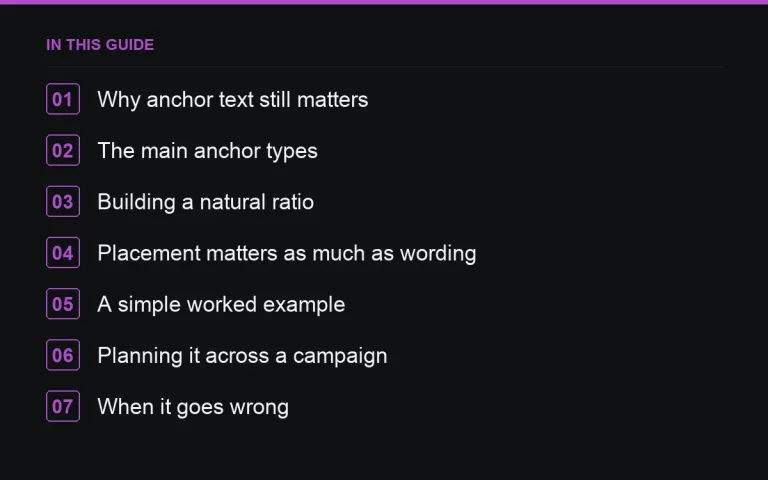
Why anchor text still matters
Search engines use anchor text as one input for understanding what a linked page is about, alongside the linking page’s own content and the site’s overall link profile. A single link rarely moves a ranking. But a pattern of hundreds of links using the same exact-match phrase, built quickly, looks nothing like how people naturally reference a business, a product or an article. That pattern is what gets flagged, not any one link in isolation.
The main anchor types
- Exact match — the anchor is the precise keyword phrase you want to rank for.
- Partial match — the keyword appears alongside other words, e.g. “a guide to project budgeting” instead of “project budgeting software”.
- Branded — your company or product name.
- Naked URL — the raw web address as the visible text.
- Generic — phrases like “this article” or “read more”.
- Contextual/topical — a related term that isn’t your target keyword but sits naturally in the sentence.
See https://successtoroad.com/blog/anchor-text-types/ for a fuller breakdown with examples of each, and https://successtoroad.com/blog/exact-match-anchor-risk/ for how much exact match is too much.
Building a natural ratio
Most healthy link profiles lean heavily on branded and naked-URL anchors, with a smaller share of partial match, an even smaller share of exact match, and a scattering of generic anchors. The exact split depends on your niche and how established the brand already is — https://successtoroad.com/blog/anchor-ratios-by-page-type/ covers how the mix should shift depending on whether you’re linking to a homepage, a blog post or a product page.
Placement matters as much as wording
Two links with identical anchor text can carry different weight depending on where they sit: in the body of an article, in an author bio, in a sidebar widget, or in a footer. Editorial context in the first half of an article tends to read as more genuine than a link buried in a bio line at the bottom. Our companion posts on https://successtoroad.com/blog/link-placement-in-article/ and https://successtoroad.com/blog/contextual-vs-author-bio-links/ go through this in detail.
A simple worked example
| Anchor | Example | Typical share |
|---|---|---|
| Branded | Acme Tools | Largest share |
| Naked URL | acmetools.com | Second largest |
| Partial match | Acme’s budgeting software | Moderate |
| Exact match | budgeting software | Small |
| Generic | this comparison | Small |
Planning it across a campaign
If you’re buying guest posts or link insertions at any volume, decide the anchor for each link before you brief the writer, not after the post is published. A simple tracking sheet — https://successtoroad.com/blog/anchor-planning-spreadsheet/ — keeps the ratio visible as the campaign grows, so you don’t discover three months in that half your links use the same exact-match phrase. It’s also worth periodically running https://successtoroad.com/blog/auditing-anchor-profile/ against your existing backlinks to catch drift.
When it goes wrong
Over-optimised anchor profiles are one of the more common reasons a site plateaus or loses rankings after a period of aggressive link building. The fix is rarely to remove every exact-match link — it’s to dilute the ratio with branded, generic and partial-match links until the profile looks like something that happened organically. https://successtoroad.com/blog/fixing-over-optimised-anchors/ walks through that process step by step.
Working with different budgets
Anchor planning doesn’t need an expensive toolset. A modest link-building budget can still apply every principle here — the discipline is in tracking and proportion, not in spend. A campaign of five links a month benefits from the same natural-ratio thinking as one of fifty a month; the smaller campaign just has less room for error, since each individual link makes up a bigger share of the total. Whatever the pace, decide the anchor before the brief goes out, not after the draft comes back.
How this series is organised
The rest of this series splits the topic into placement questions (where a link sits, how many per post, which page it should point to) and anchor questions (what type of text to use, how to phrase it, how to audit it later). Reading both halves together gives a fuller picture than either alone, since anchor wording and placement location are always working together on the same link.
Where to go next
Start with https://successtoroad.com/blog/anchor-text-types/ if you want the full taxonomy, or jump to https://successtoroad.com/blog/writing-brief-for-anchor-text/ if you’re about to commission a batch of guest posts and need the brief to actually work. If you’re sourcing the placements yourself, browse https://successtoroad.com/marketplace/ for sites in your niche, or filter by https://successtoroad.com/niche/business/ and https://successtoroad.com/niche/technology/ to start narrowing down publishers.
All anchor text and placement guides
- Anchor Text Ratios: How the Mix Should Change by Page Type
- Anchor Text Types Explained, With Examples
- Anchor Text and Internal Links: Why They Should Be Planned Together
- Anchor Text and Link Placement on Mobile Layouts
- Anchor Text for E-Commerce Category Pages
- Anchor Text for Local Business Pages
- Anchor Text for SaaS Feature Pages
- Anchor Text in Non-English Guest Posts and Link Insertions
- Anchor Text in Tables and Lists: What Changes
- Anchor Text: Guest Posts vs Link Insertions
- Branded Anchor Text: The Safest Workhorse in Your Profile
- Building an Anchor Planning Spreadsheet That Actually Gets Used
- Contextual Links vs Author Bio Links: What’s the Difference?
- Dofollow, Nofollow, Sponsored and UGC: What Each Attribute Means for Anchor Text
- Exact-Match Anchor Text: How Much Is Too Much?
- Fixing an Over-Optimised Anchor Text Profile
- How Many Links Should One Guest Post Actually Carry?
- How to Audit Your Anchor Text Profile
- Image Links and Alt Text: The Anchor Text Equivalent for Pictures
- In-Content Links vs Sidebar and Footer Links
- Linking to Multiple Pages From a Single Guest Post
- Linking to a Homepage or a Deep Page: Which Is Right?
- Long-Form vs Short Guest Posts: How Link Strategy Should Differ
- Naked URL Anchors: When the Raw Link Is the Right Choice
- Partial-Match Anchor Text: The Middle Ground That Works
- Should Your Link Be the First One in the Article?
- The Sponsored Tag and What It Means for Marketplace Placements
- Where in the Article Should Your Link Actually Sit?
- Writing a Brief So the Publisher Uses the Right Anchor (and What to Do If They Change It)
Frequently asked questions
Do I need exact-match anchors at all?
No. Many healthy link profiles use very few or none, relying instead on branded, partial-match and naked-URL anchors. Exact match can help but only in small doses relative to your total link count.
How many anchor variations should one keyword have?
There's no fixed number, but rotating through several partial-match phrasings, a branded version and a generic option is safer than repeating one exact phrase across every placement.
Does anchor text matter for nofollow or sponsored links?
It still matters for reader clarity and relevance signals, but the ranking impact is different from a followed link. See {{post:dofollow-nofollow-sponsored-ugc}} for how the link attributes interact with anchor choice.
Should I let publishers choose the anchor?
It's reasonable to give them a short list of acceptable options rather than one fixed phrase — see {{post:writing-brief-for-anchor-text}} for how to brief this without sounding demanding.
Put it into practice
Filter 54,483 websites by DR, traffic, niche and price, and order with escrow — you pay only after the link is live.
Browse the marketplace