Partial-Match Anchor Text: The Middle Ground That Works
Partial match is usually where most of your keyword-carrying links should sit.

Partial-match anchor text includes your target keyword, but embedded in a longer, more natural phrase rather than standing alone. Instead of linking “invoicing software” directly, you might link “a simple invoicing tool for freelancers” or “this guide to invoicing software.” It captures much of the relevance benefit of exact match with a fraction of the risk.
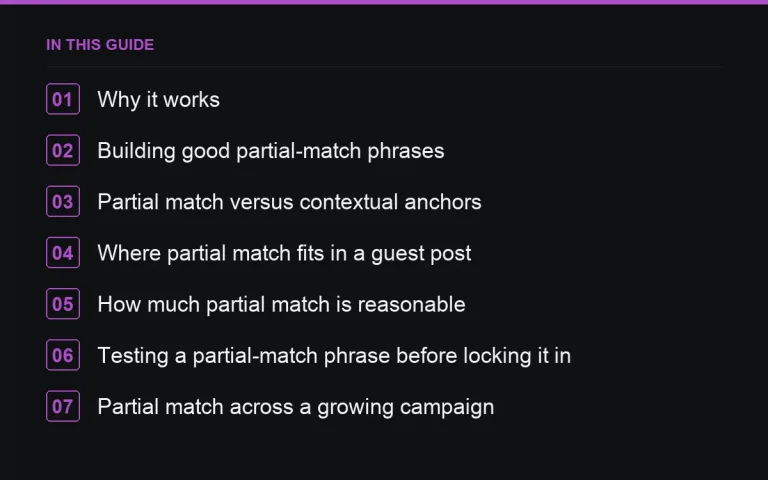
Why it works
Partial match mimics how people genuinely write when referencing something. A blogger recommending a tool doesn’t usually drop the bare keyword phrase as a link — they describe it in their own words, and the keyword happens to appear somewhere in that description. That’s precisely the pattern partial match anchors reproduce, which is why they blend into a natural link profile far more easily than exact match. See https://successtoroad.com/blog/exact-match-anchor-risk/ for the contrast.
Building good partial-match phrases
- Start from how a real reviewer would describe the page, then check the keyword fits naturally.
- Avoid stacking multiple keywords into one anchor — one phrase, one concept.
- Vary the wrapper words across different placements: “a tool for,” “our guide to,” “this option for,” and so on.
- Keep it roughly the length of a short clause, not a full sentence.
Partial match versus contextual anchors
Partial match still contains your actual keyword; a purely contextual anchor might not. Both are useful, and a good campaign uses a mix — partial match where you want some keyword association, contextual where you simply want a natural, on-topic link. https://successtoroad.com/blog/anchor-text-types/ covers where contextual anchors fit into the broader picture.
Where partial match fits in a guest post
Partial-match anchors are usually the safest choice for the primary body link in a guest post — the one placed mid-article where it needs to read as something the writer chose deliberately, not something a client demanded. See https://successtoroad.com/blog/link-placement-in-article/ for where in the piece that link should sit, and https://successtoroad.com/blog/first-link-vs-later-links/ for whether it should be the first link in the article or a later one.
Examples by target keyword
| Target keyword | Exact match | Partial match version |
|---|---|---|
| project management software | project management software | a straightforward project management tool |
| freelance invoicing | freelance invoicing | this option for freelance invoicing |
| small business loans | small business loans | a guide to small business loans |
How much partial match is reasonable
Because partial match is lower risk than exact match, it can reasonably make up a larger share of a link profile — often the second or third largest category behind branded and naked-URL anchors. https://successtoroad.com/blog/anchor-ratios-by-page-type/ has more detail on how this shifts depending on what kind of page you’re linking to.
Testing a partial-match phrase before locking it in
A useful check before finalising a partial-match anchor: read the surrounding sentence out loud. If it sounds like something a person would actually say when recommending a page to a friend, it’s probably a safe, natural anchor. If it sounds like a sentence built specifically to contain a keyword, rework it. This simple test catches most awkward partial-match phrasing before it ever reaches a publisher.
Partial match across a growing campaign
As a campaign accumulates more links to the same destination, keep a running list of partial-match phrasings already used so you’re not repeating the same wrapper words on every new placement. Small variation — “a tool for,” “an option built for,” “a straightforward way to” — keeps the category itself from becoming a repeated pattern, even though no individual anchor is a bare keyword.
Partial match and search intent alignment
A well-built partial-match anchor often mirrors how someone might actually search for the destination page, without being a bare keyword match. This gives it a practical bonus beyond the ranking signal: readers scanning the anchor text get a genuinely useful preview of what they’ll find on the other side of the click, which supports engagement metrics like time on page once they arrive.
Partial match for less commercial content
Not every destination is a product or service page — a link to a blog post or research piece can use partial match just as effectively, often even more naturally, since editorial content is exactly the kind of thing people describe conversationally when recommending it. “A useful breakdown of invoicing rules for freelancers” is a perfectly natural partial-match anchor for a blog post, not just for a commercial landing page.
Revisiting partial-match phrasing during an audit
During a periodic anchor audit, it’s worth checking not just the anchor type distribution but also whether your partial-match phrases have become repetitive across many placements — the same wrapper words used dozens of times start to function almost like an exact-match pattern once you look closely, even though each individual anchor looks fine in isolation.
Where to go next
Read https://successtoroad.com/blog/anchor-text-guide/ for the overall framework, and https://successtoroad.com/blog/anchor-planning-spreadsheet/ for a way to track which partial-match phrasing you’ve used where, so you’re not repeating the exact same wrapper words across every placement. When sourcing guest post opportunities, check https://successtoroad.com/marketplace/ or narrow by https://successtoroad.com/niche/technology/ for relevant publishers.
Frequently asked questions
Is partial match anchor text safe to use often?
Yes, it's one of the safer keyword-carrying anchor types and can reasonably make up a meaningful share of a link profile without raising flags.
How is partial match different from exact match?
Exact match is the bare keyword phrase; partial match wraps that phrase in additional natural words, which is closer to how people actually write links.
Should every guest post use a partial-match anchor?
Not necessarily every one, but it's a reasonable default for the primary body link when you want some keyword relevance without the risk of repeating exact match.
Can partial match anchors still rank a page for the keyword?
They can support relevance for that keyword, though ranking depends on many other factors beyond any single link's anchor text.
Put it into practice
Filter 54,483 websites by DR, traffic, niche and price, and order with escrow — you pay only after the link is live.
Browse the marketplace