Fixing an Over-Optimised Anchor Text Profile
The fix is almost always dilution, not deletion.

An audit that turns up an over-optimised anchor profile — one dominated by exact match, or by the same phrase repeated across dozens of links — can feel like a problem with no clean solution, since you generally can’t force other sites to change or remove links they’ve already published. The good news is that dilution, not removal, is usually the more realistic and effective fix.
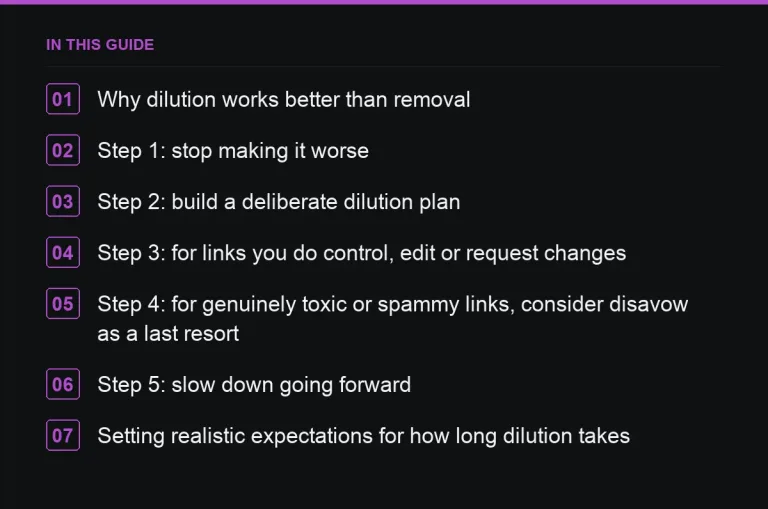
Why dilution works better than removal
You rarely control the sites hosting your existing backlinks, so asking dozens of publishers to change or remove anchor text is slow, unreliable, and sometimes simply impossible if you no longer have any relationship with the site. What you do control is what happens going forward — and adding a larger volume of natural, diverse anchors shifts the overall ratio without needing anyone else’s cooperation.
Step 1: stop making it worse
Before anything else, pause any active campaign that’s still adding to the skewed pattern. Continuing to build more exact-match links while trying to “dilute” the ratio elsewhere is working against yourself.
Step 2: build a deliberate dilution plan
Based on your audit from https://successtoroad.com/blog/auditing-anchor-profile/, calculate roughly how many branded, naked-URL and partial-match links would need to be added to bring the ratio back toward a healthier balance. This doesn’t need to be precise — it needs to meaningfully shift the proportion, not chase an exact target number.
A simplified example
| Current state | Exact match 40%, branded 20%, other 40% |
|---|---|
| Target direction | Reduce exact match share below branded share |
| Action | Add branded, naked-URL and partial-match links over time, without adding more exact match |
Step 3: for links you do control, edit or request changes
For placements on relationships you still maintain — your own guest post network, sites you have an ongoing arrangement with, or your own site’s outbound links to partners — go back and adjust anchor wording where it’s genuinely still editable. This is a smaller lever than new dilution links, but worth using where available.
Step 4: for genuinely toxic or spammy links, consider disavow as a last resort
If part of the over-optimisation comes from clearly low-quality or spammy sites rather than legitimate but overly keyword-heavy ones, a disavow file is a separate, more drastic tool worth researching on its own, rather than treated as the default fix for ordinary over-optimisation.
Step 5: slow down going forward
Over-optimisation often results from moving too fast with too narrow an anchor strategy. Slowing the pace of new link acquisition while diversifying anchor choice tends to be more sustainable than a sudden burst of “corrective” links, which can itself look like an unnatural pattern if it’s too concentrated in time.
Setting realistic expectations for how long dilution takes
Because dilution relies on new links accumulating over time, meaningful ratio improvement is measured in months, not days. Treat this as an ongoing adjustment to future link-building activity rather than a project with a fixed end date, and re-audit periodically using https://successtoroad.com/blog/auditing-anchor-profile/ to check the trend is actually moving in the right direction.
Learning from what caused the skew
It’s worth identifying, honestly, what produced the original over-optimisation — a single aggressive campaign, one vendor pushing the same anchor repeatedly, a lack of tracking — so the same pattern doesn’t simply repeat itself once the immediate ratio issue is corrected.
Communicating the fix internally
If anchor over-optimisation is discovered as part of a larger SEO review, it helps to explain the dilution approach clearly to any stakeholders expecting a faster fix — the plan is a gradual rebalancing over months, not a one-time technical correction, and setting that expectation early avoids pressure to do something more drastic and less effective later.
Working with an existing link-building vendor after a skew is found
If a vendor or agency was responsible for the original over-optimised campaign, share the audit findings with them directly and ask for a revised anchor plan going forward, rather than assuming the same process will naturally self-correct without an explicit change in approach.
Setting a review date for the fix
Pick a specific date, three to six months out, to re-run the audit and check whether the ratio has genuinely moved in the right direction. Without a scheduled check-in, dilution plans have a way of quietly stalling once the immediate concern that prompted them fades from attention.
Realistic outcomes to expect
A well-executed dilution plan typically shows a measurable shift in ratio within a couple of audit cycles, though the exact pace depends on how much new link-building activity is happening alongside the correction. Set expectations with any stakeholders accordingly, rather than promising an immediate turnaround.
Where to go next
Read https://successtoroad.com/blog/anchor-ratios-by-page-type/ for what a healthier target mix looks like by destination, and https://successtoroad.com/blog/anchor-planning-spreadsheet/ to avoid repeating the same drift going forward. Browse https://successtoroad.com/marketplace/ for a range of publishers to help diversify both anchor type and domain source.
Frequently asked questions
Can I ask publishers to remove or change existing anchor text?
You can ask, especially where you have an ongoing relationship, but it's unreliable at scale — dilution with new, natural links is usually more realistic.
Is disavowing links the right fix for over-optimised anchors?
Disavow is generally reserved for genuinely toxic or spammy links, not as a routine fix for legitimate but overly keyword-heavy anchor patterns.
How fast should I add dilution links?
Gradually — a sudden burst of corrective links concentrated in a short time can itself look like an unnatural pattern.
Should I pause all link building while fixing anchor ratio?
Not necessarily pause entirely, but stop adding to the specific anchor type that's already overrepresented while you build out the others.
Put it into practice
Filter 54,483 websites by DR, traffic, niche and price, and order with escrow — you pay only after the link is live.
Browse the marketplace