How to Audit Your Anchor Text Profile
An anchor audit doesn't need special tools — it needs a clear process and an honest read of the results.

An anchor text audit is simply the process of pulling your existing backlinks, categorising every anchor, and checking whether the resulting pattern looks like something that happened naturally or something that was clearly built. It’s worth doing periodically, not just when something has already gone wrong.
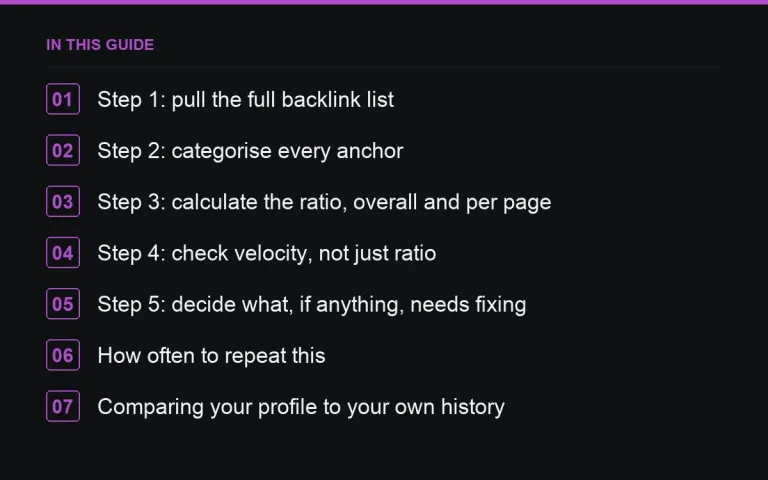
Step 1: pull the full backlink list
Export every known backlink to your domain, including the anchor text used and the destination page. Most backlink monitoring tools can produce this list; if you’ve been tracking placements yourself with https://successtoroad.com/blog/anchor-planning-spreadsheet/, cross-reference the two to catch anything a tool might have missed or misclassified.
Step 2: categorise every anchor
Go through the list and assign each anchor to a type — branded, exact match, partial match, naked URL, generic or contextual — using the definitions in https://successtoroad.com/blog/anchor-text-types/. This is the tedious but essential part; a rough eyeball estimate isn’t reliable enough to catch a genuine skew.
Step 3: calculate the ratio, overall and per page
Look at the aggregate ratio across the whole domain first, then break it down by destination page. A site-wide ratio can look fine while one specific page carries a disproportionate share of exact-match anchors — this is one of the most common things a purely aggregate view misses.
A simple audit scorecard
| Check | Healthy sign | Warning sign |
|---|---|---|
| Largest anchor category | Branded or naked URL | Exact match |
| Exact match share | Small minority | Comparable to or larger than branded |
| Per-page distribution | Spread across many pages | Concentrated on a few pages |
| Anchor wording variety | Many distinct phrasings | Same phrase repeated often |
Step 4: check velocity, not just ratio
A skewed ratio that built up gradually over years reads differently from the same ratio appearing in a three-month burst. If your audit shows a recent spike in a single anchor type, that’s worth investigating even if the overall lifetime ratio still looks reasonable.
Step 5: decide what, if anything, needs fixing
Not every audit finding needs action. A moderate skew on an established site with a long link history is lower priority than the same skew on a newer domain with few other signals to balance it out. If the audit does turn up a genuine problem, https://successtoroad.com/blog/fixing-over-optimised-anchors/ covers the remediation options.
How often to repeat this
Quarterly is a reasonable cadence for an active link-building campaign; twice a year is enough for a slower, more organic profile. The key is doing it on a schedule rather than only after a ranking drop prompts an emergency review.
Comparing your profile to your own history
Beyond a single snapshot, it’s useful to compare the current audit against the previous one, looking specifically at what changed in the interim. A ratio that’s slowly trending toward more exact match over several audits is worth addressing even if the absolute current numbers still look acceptable, since the trend itself is the early warning.
Documenting the audit for future reference
Keep a simple record of each audit’s headline numbers and date, even a few lines, so future audits can be compared against a real trail rather than relying on memory of what last quarter’s numbers looked like.
Involving more than one reviewer
A second person reviewing the categorised anchor list before conclusions are drawn helps catch classification disagreements — one person’s “branded” might be another’s “partial match” for a borderline phrase — and produces a more reliable overall picture than a single reviewer’s judgment alone, particularly for a larger link profile.
Benchmarking against industry norms loosely
While there’s no universal safe percentage, it can be informative to look at the general anchor patterns of a handful of well-established, clearly non-manipulated sites in your space as a loose sanity check, understanding that their specific numbers aren’t a target to hit exactly, just a rough sense of what naturally-built profiles in your niche tend to look like.
What to do if the audit is inconclusive
Not every audit produces a clear verdict. If the numbers are ambiguous — no single category obviously dominant, no clear recent spike — it’s reasonable to conclude the profile is currently healthy and simply schedule the next audit as planned, rather than searching for a problem that isn’t clearly there.
Keeping the audit proportionate to campaign size
A small site with a handful of backlinks doesn’t need an elaborate audit process — a simple manual review is enough. Reserve more formal tooling and process for larger profiles where manual review alone would be impractical to keep current.
Sharing audit results with a wider team
A short summary of each audit’s key findings, shared with whoever commissions future placements, keeps the whole team working from the same understanding of the current ratio rather than each person relying on their own impression of how the profile looks.
Where to go next
Read https://successtoroad.com/blog/anchor-text-guide/ for the ratio principles this audit checks against, and https://successtoroad.com/blog/anchor-planning-spreadsheet/ to make future audits faster by tracking anchors as you go rather than reconstructing them after the fact. Browse https://successtoroad.com/marketplace/ to plan corrective placements if the audit points that way.
Frequently asked questions
How often should I audit my anchor text profile?
Quarterly for an active link-building campaign is reasonable; twice a year is usually enough for a slower-moving, more organic profile.
Should I look at anchor ratio site-wide or per page?
Both — a healthy site-wide ratio can hide a badly skewed individual page, so check per-destination distribution as well as the aggregate.
Does a skewed ratio always need fixing?
Not always — an established site with a long, varied link history can absorb more skew than a newer domain with few other balancing signals.
What's the most common mistake in a manual anchor audit?
Eyeballing the list instead of formally categorising every anchor by type, which usually understates how concentrated the pattern actually is.
Put it into practice
Filter 54,483 websites by DR, traffic, niche and price, and order with escrow — you pay only after the link is live.
Browse the marketplace