Exact-Match Anchor Text: How Much Is Too Much?
Exact match isn't banned, but leaning on it too hard is the fastest way to make a link profile look built rather than earned.

Exact-match anchor text — using your target keyword phrase word for word as the link text — is the most direct anchor signal you can send, and also the one most closely associated with manipulated link profiles. This isn’t because the anchor itself is bad; it’s because heavy, repeated use of it across many links is a pattern almost no natural link profile produces on its own.
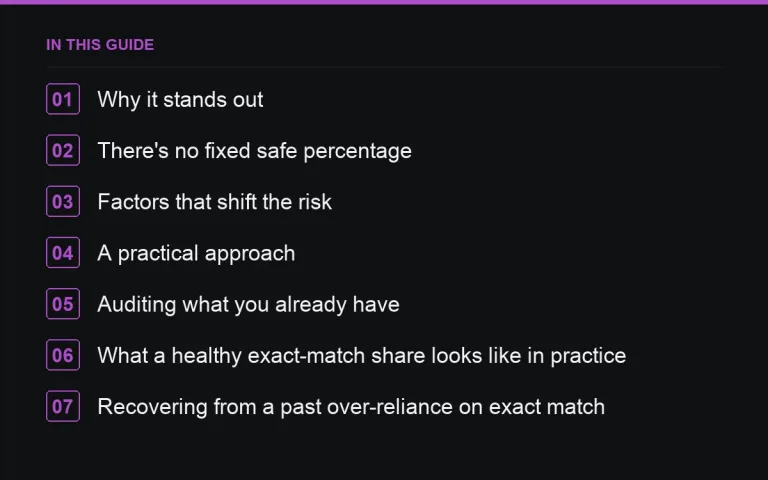
Why it stands out
Think about how people actually link to things. A journalist mentions a company by name. A blogger links to “this tool” or the raw URL. Almost nobody, writing naturally, repeatedly links to the same page using its exact target keyword phrase — because that’s not how anyone talks. When a large share of a site’s backlinks all use one exact phrase, it reads as constructed rather than earned, and that pattern is exactly what link-spam filters are built to catch.
There’s no fixed safe percentage
Anyone quoting a precise number here is guessing — there is no published, verifiable threshold. What matters more than a number is proportion relative to your other anchor types: if exact match is your single largest anchor category by a wide margin, that’s the warning sign, regardless of the exact figure. A profile dominated by branded and naked-URL anchors, with exact match as a minority, reads very differently to one where exact match leads.
Factors that shift the risk
- Brand maturity — an established brand with years of natural mentions can absorb more exact match than a brand new site whose link profile is almost entirely link-building activity.
- Velocity — a burst of exact-match links appearing in a short window is riskier than the same links accumulating over a year.
- Diversity of domains — the same exact-match anchor from many unrelated, low-relevance sites looks worse than it appearing occasionally on topically related ones.
- Placement quality — exact match sitting naturally mid-article reads better than the same anchor stuffed into a footer link or sidebar widget. See https://successtoroad.com/blog/in-content-vs-sidebar-footer/.
A practical approach
Rather than chasing a magic ratio, treat exact match as a garnish, not the main course. Default new links to branded, partial-match, or naked-URL anchors, and reserve exact match for a minority of placements — ideally ones on genuinely relevant, well-established sites where the link would plausibly exist anyway. https://successtoroad.com/blog/anchor-ratios-by-page-type/ has more detail on how this shifts by destination page type.
Auditing what you already have
If you’ve been building links for a while without tracking anchor text carefully, the first step is an audit, not a rewrite. Pull your backlink list, categorise every anchor, and see where the weight actually sits before deciding anything needs to change. https://successtoroad.com/blog/auditing-anchor-profile/ covers the process, and https://successtoroad.com/blog/fixing-over-optimised-anchors/ covers what to do if the audit turns up a problem.
A simple risk snapshot
| Exact match share of total links | General read |
|---|---|
| Small minority | Low risk, looks incidental |
| Roughly even with branded | Worth monitoring |
| Clearly the largest category | High risk, worth diluting |
What a healthy exact-match share looks like in practice
Picture a site with fifty backlinks: thirty branded or naked URL, twelve partial match, five contextual or generic, and three exact match. That’s a profile where exact match is present but clearly a minority, sitting comfortably behind every other category. Compare that with a site where twenty-five of fifty links are the same exact phrase — even though the raw exact-match count only grew slightly relative to the first example, the proportion has shifted dramatically, and that shift is what tends to draw scrutiny.
Recovering from a past over-reliance on exact match
If your current link profile already leans too heavily on exact match, resist the urge to solve it with a single dramatic action. The steadier route is to stop adding to that category and let new branded, partial-match and naked-URL links accumulate around it over the following months, which gradually normalises the ratio. https://successtoroad.com/blog/fixing-over-optimised-anchors/ covers this process in full.
How this compares across common niches
Highly competitive commercial niches — finance, legal, insurance — tend to see more aggressive historical use of exact-match anchor text, simply because competition for a handful of valuable keywords has been intense for a long time. If you’re operating in one of these spaces, it’s worth being even more conservative with exact match than the general guidance here suggests, since your competitors’ link profiles are more likely to already be under scrutiny.
A note on branded keyword hybrids
An anchor combining your brand with a keyword — “Acme project management software” — sits in an interesting middle ground: it’s not pure exact match, but it’s more commercial than a simple branded mention. Treat these hybrids as closer to partial match in terms of how heavily you can safely use them, rather than assuming the branded component alone makes them fully safe.
What a sudden ranking change might (and might not) indicate
A drop in rankings after a burst of exact-match link building is a reasonable prompt to review anchor ratio, but it’s not the only possible cause, and jumping straight to a disavow or link removal campaign without first confirming the actual pattern through an audit can do more harm than good. See https://successtoroad.com/blog/auditing-anchor-profile/ before assuming anchor text is the culprit.
Where to go next
Read https://successtoroad.com/blog/anchor-text-guide/ for the full picture and https://successtoroad.com/blog/branded-anchors/ for the anchor type that should usually carry the largest share instead. When sourcing new placements, use https://successtoroad.com/marketplace/ and filter by relevance rather than chasing the cheapest exact-match opportunity, and consider https://successtoroad.com/niche/technology/ or https://successtoroad.com/niche/business/ if that’s your space.
Frequently asked questions
Is exact-match anchor text against Google's guidelines?
It isn't banned outright, but excessive, unnatural use of it is treated as a manipulative link pattern rather than a normal editorial choice.
Should new sites avoid exact match entirely?
Not entirely, but new sites have less natural link history to absorb it, so leaning more heavily on branded and partial-match anchors early on is the safer default.
How do I know if my exact-match share is too high?
Compare it against your branded and naked-URL share. If exact match is your single biggest category, that's usually a sign to dilute it rather than add more.
Can I fix an over-optimised profile by removing links?
Sometimes, but adding diverse, natural-looking anchors is often more effective than trying to remove existing links, which isn't always possible. See {{post:fixing-over-optimised-anchors}}.
Put it into practice
Filter 54,483 websites by DR, traffic, niche and price, and order with escrow — you pay only after the link is live.
Browse the marketplace