Branded Anchor Text: The Safest Workhorse in Your Profile
Branded anchors mirror how people actually talk about a business, which is exactly why they carry the least risk.
Branded anchor text uses your company or product name as the clickable link — “Acme,” “Acme Analytics,” or a close variant. It’s the least glamorous anchor type to plan around, and also the one that should usually make up the largest share of any healthy link profile.
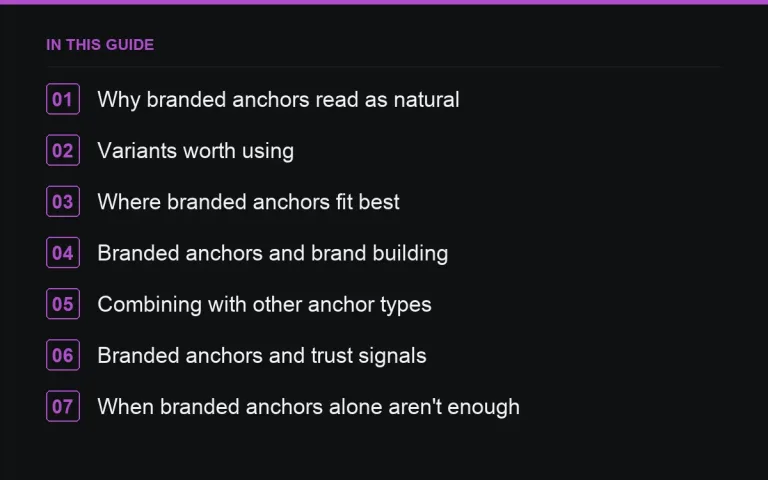
Why branded anchors read as natural
When a journalist, blogger or reviewer mentions a company, they almost always use its name. That’s simply how people write about businesses in the real world, which means a link profile heavy in branded anchors matches what an unmanipulated profile actually looks like. It’s the opposite of exact-match anchor text, which almost nobody produces by accident.
Variants worth using
- The full company name: “Acme Analytics”
- A shortened version: “Acme”
- Company plus category: “the Acme dashboard” or “Acme’s reporting tool”
- Founder or product name where relevant: “the Acme app”
Rotating between two or three of these across a campaign avoids the same trap as exact match — even a branded anchor, repeated identically hundreds of times, can look slightly mechanical, though the risk is far lower than with keyword anchors.
Where branded anchors fit best
Branded anchors work anywhere, but they’re the obvious default for author bios, “About the author” mentions, and any place a link is clearly attached to who is writing rather than what the article is about. See https://successtoroad.com/blog/contextual-vs-author-bio-links/ for how bio placements differ from in-content links. They’re also the natural anchor for homepage links — see https://successtoroad.com/blog/homepage-vs-deep-page-links/ — since a homepage rarely needs a keyword-stuffed anchor to make sense contextually.
Branded anchors and brand building
Beyond the SEO angle, a branded anchor is doing double duty: it reinforces brand recall for anyone scanning the article, even those who never click. That’s a real, if unmeasurable, benefit that a generic “click here” anchor doesn’t offer, and it’s part of why digital PR campaigns often favour branded mentions even when the primary goal is coverage rather than links.
Combining with other anchor types
A single guest post can carry a branded anchor in the bio and a partial-match or contextual anchor in the body — that combination often looks more natural than two branded links or two keyword links in the same piece. https://successtoroad.com/blog/links-per-guest-post-placement/ covers how many total links is reasonable per placement, and https://successtoroad.com/blog/linking-multiple-pages-one-post/ covers what to do when you want to send links to more than one destination from a single article.
A simple allocation example
| Placement | Suggested anchor |
|---|---|
| Author bio | Branded |
| First body link | Partial match or contextual |
| Second body link (if any) | Branded or naked URL |
Branded anchors and trust signals
A branded anchor also does quiet work for trust: a reader who sees a company name mentioned and linked across several unrelated, credible sites over time forms an impression of that company as established, even without consciously registering the mechanism. This halo effect is one of the underappreciated benefits of a link-building strategy that leans on branded mentions rather than chasing keyword anchors exclusively.
When branded anchors alone aren’t enough
A profile built entirely from branded anchors, with no partial match or contextual variety at all, can look slightly one-dimensional too, even though the individual risk of any one branded link is very low. The goal isn’t a profile of nothing but branded anchors — it’s one where branded forms the largest slice of a genuinely varied pie, alongside the other types covered in https://successtoroad.com/blog/anchor-text-types/.
Branded anchors during a rebrand
If a company changes its name, existing branded anchors using the old name don’t need to be treated as a liability — they remain a historical record of how the business was previously known, and search engines generally handle name changes reasonably well over time as new branded mentions accumulate under the current name. Avoid the temptation to request mass edits to old branded anchors; it’s rarely worth the effort compared to building new mentions going forward.
Branded anchors in translated content
When a guest post is published in another language, the brand name usually stays in its original form rather than being translated, which keeps the branded anchor consistent and recognisable across markets. See https://successtoroad.com/blog/anchors-non-english-placements/ for the broader set of considerations that apply once translation enters the picture.
Measuring the effect of branded mentions over time
Because branded anchors support recognition as much as ranking, it’s worth occasionally checking branded search volume or direct traffic alongside your link-building reports, rather than judging a branded-heavy campaign purely by its keyword-ranking impact, which was never really the point of that anchor type in the first place.
Branded anchors in press releases and syndicated content
Press releases distributed through wire services often get republished verbatim across many sites, which can produce a cluster of identical branded anchors appearing simultaneously across unrelated domains. This is generally understood as a distinct, lower-weight pattern rather than treated the same as a series of individually written editorial mentions, so it’s worth not over-relying on syndicated coverage as your main source of branded anchor diversity.
Where to go next
Pair this with https://successtoroad.com/blog/naked-url-anchors/ for the other low-risk anchor type, and https://successtoroad.com/blog/anchor-text-guide/ for how it all fits together. When you’re planning the placements themselves, browse https://successtoroad.com/marketplace/ or check https://successtoroad.com/niche/business/ publishers for relevant bio-link opportunities.
Frequently asked questions
Should branded anchors always link to the homepage?
No — a branded anchor can link to any page; it simply describes who is linking, not what the destination page is about, so it works for deep pages too.
Is it a problem if my branded anchor share is very high?
Not usually. A dominant branded share is what most natural link profiles look like, especially for established companies with existing media coverage.
Can branded anchor text include a slogan?
It can, but keep it close to how your brand is actually referred to elsewhere online, rather than inventing a phrase specifically for link building.
Do branded anchors help with anything other than SEO?
Yes — they reinforce brand recognition for readers who see the mention but don't click, which is a genuine benefit of digital PR beyond the link itself.
Put it into practice
Filter 54,483 websites by DR, traffic, niche and price, and order with escrow — you pay only after the link is live.
Browse the marketplace