Linking to Multiple Pages From a Single Guest Post
It can work, but only when the article's structure actually supports more than one destination.
Most guest post advice defaults to “one link, one destination,” and that’s the right starting point. But some articles genuinely cover enough ground to justify linking to more than one of your pages — a comparison piece, a longer guide, or a post that naturally touches on two related products. Here’s how to do that without it reading as a link dump.
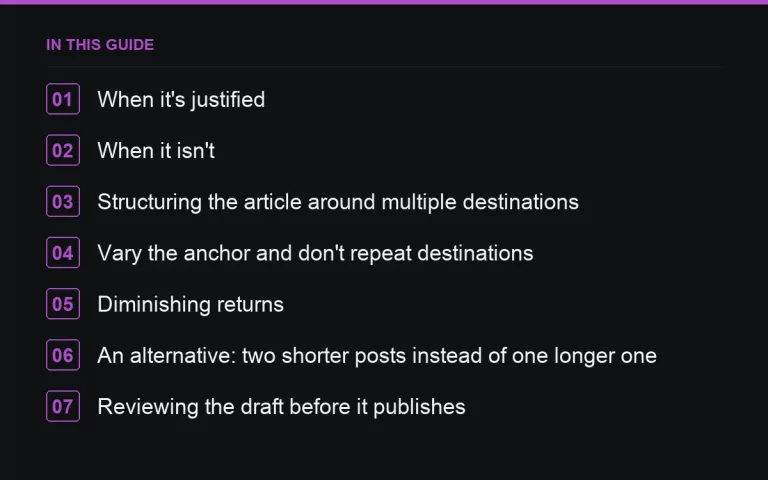
When it’s justified
- The article is long enough to have multiple distinct sections, each of which naturally supports a different link (see https://successtoroad.com/blog/links-per-guest-post-placement/ for length guidance).
- The pages you’re linking to are genuinely different in purpose — a feature page and a pricing page, or two different product categories — not the same page linked twice with different anchors.
- The publisher’s own editorial style already supports multiple outbound links in comparable articles they’ve published.
When it isn’t
If the extra links exist purely because you have several pages you’d like to promote, and the article’s structure doesn’t actually change topic to support each one, that’s a sign to split the campaign across separate posts instead of stuffing one piece. A reader (and anyone assessing the page) can tell the difference between an article that organically discusses two things and one that’s been retrofitted to justify two links.
Structuring the article around multiple destinations
If a second link genuinely fits, give it its own section or sub-heading rather than placing both links in the same paragraph. A guide comparing two approaches, with a natural link to each relevant page under its own subheading, reads as considered; two links crammed into one paragraph reads as opportunistic. See https://successtoroad.com/blog/link-placement-in-article/ for placement mechanics.
A reasonable structure example
| Section | Link destination |
|---|---|
| Intro / problem framing | No link |
| Section on approach A | Link to relevant page A |
| Section on approach B | Link to relevant page B |
| Author bio | Branded link to homepage (optional) |
Vary the anchor and don’t repeat destinations
If you do send two links from one post, make sure they go to genuinely different pages with distinct anchors — two links to the same page with slightly different wording just looks like an attempt to double the value of one placement, and rarely fools anyone reviewing the piece. See https://successtoroad.com/blog/anchor-text-types/ for a refresher on varying anchor choice.
Diminishing returns
Even when justified, going beyond two or three total outbound links (excluding bio) on a single article is rarely worth it — you’re better off saving the third destination for a separate placement on a different publisher, which also helps diversify your link profile across more domains rather than concentrating value in one.
An alternative: two shorter posts instead of one longer one
When you’re tempted to link two destinations from a single article, consider whether splitting the idea into two shorter, separately published guest posts on two different sites might serve both goals better — one link per post, on two different domains, rather than two links crammed into one. This also diversifies the publishers in your backlink profile, which is generally a healthier outcome than concentrating value in a single site.
Reviewing the draft before it publishes
Whichever structure you choose, review the draft specifically for whether each link’s surrounding section earns its place, not just whether the link count matches your brief. A structurally sound article with two well-supported links beats a padded one with two links stapled onto unrelated paragraphs.
Sequencing links across two separate posts instead
An alternative to squeezing two destinations into one article is publishing them a few weeks apart on different sites, each with its own single, well-supported link. This spreads your link-building activity over more time and more domains, which tends to look more like how links accumulate naturally than two destinations landing simultaneously from the same piece.
Keeping the reader’s experience in mind
Beyond the SEO considerations, think about the actual reading experience: does the article genuinely help a reader by covering two related topics, or does it feel like two separate ideas awkwardly stitched together to justify two links? If it reads well as a single coherent piece to someone with no interest in the links at all, that’s a good sign the structure is justified.
Multiple links to the same site, different pages
If both links are pointing to different pages on your own site, from the reader’s perspective that’s still just one recommendation of your brand overall, described in more depth — which is a reasonable, low-risk pattern compared with a post linking out to two unrelated third-party sites for unrelated reasons.
When a single strong destination is genuinely enough
If one page on your site is clearly the most important beneficiary of a given placement, it’s often better to give that single destination the full weight of the article rather than splitting attention and diluting both the content quality and the anchor relevance across two less-developed sections.
Where to go next
Read https://successtoroad.com/blog/homepage-vs-deep-page-links/ for how to choose the right destination for each link, and https://successtoroad.com/blog/anchor-planning-spreadsheet/ for tracking multiple destinations across a campaign. Browse https://successtoroad.com/marketplace/ for publishers whose long-form content naturally supports this kind of structure.
Frequently asked questions
Is it ever okay to link to two different pages from one guest post?
Yes, when the article genuinely has distinct sections that separately support each destination — it should never feel like two links squeezed into one paragraph.
Should the two links use similar anchor text?
No, vary both the anchor and make sure the destinations are meaningfully different pages, not the same page with two different anchor phrasings.
Is there a limit even when it's justified?
Two or three total outbound links, bio aside, is a reasonable ceiling — beyond that it's usually better to split across separate placements.
What if the publisher's site doesn't normally allow multiple links?
Follow their standard, and don't push for an exception just because your article happens to touch on two topics — one link per post is always a safe default.
Put it into practice
Filter 54,483 websites by DR, traffic, niche and price, and order with escrow — you pay only after the link is live.
Browse the marketplace