Anchor Text for SaaS Feature Pages
A feature page lives or dies on relevant links from content that genuinely discusses the problem it solves.
SaaS companies often have dozens of individual feature pages — one for reporting, one for integrations, one for automation — each targeting a fairly specific use case. These pages benefit enormously from well-targeted backlinks, but they need a different anchor approach than a homepage or a general blog post.
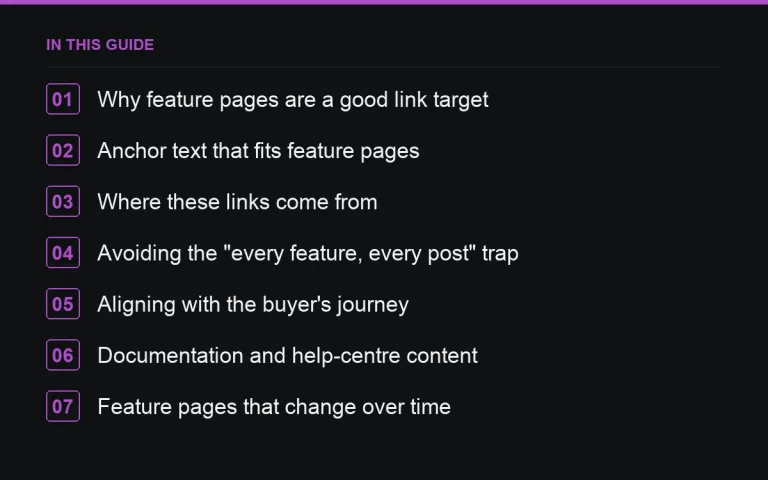
Why feature pages are a good link target
Feature pages rarely attract natural links on their own; press coverage and general mentions tend to point at the homepage or the product as a whole, not one specific feature buried a few clicks deep. That makes deliberate link building to feature pages genuinely useful, since it’s filling a gap that organic mentions usually don’t reach — a point covered more generally in https://successtoroad.com/blog/homepage-vs-deep-page-links/.
Anchor text that fits feature pages
- Descriptive partial match: “their reporting dashboard” or “automated invoice reminders” — describes the feature without repeating a bare keyword.
- Branded plus feature: “Acme’s automation tools” — combines brand recognition with topical relevance.
- Problem-oriented contextual anchors: linking a phrase about the underlying problem (“cutting down manual data entry”) rather than the feature’s marketing name, which often matches how a reviewer would actually describe it.
Bare exact-match feature names (“automated invoice reminders” used identically across every placement) should stay a minority, following the same logic as https://successtoroad.com/blog/exact-match-anchor-risk/.
Where these links come from
Comparison articles, “best tools for X” round-ups, and how-to guides that reference a specific capability are the most natural sources for feature-page links, since they’re already discussing the exact problem the feature solves. This is a better fit than a generic company-focused guest post trying to work in a feature mention that doesn’t match the article’s actual angle.
Feature page anchor examples
| Feature | Reasonable anchor |
|---|---|
| Reporting dashboard | a customisable reporting dashboard |
| Integrations | Acme’s integration options |
| Automation | tools that automate repetitive tasks |
Avoiding the “every feature, every post” trap
It’s tempting to try to link every feature page from every guest post, but a single article should support one, occasionally two, genuinely relevant feature links — not a checklist of every product capability squeezed into unrelated paragraphs. See https://successtoroad.com/blog/links-per-guest-post-placement/ for the underlying reasoning.
Aligning with the buyer’s journey
Feature pages often serve readers already fairly far along in evaluating a solution, which means the content linking to them — comparison guides, in-depth reviews — tends to be more specialised than general top-of-funnel content. Seek out publishers who write genuinely for that more informed audience, often within https://successtoroad.com/niche/software-development/ or https://successtoroad.com/niche/technology/ listings in https://successtoroad.com/marketplace/.
Documentation and help-centre content
SaaS companies often maintain public documentation or a help centre alongside marketing feature pages, and these can also be worthwhile link destinations from more technical guest content — a developer-focused guest post, for instance, might reasonably link to an API documentation page rather than the marketing feature page, using a more technical, precise anchor.
Feature pages that change over time
SaaS features get renamed, merged or retired more often than a typical e-commerce category. Keep a note of which anchor text and destination pairs are currently accurate, and revisit older placements periodically — a backlink using a feature name that no longer exists on your site is a small but avoidable form of link rot.
Pricing pages as a distinct case
Pricing pages are a special category of “feature” page in SaaS: they’re commercially important but rarely the natural subject of independent editorial content, since few writers organically discuss a competitor’s or partner’s pricing structure in detail. Links here more often come from comparison articles specifically built to evaluate cost, and the anchor should reflect that comparative framing rather than pretending it’s a general feature mention.
Free trial and sign-up pages
Similarly, a free-trial or sign-up page is a conversion-focused destination rather than an explanatory one, and anchor text pointing there tends to look more natural coming from a call-to-action style mention (“start a free trial”) than from a purely descriptive phrase that would suit an explanatory feature page instead.
Coordinating feature-page links with your product marketing calendar
If a feature is being actively promoted through a launch or marketing push, that’s often a good moment to also seek relevant backlinks to its page, since fresh press and content coverage genuinely exists to discuss it at that time, producing more natural link opportunities than trying to manufacture interest in an older, unchanged feature.
Integration and partner pages
Pages listing third-party integrations are another SaaS-specific page type worth linking to from content that discusses connecting tools together, using an anchor that names the integration or workflow rather than a generic feature description that doesn’t reflect what the page actually covers.
Reviews platforms and local anchor text
Mentions on review platforms typically use the business name as the anchor by default, which is a convenient, naturally branded pattern worth encouraging when you have any influence over how a listing or citation is phrased.
Where to go next
Read https://successtoroad.com/blog/anchor-ratios-by-page-type/ for how this compares with other destination types, and https://successtoroad.com/blog/writing-brief-for-anchor-text/ for briefing a writer on a specific feature without over-explaining the product to them.
Frequently asked questions
Do feature pages need different anchors than the homepage?
Yes — feature pages benefit from descriptive, problem-oriented anchors that reflect the specific capability, rather than the branded or naked-URL anchors that suit a homepage.
What kind of content is the best source for feature-page links?
Comparison articles and how-to guides that already discuss the specific problem the feature solves are a much better fit than a generic company-focused guest post.
Should I try to link every feature page from every post?
No — one or two genuinely relevant feature links per article is more credible than trying to force in every capability regardless of fit.
Can a feature page use the same anchor as the homepage?
Generally no, since a feature-specific anchor helps establish the page's own relevance distinct from the general brand mentions that suit the homepage.
Put it into practice
Filter 54,483 websites by DR, traffic, niche and price, and order with escrow — you pay only after the link is live.
Browse the marketplace