Anchor Text for E-Commerce Category Pages
Category pages are some of the hardest pages to link to naturally, and also some of the most valuable to get right.
E-commerce category pages — “running shoes,” “office chairs,” “organic skincare” — are commercially important but awkward to link to naturally. They’re too broad for a single specific product mention, but too narrow for a pure branded anchor to always feel complete. Getting the anchor mix right here matters more than it might seem, given how much revenue these pages often drive.
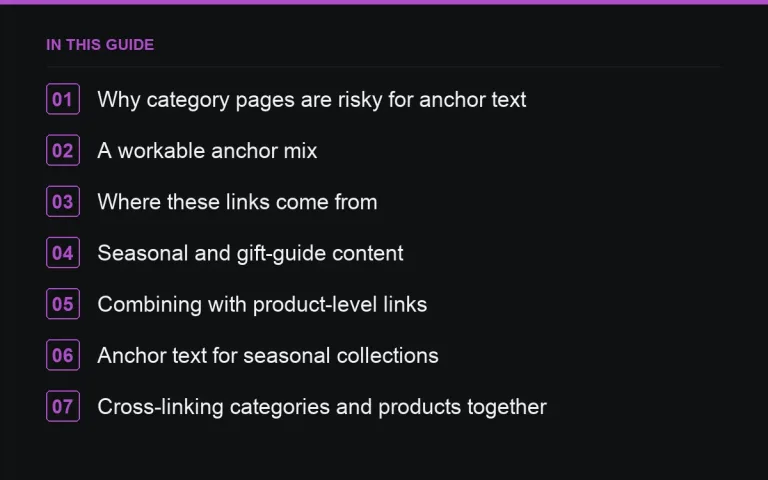
Why category pages are risky for anchor text
A category page usually targets a fairly commercial, competitive keyword phrase — exactly the kind of term someone might be tempted to use as an exact-match anchor repeatedly. But almost nobody writing a genuine article links to a category page using its literal target keyword; they describe it — “their range of running shoes,” “the site’s home office collection.” That gap between natural writing and the keyword you want is exactly where over-optimisation risk shows up.
A workable anchor mix
- Branded plus category: “Acme’s running shoe range” — reads naturally and still carries relevant context.
- Partial match: “a solid range of running shoes for beginners” — natural phrasing that includes the target term.
- Naked URL or branded alone: for citation-style mentions, particularly in comparison or “best of” content.
- Contextual: linking a related but non-identical phrase, such as “footwear built for long distances,” to the category page.
Exact match — the bare category term with no wrapper — should stay a small minority here, following the same logic as https://successtoroad.com/blog/exact-match-anchor-risk/.
Where these links come from
Category pages are natural destinations for “best of” round-ups, gift guides, buying guides and comparison content on relevant blogs and niche publishers — the kind of content that would genuinely reference a retailer’s range as part of a broader recommendation. Seek out publishers already writing in this style rather than commissioning generic guest posts and forcing a category link into them.
Anchor examples for a “running shoes” category page
| Anchor type | Example |
|---|---|
| Branded + category | Acme’s running shoe collection |
| Partial match | a well-reviewed range of running shoes |
| Contextual | footwear designed for daily training |
| Naked URL | acmestore.com/running-shoes |
Seasonal and gift-guide content
Gift guides and seasonal buying guides are a particularly natural home for category-page links, since that content type already exists to recommend a range of products rather than one specific item — the link fits the article’s actual purpose rather than being forced in.
Combining with product-level links
A broader e-commerce link-building plan usually mixes category-page links (from broad recommendation content) with individual product-page links (from more specific reviews) rather than sending every placement to the same category page. This mirrors the destination-matching logic in https://successtoroad.com/blog/homepage-vs-deep-page-links/.
Anchor text for seasonal collections
Seasonal or limited-time collection pages (holiday gift sets, summer collections) present a slightly different case, since the page itself may not exist year-round. Anchors here can lean more descriptive and time-bound — “their holiday gift range” — which also naturally avoids the exact-match risk since that phrasing wouldn’t make sense to repeat outside the season anyway.
Cross-linking categories and products together
A single well-structured guest post discussing a broader shopping topic can sometimes reasonably support one category-page link and, separately, one specific product mention, provided the article genuinely covers both at a natural length — see https://successtoroad.com/blog/linking-multiple-pages-one-post/ for how to structure that without it reading as a link dump.
Anchor text for out-of-stock or seasonal-gap periods
If a category page temporarily has limited stock or sits between seasons, consider whether a link built around very specific, time-bound language will still make sense to a reader arriving months later. A slightly more general branded-plus-category anchor tends to age better than one referencing a specific, temporary state of the page.
International and multi-currency category pages
E-commerce sites operating in multiple countries or currencies sometimes maintain separate category pages per region. Be specific about which regional version you want linked when briefing a publisher, and consider whether the anchor should include any regional qualifier if the content is aimed at readers in that specific market.
Category pages and internal linking support
A category page that already receives strong internal linking from your own product pages and navigation is generally a better candidate for external link-building investment than one that’s internally isolated, since the internal structure helps external link equity flow further across the site. See https://successtoroad.com/blog/anchor-text-internal-links-together/ for this broader point.
New arrivals and frequently changing inventory
Category pages with fast-changing inventory can still be linked confidently using branded-plus-category anchors, since that phrasing describes the ongoing category rather than any specific, temporary set of items, keeping the link relevant even as the actual products on the page change over time.
Onboarding and setup pages
Pages walking new users through initial setup are another reasonable link target from tutorial-style guest content, using an anchor that reflects the practical outcome — “getting started with automated reporting” — rather than the internal product name for that onboarding flow.
Where to go next
Read https://successtoroad.com/blog/anchor-ratios-by-page-type/ for how this fits the broader destination framework, and https://successtoroad.com/blog/linking-multiple-pages-one-post/ if you want to link to both a category page and a specific product from the same article. Browse https://successtoroad.com/marketplace/ or filter by https://successtoroad.com/niche/e-commerce/ for relevant publishers.
Frequently asked questions
Should category page anchors use the exact keyword phrase?
Rarely as the majority approach — branded-plus-category or partial-match phrasing reads far more naturally and carries less risk.
What kind of content naturally links to category pages?
Gift guides, seasonal buying guides, and broader product round-ups are a natural fit, since they already exist to recommend a range rather than one item.
Should every e-commerce link go to a category page?
No, mixing category-page links with individual product-page links, matched to what each article is actually reviewing, is a more balanced approach.
Is a naked URL a good anchor for a category page?
Yes, particularly in citation-style content like a comparison article or resource list, where a plain address anchor is an expected convention.
Put it into practice
Filter 54,483 websites by DR, traffic, niche and price, and order with escrow — you pay only after the link is live.
Browse the marketplace