How Much Does Link Building Cost? A Realistic Breakdown
What actually drives the price of a backlink, and how to think about your budget instead of chasing a single number.
Ask ten SEOs what a link costs and you will get ten different answers, and all of them can be correct at the same time. Link building pricing is not a single number; it is a range shaped by the authority of the site, the traffic it gets, the niche it covers, the format of the placement, and how much work goes into the content around it. This post walks through the real drivers of cost so you can set a sensible budget instead of anchoring on a figure someone quoted you once.
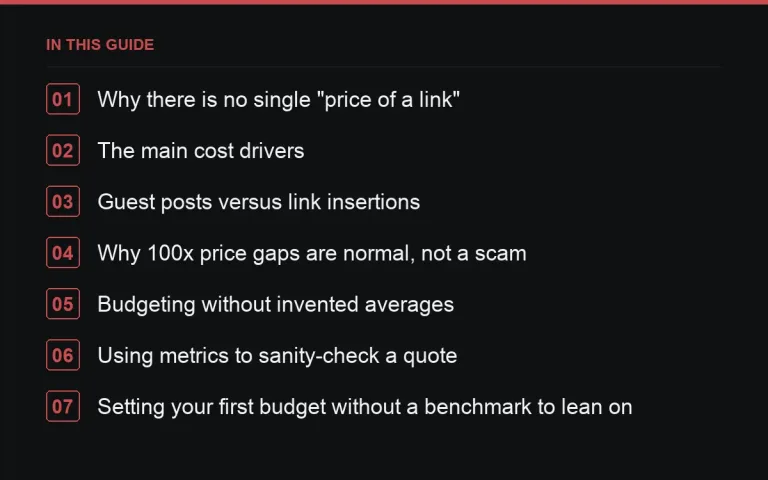
Why there is no single “price of a link”
A link is not a commodity like a barrel of oil. Two sites with similar domain authority scores can have wildly different traffic, editorial standards, and audience relevance, and that alone changes what a fair price looks like. A publisher with genuine organic traffic in a competitive niche can reasonably charge more than a site with a high authority score but almost no real visitors, because the first is selling exposure and trust, not just a link. When you compare quotes, compare the underlying site quality, not just the sticker price.
The main cost drivers
- Authority and traffic — sites with real, growing organic traffic and referring domains from reputable sources typically price higher than low-traffic lookalikes.
- Niche relevance — a placement on a site that closely matches your industry is usually worth paying a premium for, because it is both more useful for SEO and more likely to send referral clicks.
- Placement type — a brand-new guest post costs more than a link inserted into existing content, because it includes writing, editing, and often a permanent content asset.
- Editorial strictness — publishers who reject low-quality pitches, edit content carefully, and limit the number of outbound links per page tend to charge more than sites that will publish almost anything.
- Country and language — market size and typical living costs in the publisher’s country affect price, independent of the site’s metrics.
Guest posts versus link insertions
Guest posts, where you supply or commission a full article, generally cost more than link insertions, where an existing sentence or paragraph on a live page is edited to include your link. The insertion is cheaper because there is no new content to write and no editorial review of an entire draft, but it depends on finding a page that is already relevant to your target. For a deeper comparison of when each format makes sense, see https://successtoroad.com/blog/link-insertion-vs-guest-post-pricing/.
Why 100x price gaps are normal, not a scam
It is common to see one publisher charge a small fraction of what another charges for what looks, on paper, like a similar link. This is rarely fraud on either end. It usually reflects real differences in traffic quality, how selective the site is about content, and whether the price includes writing and revisions. https://successtoroad.com/blog/why-link-prices-vary-so-much/ goes into the specific reasons in more detail, including how spam scores and content quality factor in.
Budgeting without invented averages
Rather than anchoring on a market average — which shifts constantly and varies by niche and country — budget as a range tied to your goals. Decide how many placements you need per month, what mix of guest posts and insertions makes sense, and how much of your budget goes to content versus the placement fee itself. https://successtoroad.com/blog/hidden-costs-of-link-building/ explains the costs that are easy to forget, like revisions and internal management time.
| Factor | Effect on price |
|---|---|
| High organic traffic | Pushes price up |
| Strict editorial review | Pushes price up |
| Link insertion vs new post | Insertion usually cheaper |
| Low-competition niche | Can push price down |
| Bulk or repeat orders | Often unlocks discounts, see https://successtoroad.com/blog/bulk-link-discounts/ |
Using metrics to sanity-check a quote
Instead of comparing price alone, compare cost per referring domain, factoring in whether the content was included. https://successtoroad.com/blog/cost-per-referring-domain/ walks through how to use this metric to compare offers that look different on the surface but serve the same goal. Filtering the marketplace by DA, DR, traffic, and price together, rather than price alone, gives you a much better read on value; you can browse the full range of available sites at https://successtoroad.com/marketplace/.
Setting your first budget without a benchmark to lean on
Most people new to link buying want a target number before they start, and the honest answer is that you have to build that number yourself rather than import one. Begin with how many placements you realistically want per month, split roughly between insertions and guest posts based on your content capacity, then price out a handful of real listings in your niche to see where your specific market actually sits. That gives you a grounded starting figure rather than a guess borrowed from someone else’s very different situation.
Reassessing as you go
Treat your first month or two as a calibration period. You will learn quickly whether your assumed price range matches what quality, relevant sites in your niche actually charge, and whether your split between formats was realistic given your content resources. Adjust the plan rather than treating the first draft of your budget as fixed. A budget that flexes based on early results is far more useful than one that was accurate on paper but never checked against reality.
Common mistakes worth avoiding early
- Assuming every site with a similar authority score should cost the same, when traffic and editorial standards vary enormously.
- Chasing the cheapest available inventory without checking real traffic first, which usually wastes more budget than it saves.
- Treating link building as a one-time purchase rather than an ongoing investment that compounds over time.
- Ignoring the cost of content and management time when comparing your actual spend against a plan.
Where to go next
If you are new to buying links, start by reading about the factors publishers weigh when setting prices in https://successtoroad.com/blog/how-publishers-set-their-prices/, then look at https://successtoroad.com/blog/fair-price-for-mid-authority-site/ to reason through what a reasonable offer looks like for a specific type of site. If you manage a client budget, https://successtoroad.com/blog/presenting-link-building-budget-to-cfo/ and https://successtoroad.com/blog/link-building-budget-for-agency-clients/ cover how to translate all of this into a number leadership will actually approve.
All pricing and budget guides
- A Simple Framework for Link Building ROI
- Cost Per Referring Domain: A Better Way to Compare Link Spend
- Does Link Building Pricing Change Seasonally?
- How Bulk Discounts Work in Link Building
- How Escrow Protects Your Link Building Budget
- How Link Pricing Differs in Non-English Markets
- How Niche Affects Link Building Prices
- How Publishers Actually Set Their Link Prices
- How Small Businesses Should Budget for Link Building
- How the Sponsored Tag Affects Link Pricing
- How to Allocate Your Budget Across Link Building Tactics
- How to Negotiate Publisher Prices Without Burning Relationships
- How to Present a Link Building Budget to a CFO or Client
- How to Sort by Price Without Sacrificing Link Quality
- Link Insertion vs Guest Post: Comparing the Real Cost
- Long-Term Value vs Upfront Cost in Link Building
- Monthly Retainer vs Campaign Budgets for Link Building
- Paying a Publisher for Content vs Writing Your Own Guest Post
- Refunds and Disputes When Buying Backlinks
- Setting a Link Building Budget for an Agency Client
- The Hidden Costs of Link Building Beyond the Placement Fee
- The Real Cost of Chasing the Cheapest Links
- The Real Cost of Not Investing in Link Building
- The Real Factors Behind Guest Post Pricing
- Thinking About Link Building Budgets in Tiers
- Using Price Alerts and Saved Searches to Manage Your Budget
- What a Fair Price for a Mid-Authority Site Looks Like
- Why Homepage Link Placements Cost More
- Why Link Prices Can Vary by 100x Between Sites
Frequently asked questions
Is there a standard price for a backlink?
No. Price depends on the site's traffic, niche, editorial standards, and placement type. Treat any single quoted number as specific to one site, not a market standard, and compare offers using site quality plus format, not price alone.
Are cheap links always low quality?
Not necessarily, but a very low price usually means low traffic, weak editorial standards, or a site built mainly to sell links. Check traffic and content quality before assuming a low price is a bargain.
Should I pay more for a guest post or an insertion?
It depends on whether you need a new content asset and whether a relevant existing page is available for insertion. See {{post:link-insertion-vs-guest-post-pricing}} for a fuller comparison.
How do I compare prices across very different sites?
Use cost per referring domain alongside traffic and niche relevance rather than comparing headline prices directly, since one quote may include content and another may not.
Put it into practice
Filter 54,483 websites by DR, traffic, niche and price, and order with escrow — you pay only after the link is live.
Browse the marketplace