Setting a Link Building Budget for an Agency Client
A repeatable way for agencies to size a client's link building budget based on goals, competition, and account size.

A clear, repeatable framework also protects agencies from the awkward position of pricing similar clients very differently without a good reason, which can surface uncomfortably if two clients ever compare notes, or if account managers move between teams and need to explain a legacy number they didn’t originally set.
Agencies juggling multiple client accounts need a repeatable, defensible way to set link building budgets, rather than picking a number that feels right for each client individually. A consistent framework also makes it much easier to explain and justify the number when a client or their finance team asks how it was calculated. This post lays out that framework; see https://successtoroad.com/blog/link-building-costs/ for the underlying cost factors it draws on.
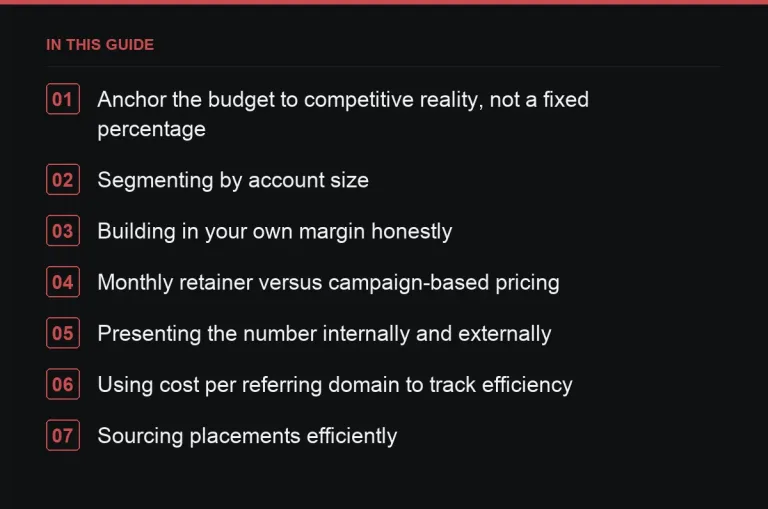
Anchor the budget to competitive reality, not a fixed percentage
Rather than defaulting to a flat percentage of ad spend or revenue, look at what level of link building activity the client’s actual competitors appear to be running, and how competitive their target keywords are. A client in a niche with well-established, aggressively linked competitors needs a materially different budget than one in a quieter, less contested space.
Segmenting by account size
- Smaller retainers — a modest, consistent monthly spend focused on a small number of high-relevance placements.
- Mid-size accounts — a broader monthly mix of guest posts and insertions across a wider set of target pages.
- Larger accounts — room for higher-authority placements, more original content investment, and multiple concurrent campaigns across product lines.
Building in your own margin honestly
Agencies typically mark up placement and content costs to cover account management, strategy, and reporting time. Being transparent internally about where that margin sits — separate from the raw placement cost — makes it much easier to defend the number if a client asks for a breakdown, and to adjust pricing without guessing. https://successtoroad.com/blog/hidden-costs-of-link-building/ is a useful checklist of the non-placement costs that should be reflected somewhere in your rate.
Monthly retainer versus campaign-based pricing
Some clients are better served by an ongoing monthly retainer, others by a defined campaign with a start and end date and a specific target number of placements. https://successtoroad.com/blog/monthly-vs-campaign-link-budgets/ compares the two models directly, including how each affects cash flow and reporting cadence.
Presenting the number internally and externally
Whether you’re pitching a new client or defending a renewal, the budget needs a clear rationale a non-specialist can follow: what it buys, why that level of spend, and what return is realistic on what timeline. https://successtoroad.com/blog/presenting-link-building-budget-to-cfo/ covers how to frame this for a client’s finance stakeholders specifically, which is often a different conversation than the one you’d have with a marketing lead.
Using cost per referring domain to track efficiency
Across a portfolio of client accounts, cost per referring domain is a useful common metric for comparing efficiency between campaigns that otherwise look quite different — different niches, different formats, different publishers. https://successtoroad.com/blog/cost-per-referring-domain/ explains how to calculate it consistently so you can compare account performance apples-to-apples.
| Account tier | Typical budget shape |
|---|---|
| Small | Few, highly relevant placements monthly |
| Mid-size | Broader monthly mix, insertions and guest posts |
| Enterprise | Multiple campaigns, higher-authority mix, more content investment |
Sourcing placements efficiently
A marketplace with filters by DA, DR, traffic, price, niche, and language lets your team build a shortlist quickly rather than cold-emailing publishers one at a time, and saved searches with alerts keep new matching inventory flowing in automatically. Explore options across niches at https://successtoroad.com/marketplace/ or narrow to a client’s specific vertical at https://successtoroad.com/niche/marketing/.
Handling client pushback on the number
Clients sometimes push back on a proposed budget by citing a much lower figure they’ve seen quoted elsewhere, often without full context on what that figure includes. Rather than simply defending your number, walk through the specific factors that explain the difference: site quality standards, whether content is included, and what level of account management and reporting is bundled in. A client who understands the breakdown is far more likely to accept a well-reasoned number than one who’s simply told to trust the agency.
Adjusting budgets mid-engagement
As a campaign progresses, you’ll often have real data on cost per referring domain and placement quality that justifies adjusting the budget up or down from the original estimate. Build a periodic review point into the engagement, rather than treating the initial budget as fixed for the life of the account, so adjustments are grounded in performance rather than feeling arbitrary to the client.
Documenting the rationale for future reference
Keep a simple record of how you arrived at each client’s budget — competitive intensity, account tier, and any specific goals that shaped the number. This makes budget renewals and new client pitches faster, and gives you a consistent, defensible answer when a client or a new team member asks how the figure was calculated months after the original conversation.
Where to go next
For allocating an approved budget across specific tactics, read https://successtoroad.com/blog/budget-allocation-across-link-tactics/, and for negotiating better rates from publishers you use across multiple accounts, see https://successtoroad.com/blog/negotiating-publisher-prices/.
Frequently asked questions
How should an agency decide a client's link building budget?
Base it on competitive intensity in the client's niche and target keywords, account size, and goals, rather than a fixed percentage rule applied to every client the same way.
Should agencies use a retainer or a campaign model?
Both are valid; retainers suit ongoing, steady link acquisition, while campaigns suit a defined push with a clear start and end. See {{post:monthly-vs-campaign-link-budgets}}.
How transparent should an agency be about markup?
That's a business decision, but internally tracking your margin separately from raw placement costs makes it far easier to defend pricing and adjust it confidently when asked.
Put it into practice
Filter 54,483 websites by DR, traffic, niche and price, and order with escrow — you pay only after the link is live.
Browse the marketplace