How to Present a Link Building Budget to a CFO or Client
How to translate a link building budget into language a finance stakeholder will actually find convincing.
Getting this conversation right matters well beyond a single approval, since the credibility you build in one budget presentation carries forward into every future renewal and every future request, while a poorly framed pitch can make even a genuinely sound plan a hard sell. Treat the first presentation as the foundation for an ongoing, trust-based relationship with whoever controls the budget, not a one-time hurdle to clear. A little extra preparation here pays dividends for years of future conversations, and it makes every subsequent renewal conversation faster and less contentious, freeing up time that would otherwise go into re-justifying the same case from scratch every single budget cycle that comes around each year.
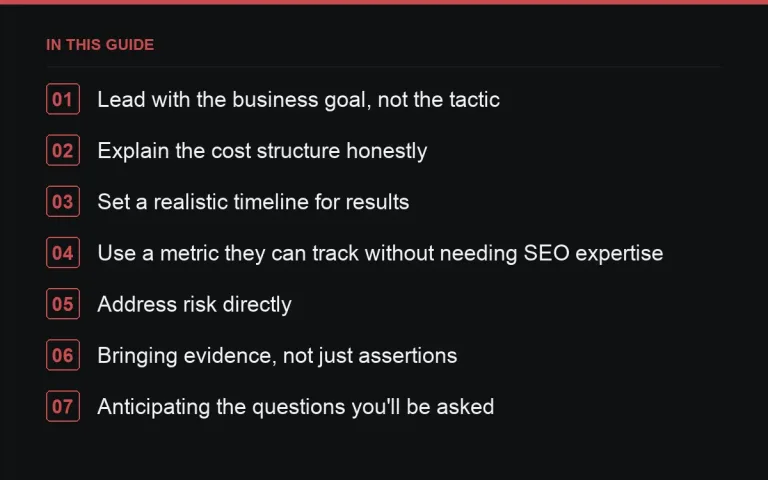
A marketer’s case for a link building budget and a CFO’s questions about it usually operate on different logic entirely. Marketers often lead with tactics and metrics like domain authority; finance stakeholders want to know what the spend buys, over what timeline, and how you’ll know if it worked. Bridging that gap is mostly about translation, not persuasion tactics. See https://successtoroad.com/blog/link-building-costs/ for the underlying cost detail this presentation draws on.
Lead with the business goal, not the tactic
Rather than opening with “we need budget for guest posts,” frame the request around the business outcome: improving organic visibility for pages that drive a specific part of the funnel, reducing reliance on paid channels over time, or supporting a competitive response in a market where competitors are visibly investing in content and authority. The tactic comes second, as the method, not the headline.
Explain the cost structure honestly
- Break the budget into placement fees, content production, and management time, rather than presenting one lump figure — see https://successtoroad.com/blog/hidden-costs-of-link-building/.
- Explain why prices vary across sites, briefly, so a CFO doesn’t assume every placement should cost the same — https://successtoroad.com/blog/why-link-prices-vary-so-much/ has the detail if a deeper explanation is needed.
- Be upfront about the fact that this is an investment in durable authority, not a one-time purchase with an immediate, guaranteed return.
Set a realistic timeline for results
A CFO who expects a paid-ad-style immediate return will be frustrated by link building’s genuinely slower feedback loop, so set that expectation clearly upfront rather than letting an implicit mismatch surface later as disappointment. https://successtoroad.com/blog/link-building-roi-framework/ gives you a way to talk about leading and lagging indicators that avoids either overpromising short-term results or leaving the return entirely undefined.
Use a metric they can track without needing SEO expertise
Cost per referring domain, tracked over time, is a relatively simple metric a non-specialist can follow month to month without needing to understand the mechanics of search rankings. Pairing it with periodic updates on ranking and traffic trends for target pages gives a finance stakeholder both an efficiency metric and an outcome metric, without requiring them to become SEO experts to evaluate the spend.
Address risk directly
Mention the protections in place — escrow-based payment that only releases funds once a placement is verified live, and a formal dispute process for anything that doesn’t match what was agreed — since this directly addresses a natural finance concern about paying for something before confirming delivery. https://successtoroad.com/blog/escrow-and-your-link-building-budget/ covers this mechanism if more detail is useful in the conversation.
| Marketer framing | Finance-friendly framing |
|---|---|
| “We need budget for guest posts” | “Investment in organic visibility for [specific business goal], with defined tracking” |
| “Domain authority 40+” | “Sites verified for genuine traffic and relevance” |
| “Trust me, it works” | “Leading indicators monthly, outcome review quarterly” |
Bringing evidence, not just assertions
Where possible, reference the specific pages or sites under consideration rather than speaking abstractly, using a filtered marketplace view at https://successtoroad.com/marketplace/ to show concrete examples of the kind of quality and pricing the budget supports, which makes the request feel grounded rather than speculative.
Anticipating the questions you’ll be asked
- How does this compare to what we’d spend on an equivalent amount of paid traffic?
- What happens if we pause the budget for a quarter — does progress simply resume later, or is ground genuinely lost?
- How will we know within the next reporting period whether this is working?
- What’s protecting us if a placement doesn’t get delivered as agreed?
Preparing clear, honest answers to these questions in advance makes the actual conversation far smoother than trying to improvise responses to a skeptical finance stakeholder in the moment.
Following up after approval
Once a budget is approved, keep the same finance stakeholder briefly updated at agreed intervals, even if it’s a short summary rather than a full report. This maintains trust and makes future budget conversations easier, since you’re building a track record of transparent communication rather than only surfacing the topic when you need something approved.
Where to go next
For sizing the specific number you’ll present, see https://successtoroad.com/blog/link-building-budget-for-agency-clients/ or https://successtoroad.com/blog/tiered-link-building-budgets/, and for the allocation detail behind the headline figure, read https://successtoroad.com/blog/budget-allocation-across-link-tactics/.
Frequently asked questions
How do I explain link building ROI to a non-marketer?
Use a simple efficiency metric like cost per referring domain for ongoing tracking, paired with periodic updates on ranking and traffic trends, rather than promising a precise short-term dollar return.
Should I present link building as a one-time cost or ongoing investment?
Frame it as an ongoing investment in durable authority rather than a one-time purchase, and set a realistic timeline for when results become meaningful.
What financial protections are worth mentioning to a CFO?
Escrow-based payment that releases funds only once a placement is verified live, and a formal dispute process for non-delivery, directly address a natural concern about paying before confirming results.
Put it into practice
Filter 54,483 websites by DR, traffic, niche and price, and order with escrow — you pay only after the link is live.
Browse the marketplace