A Simple Framework for Link Building ROI
How to reason about link building ROI honestly, given how indirect and long-term the return usually is.

Every marketing channel eventually faces a question about its return, and link building’s answer requires more nuance than a simple ratio, which is exactly why a clear, honest framework matters more here than in channels with more direct, immediate feedback loops. Skipping that nuance tends to produce misleading conclusions either way, whether that means overclaiming a win or wrongly writing off a strategy that was actually working.
Link building return on investment is genuinely harder to measure than a paid ad click, because the return is indirect, compounding, and spread out over months rather than immediate and directly attributable. That doesn’t mean you can’t reason about ROI sensibly — it just means the framework needs to account for that indirectness rather than pretending it doesn’t exist. See https://successtoroad.com/blog/link-building-costs/ for the cost side of this equation.
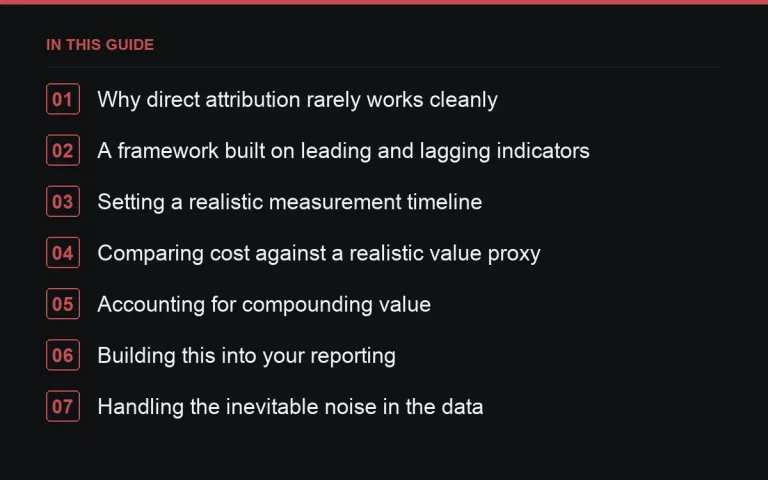
Why direct attribution rarely works cleanly
A single link rarely, on its own, moves a page from page three of search results to page one; rankings usually respond to the cumulative effect of many signals, including but not limited to link building. Trying to attribute a specific ranking or traffic improvement to a single placement is usually a false precision that doesn’t reflect how search engines actually work.
A framework built on leading and lagging indicators
- Leading indicators — cost per referring domain, quality of placements relative to your standards, and consistency of ongoing activity. These are visible immediately and tell you whether you’re executing the strategy well.
- Lagging indicators — organic ranking movement for target pages, organic traffic trends, and referral traffic from placements over a period of months. These take longer to show up and are influenced by more than just link building alone.
Judging ROI purely on lagging indicators too early leads to premature conclusions; judging purely on leading indicators without ever checking lagging outcomes risks spending well on activity that isn’t actually working.
Setting a realistic measurement timeline
Because links take time to be discovered, credited, and to influence rankings, meaningful ROI assessment usually needs a multi-month window rather than a monthly one. Treat monthly reporting as tracking leading indicators and overall progress, and reserve a genuine ROI judgment for a longer period once you have enough data to see a trend rather than noise.
Comparing cost against a realistic value proxy
Rather than claiming a precise dollar return, which invites invented numbers, compare your link building spend against a reasonable proxy for value: the traffic and ranking positions your target pages would need to achieve, and what a comparable amount of that traffic might cost through a channel like paid search, as a rough sense check on whether the investment is proportionate to your goals.
Accounting for compounding value
Unlike a paid ad, a link’s value doesn’t stop accruing once the initial spend is made; a durable placement on a stable site can continue contributing to authority and referral traffic for years. https://successtoroad.com/blog/long-term-value-vs-upfront-link-cost/ covers this distinction, which matters for ROI specifically because it means early months of a new link building programme often look less efficient than they eventually will once the investment compounds.
| Indicator type | Example | Timeline |
|---|---|---|
| Leading | Cost per referring domain, placement quality | Immediate |
| Lagging | Ranking movement, organic traffic trend | Months |
Building this into your reporting
Report leading indicators monthly to show consistent execution, and reserve lagging-indicator ROI conversations for quarterly or longer reviews, where trends are more meaningful than noise. This structure also makes it much easier to present the investment honestly to a client or finance stakeholder, discussed further in https://successtoroad.com/blog/presenting-link-building-budget-to-cfo/. Source consistent, quality placements to support this framework at https://successtoroad.com/marketplace/.
Handling the inevitable noise in the data
Organic traffic and rankings fluctuate for many reasons unrelated to your link building activity — algorithm updates, seasonal demand shifts, competitor activity, or changes elsewhere on your own site. When reviewing lagging indicators, look for a sustained trend over several months rather than reacting to any single week or month’s movement, which is far more likely to be noise than a genuine signal of the campaign’s effect.
What a credible internal ROI narrative includes
- A clear statement of what was spent and on what mix of tactics.
- Leading indicators showing consistent, quality execution over the period.
- Lagging indicators reviewed over a sensible, multi-month timeframe.
- An honest acknowledgment of what can and can’t be precisely attributed to link building alone.
Avoiding both overclaiming and underclaiming
It’s tempting either to overclaim credit for every positive traffic movement, or to underclaim and dismiss link building’s contribution simply because it can’t be measured with paid-ad-style precision. Both extremes are unhelpful; a measured, honest framework that acknowledges the indirect but real nature of the return tends to hold up far better under scrutiny over time.
Where to go next
For how to size the budget behind this framework in the first place, revisit https://successtoroad.com/blog/link-building-budget-small-business/ or https://successtoroad.com/blog/link-building-budget-for-agency-clients/, and for the cost side of the ROI equation specifically, see https://successtoroad.com/blog/cost-per-referring-domain/.
Frequently asked questions
Can link building ROI be measured precisely, like a paid ad?
Not with the same precision, since ranking improvements reflect many combined signals, not a single placement. A framework using leading and lagging indicators is more honest than a single attributed dollar figure.
How long before I can judge link building ROI fairly?
Usually a multi-month window is needed, since links take time to be discovered and to influence rankings; monthly reviews are better used for tracking execution quality than final ROI.
What are leading indicators in a link building ROI framework?
Metrics like cost per referring domain and placement quality that are visible immediately and reflect whether the strategy is being executed well, ahead of any ranking or traffic changes.
Put it into practice
Filter 54,483 websites by DR, traffic, niche and price, and order with escrow — you pay only after the link is live.
Browse the marketplace