How to Allocate Your Budget Across Link Building Tactics
How to decide what share of your link building budget should go to each tactic, based on your specific goals.

An overall budget number is only half the planning work; how that number gets split across tactics often has a bigger effect on results than the total figure itself, since two campaigns with identical total spend can produce very different outcomes depending on how the money was allocated. Getting the split right is where a good plan turns into good results, and it’s worth revisiting the split at least as often as you revisit the overall budget number itself, since a stale allocation can quietly undermine an otherwise well-sized budget without anyone noticing until results disappoint.
Once you have a total link building budget set, the next decision is how to split it across tactics: guest posts, link insertions, and any other approaches you’re using. There’s no universal split that works for every business, but there is a sensible way to reason through the allocation based on your specific goals and constraints. See https://successtoroad.com/blog/link-building-costs/ for the cost fundamentals behind each tactic.
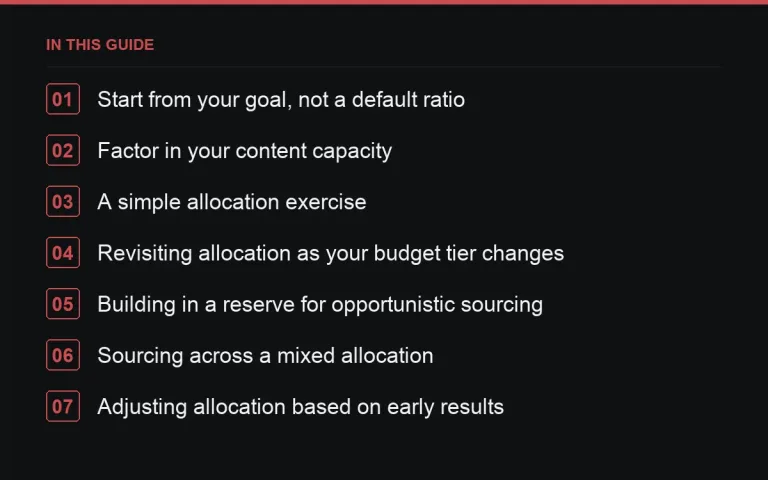
Start from your goal, not a default ratio
If your priority is building a small number of durable, high-authority relationships, allocate more toward fewer, well-chosen guest posts on established sites. If your priority is efficiently building link volume across a wider set of target pages within a constrained budget, link insertions on already-relevant, already-ranking pages may deliver more value per pound spent. https://successtoroad.com/blog/link-insertion-vs-guest-post-pricing/ covers the trade-off between these formats directly.
Factor in your content capacity
A heavier allocation toward guest posts assumes you either have writing capacity or budget to pay for content, discussed in https://successtoroad.com/blog/paying-for-content-vs-writing-your-own/. If content production is your bottleneck rather than placement budget itself, shifting more of your allocation toward insertions, which don’t require new content, may be the more practical choice regardless of which format would otherwise be preferred.
A simple allocation exercise
- List your target pages and what each one needs — a new supporting content asset, or simply more authority pointed at an existing, already-strong page.
- Match tactic to need: pages needing a new asset suit guest posts; pages that just need more link signal suit insertions.
- Reserve a smaller portion of budget for opportunistic premium placements — homepage features or particularly strong niche matches — that come up outside your regular planning cycle.
Revisiting allocation as your budget tier changes
As your overall budget grows, discussed in https://successtoroad.com/blog/tiered-link-building-budgets/, your allocation should evolve too — a larger budget can support more original content and a broader mix of formats, rather than simply scaling the same ratio proportionally. Reassess the split periodically rather than treating an early-stage allocation as permanent.
Building in a reserve for opportunistic sourcing
Keeping a modest, flexible portion of your budget unallocated to any specific tactic lets you take advantage of an unusually strong opportunity — a highly relevant site, a favourable seasonal price, or a bulk discount — that comes up outside your regular planning without needing to fully restructure your budget to accommodate it. https://successtoroad.com/blog/seasonal-link-pricing/ and https://successtoroad.com/blog/bulk-link-discounts/ both describe situations this kind of reserve is useful for.
| Goal | Suggested lean |
|---|---|
| Build durable topical authority | More toward guest posts |
| Efficiently scale link volume | More toward insertions |
| Limited content capacity | Lean toward insertions or publisher-written guest posts |
| Opportunistic strong deals | Keep a flexible reserve |
Sourcing across a mixed allocation
A marketplace that lets you filter and compare both formats side by side by niche, authority, and price makes it easier to execute a mixed strategy without needing separate sourcing processes for each tactic. Browse both formats at https://successtoroad.com/marketplace/.
Adjusting allocation based on early results
After the first few months of a new allocation, review which tactic is producing the strongest results relative to its cost, and be willing to shift the split accordingly rather than treating the original plan as fixed. A tactic that looked promising on paper may underperform in practice for reasons specific to your niche or target pages, and the allocation should respond to that real-world feedback.
Coordinating allocation with your content calendar
If your guest post allocation depends on a steady flow of new content, coordinate your link building allocation with your broader content calendar rather than planning them separately. A spike in guest post commitments that isn’t matched by available content capacity in that same period creates exactly the kind of bottleneck discussed earlier, undermining an otherwise sound allocation plan.
Documenting the allocation rationale
Keep a short written record of why your budget is split the way it is — which target pages drove the guest post allocation, which needed only insertions, and how much was kept as a flexible reserve. This makes it far easier to explain and defend the allocation later, whether to yourself when reviewing performance or to a stakeholder asking how the plan was built.
Where to go next
For tracking whether your allocation is working, read https://successtoroad.com/blog/cost-per-referring-domain/, and for presenting the resulting split to a client or finance stakeholder, see https://successtoroad.com/blog/presenting-link-building-budget-to-cfo/.
Frequently asked questions
What's the right split between guest posts and link insertions?
There's no universal ratio; base it on your specific goals, target pages, and content production capacity rather than a fixed default split.
Should I keep some budget unallocated to any specific tactic?
A modest flexible reserve is often useful for taking advantage of unusually strong opportunities that come up outside your regular planning cycle.
How often should I revisit my tactic allocation?
Periodically, especially as your overall budget tier changes, since a larger budget often supports a broader, more content-heavy mix rather than simply scaling the same ratio.
Put it into practice
Filter 54,483 websites by DR, traffic, niche and price, and order with escrow — you pay only after the link is live.
Browse the marketplace