How Small Businesses Should Budget for Link Building
A step-by-step way to size a link building budget when you're running a small business, not an agency.
Getting this decision right early matters more for a small business than for a larger company, since there’s usually no slack in the budget to absorb an early misstep, and no dedicated SEO hire to catch problems quickly. A clear, simple approach from the start avoids both overspending on an unproven strategy and underspending in a way that never produces visible results.
Small business owners usually come to link building with a limited, fixed marketing budget and no in-house SEO team, which means every pound or dollar spent needs to earn its place. The good news is that a modest, consistent budget applied over time generally outperforms a single large burst of spending. This post lays out a practical way to size that budget. For the underlying cost drivers, see https://successtoroad.com/blog/link-building-costs/.
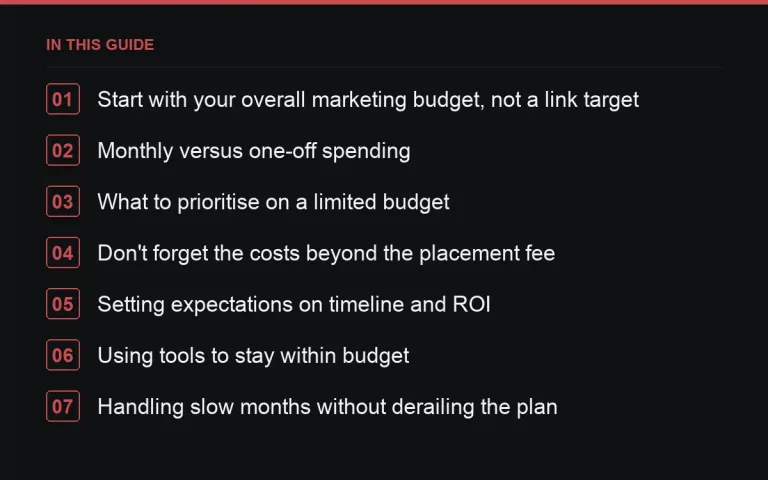
Start with your overall marketing budget, not a link target
Rather than deciding “I want 20 links” and then figuring out what that costs, work backwards from what you can actually afford to spend on marketing each month, and decide what share of that goes to link building versus other channels like paid search or content. For most small businesses, link building is one part of a broader SEO effort, not the whole budget.
Monthly versus one-off spending
A small, steady monthly spend tends to build authority more sustainably than one large campaign, because search engines and publishers alike respond better to a natural, ongoing pattern of activity than to a sudden spike. https://successtoroad.com/blog/monthly-vs-campaign-link-budgets/ compares these two approaches directly if you’re weighing a big one-time push against an ongoing retainer-style spend.
What to prioritise on a limited budget
- Niche relevance over raw authority — a smaller, closely relevant site is often better value than an expensive, loosely related one.
- A mix of link insertions and guest posts, leaning toward whichever is cheaper for pages you’ve already identified as needing links.
- Fewer, better placements over a larger number of weak ones — quality compounds, thin volume mostly doesn’t.
- Tracking cost per referring domain so you can compare offers on a like-for-like basis; see https://successtoroad.com/blog/cost-per-referring-domain/.
Don’t forget the costs beyond the placement fee
If you’re not writing content yourself, budget for it separately, and factor in the time you or someone on your team will spend researching sites, communicating with publishers, and reviewing drafts. https://successtoroad.com/blog/hidden-costs-of-link-building/ covers these often-overlooked costs, which can be a meaningful share of total spend for a small operation without a dedicated SEO hire.
Setting expectations on timeline and ROI
Link building is a compounding investment, not a purchase with an immediate, guaranteed return. Rankings and referral traffic typically build over months, not weeks. https://successtoroad.com/blog/link-building-roi-framework/ offers a way to think about return that doesn’t depend on unrealistic short-term promises, which is useful both for your own planning and for explaining the investment to a business partner or co-owner.
Using tools to stay within budget
Set filters for the DA, DR, traffic, and price ranges that fit your budget, and use saved searches with alerts so new matching sites reach you automatically rather than requiring constant manual searching — https://successtoroad.com/blog/price-alerts-with-saved-searches/ explains how this works in practice. Browse sites filtered to your industry at https://successtoroad.com/niche/business/ or across all niches at https://successtoroad.com/marketplace/.
| Budget tier | Reasonable approach |
|---|---|
| Very limited | Few, carefully chosen niche-relevant placements, mostly insertions |
| Moderate, ongoing | Steady monthly mix of insertions and guest posts |
| Growing | Add higher-authority placements and more original content |
Handling slow months without derailing the plan
Small businesses often have uneven cash flow, and it’s tempting to cut the link building budget entirely during a tight month. Where possible, resist cutting it to zero; even a reduced but consistent spend maintains momentum better than stopping and restarting later, since restarting often means re-establishing publisher relationships and losing the compounding benefit of continuous activity. If a genuine cut is unavoidable, scale back the number of placements rather than abandoning the programme altogether.
Deciding when to bring in outside help
At some point, the time cost of managing link building yourself may exceed what it would cost to bring in a freelancer or a small agency to manage part of the process. This is worth reassessing periodically rather than assuming DIY is always cheaper once your own time is properly valued. https://successtoroad.com/blog/link-building-budget-for-agency-clients/ is written from the agency side, but the underlying budgeting logic applies just as well when you’re the one deciding whether to become a client.
A simple monthly checklist
- Confirm which target pages still need links this month, based on current rankings.
- Check saved search alerts for new matching sites within your price range.
- Review any pending orders and respond promptly to publisher messages to avoid delays.
- Track cost per referring domain against the previous month to catch drift early.
Where to go next
If you’re weighing doing this yourself versus hiring help, https://successtoroad.com/blog/paying-for-content-vs-writing-your-own/ and https://successtoroad.com/blog/negotiating-publisher-prices/ are both practical next reads, and https://successtoroad.com/blog/budget-allocation-across-link-tactics/ is worth reading once your monthly number is set.
Frequently asked questions
How much should a small business spend on link building?
There's no fixed figure that fits every business; base it on your overall marketing budget and goals rather than a market average, and prioritise consistency over a single large spend.
Is it better to do one big campaign or spend monthly?
A steady monthly spend usually builds authority more naturally and is easier to sustain than an occasional large campaign. See {{post:monthly-vs-campaign-link-budgets}} for the full comparison.
Should a small business use guest posts or link insertions?
Often a mix works best; insertions can be cheaper for pages you've already identified, while guest posts help build a longer-term content footprint.
Put it into practice
Filter 54,483 websites by DR, traffic, niche and price, and order with escrow — you pay only after the link is live.
Browse the marketplace