Monthly Retainer vs Campaign Budgets for Link Building
When an ongoing monthly link building spend makes more sense than a fixed campaign, and vice versa.
This decision is worth making deliberately rather than defaulting to whichever model a particular vendor or agency happens to offer by default, since the structure you choose affects not just cash flow but how naturally your link acquisition pattern looks over time, and how easily you can adjust course partway through. Getting it right early avoids a disruptive restructuring later once a programme is already underway.
One of the first structural decisions in setting a link building budget is whether to run it as an ongoing monthly spend or as a defined campaign with a start date, end date, and target number of placements. Both are legitimate models, and the right choice depends on your goals, your team’s capacity, and how the rest of your SEO work is structured. See https://successtoroad.com/blog/link-building-costs/ for the cost fundamentals behind either approach.
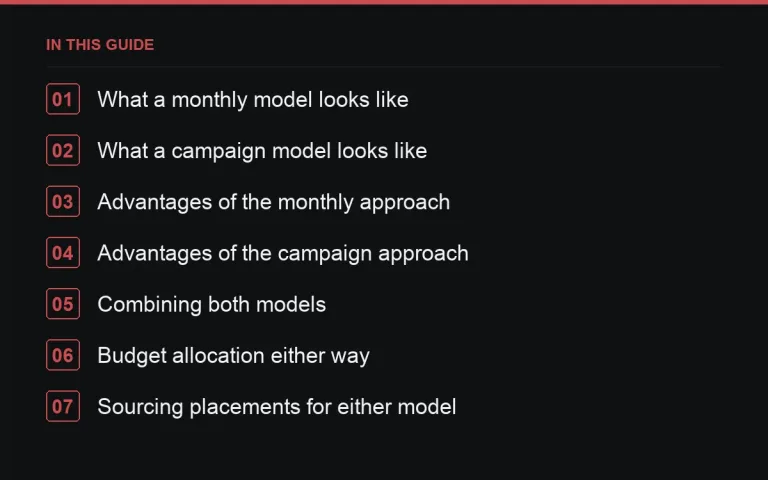
What a monthly model looks like
A monthly retainer approach commits a consistent amount each month to link acquisition, without a fixed end date. This suits businesses treating link building as an ongoing part of their SEO programme, similar to content publishing or technical maintenance. It creates a steady, natural-looking pattern of link acquisition over time, which many practitioners believe is safer and more sustainable than sudden bursts of activity.
What a campaign model looks like
A campaign model sets a defined budget and timeframe tied to a specific goal — supporting a product launch, targeting a set of pages ahead of a seasonal peak, or catching up after a period of neglect. It has a clear beginning and end, and success is measured against a specific target, such as a set number of placements or referring domains gained within that window.
Advantages of the monthly approach
- Easier to budget as a predictable, recurring line item.
- Naturally spreads placements over time rather than concentrating them.
- Allows continuous relationship-building with publishers, which can improve pricing over time — see https://successtoroad.com/blog/negotiating-publisher-prices/.
- Easier to pause or adjust incrementally if priorities shift.
Advantages of the campaign approach
- Clear, time-bound accountability tied to a specific business event.
- Easier to justify a larger one-time spend to stakeholders when it’s tied to a launch or major initiative.
- Can concentrate effort where it matters most, such as ahead of a known seasonal spike — see https://successtoroad.com/blog/seasonal-link-pricing/.
Combining both models
Many mature link building programmes run a baseline monthly spend for ongoing authority building, with occasional campaign bursts layered on top for specific initiatives. This gives you the steadiness of a monthly programme with the flexibility to respond to specific business needs without restructuring your whole budget every time something comes up.
Budget allocation either way
Whichever model you choose, the underlying allocation questions are the same: how much goes to placement fees versus content, how much to insertions versus guest posts, and how you’ll measure efficiency. https://successtoroad.com/blog/budget-allocation-across-link-tactics/ and https://successtoroad.com/blog/cost-per-referring-domain/ both apply regardless of which structure you pick.
| Monthly retainer | Fixed campaign | |
|---|---|---|
| Predictability | High | Lower, spend is front-loaded |
| Best for | Ongoing authority building | Specific launches or events |
| Flexibility to pause | Easier | Harder mid-campaign |
Sourcing placements for either model
A marketplace with saved searches and price alerts is useful for a monthly model, since new matching inventory arrives continuously — see https://successtoroad.com/blog/price-alerts-with-saved-searches/. For a campaign, filtering directly by niche, authority, and price at https://successtoroad.com/marketplace/ lets you build a shortlist quickly against a deadline.
Switching between models as needs change
Businesses often start with a campaign to build initial momentum, then transition to a monthly retainer once they have a working process and want to maintain results without a dedicated push every time. Others do the reverse, running a steady monthly baseline and layering short campaigns on top around specific launches. Neither direction is unusual, and it’s worth revisiting which model fits your current situation every few months rather than assuming the original choice should hold indefinitely.
Cash flow implications worth planning for
A campaign model concentrates spend into a shorter window, which can strain cash flow if it coincides with other significant expenses, while a monthly model spreads the same total spend more evenly and is generally easier to plan around from a cash flow perspective. If your business has predictable seasonal cash flow patterns, it’s worth aligning your choice of model with those patterns rather than treating the decision purely as a marketing one.
Reporting cadence differs between the two
A campaign typically ends with a defined results summary against its original goal, which suits stakeholders who want a clear before-and-after comparison. A monthly retainer suits ongoing dashboards and periodic trend reviews rather than a single defined endpoint. Choose the model partly based on which reporting style your own stakeholders will find most useful and credible.
Where to go next
If you’re setting this budget for a client, https://successtoroad.com/blog/link-building-budget-for-agency-clients/ and https://successtoroad.com/blog/presenting-link-building-budget-to-cfo/ cover how to frame either model for stakeholders, and https://successtoroad.com/blog/tiered-link-building-budgets/ discusses how budget levels scale as goals grow.
Frequently asked questions
Which is better, a monthly retainer or a campaign budget?
Neither is universally better; a monthly retainer suits ongoing authority building, while a campaign suits a specific, time-bound goal like a launch. Many programmes use both.
Can I switch from a campaign to a monthly model later?
Yes, and it's common to run a campaign first to establish momentum, then move to a steady monthly spend to maintain and build on the results.
Does a campaign model cost more overall?
Not necessarily more per placement, but spend is concentrated in a shorter window, which can affect cash flow even if the total annual spend is similar to a monthly model.
Put it into practice
Filter 54,483 websites by DR, traffic, niche and price, and order with escrow — you pay only after the link is live.
Browse the marketplace