Why Link Prices Can Vary by 100x Between Sites
The real reasons two backlinks can be priced 100x apart, and how to tell which one is the better deal.
It’s common to see a link on one site priced at a small fraction of a link on another site, even when both sites show broadly similar authority metrics. This isn’t a pricing error, and it isn’t proof that one seller is ripping you off. Large price gaps almost always trace back to real differences in traffic, editorial standards, niche, and what’s included in the price. This post breaks those differences down so you can judge a quote on its merits rather than assuming the cheaper option is automatically the smarter buy. For the broader cost picture, start with https://successtoroad.com/blog/link-building-costs/.
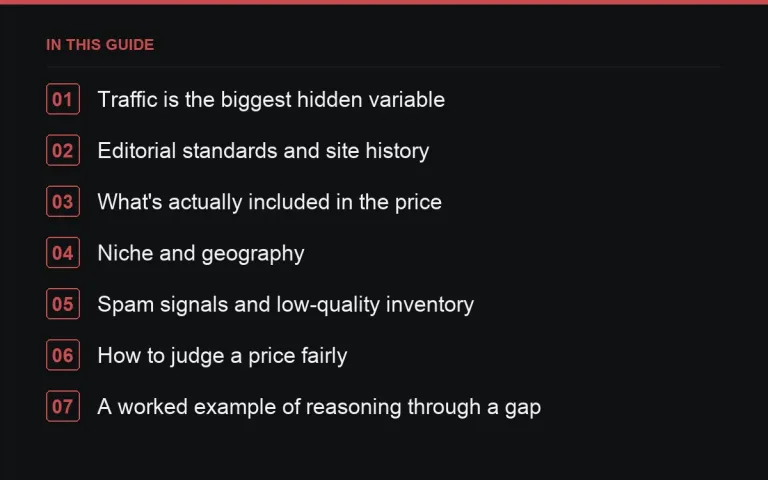
Traffic is the biggest hidden variable
Domain authority scores are estimates built from backlink profiles, not from actual visitor numbers. A site can have a respectable authority score while getting very little real organic traffic, and another site with a more modest score can be pulling in a steady, relevant audience. Publishers who know their traffic is genuinely valuable price accordingly; sites optimised mainly to rank well on authority metrics, without much real audience, often can’t justify the same price.
Editorial standards and site history
A publication with a long editorial history, a real editorial team, and strict content guidelines is protecting something valuable: reader trust and search engine trust built up over years. That site has more to lose by publishing low-quality or clearly paid content carelessly, so it charges more and is more selective. A newer site with looser standards has less at stake and can afford to accept more paid placements at a lower price.
What’s actually included in the price
- Some quotes cover only the placement; others include full content writing and multiple revision rounds.
- Some publishers guarantee the link stays live for a set period or indefinitely; others make no such promise.
- Turnaround time differs — a faster publish can command a premium.
- Whether the price includes a dedicated author bio, internal linking from the publisher’s own site, or social sharing.
Niche and geography
Competitive commercial niches and larger, wealthier markets generally support higher prices, simply because the businesses buying links there have bigger budgets and more competition for visibility. https://successtoroad.com/blog/link-pricing-by-niche/ and https://successtoroad.com/blog/pricing-in-non-english-markets/ cover this in more depth if you’re working across multiple verticals or countries.
Spam signals and low-quality inventory
Some very cheap “link opportunities” are sites built specifically to sell links at volume, with thin content and little genuine readership. These can carry real risk rather than just low value, since search engines increasingly discount or penalise obvious link networks. A low price on its own isn’t a red flag, but a low price combined with high spam scores, irrelevant content, and no real traffic is worth walking away from — see https://successtoroad.com/blog/cheap-links-real-cost/.
How to judge a price fairly
Instead of comparing sticker prices, look at cost per referring domain relative to what you’re getting: traffic quality, niche fit, and content inclusion. https://successtoroad.com/blog/cost-per-referring-domain/ explains how to build this comparison properly. Filtering a marketplace like https://successtoroad.com/marketplace/ by DA, DR, traffic, and price side by side is far more useful than sorting by price alone, which https://successtoroad.com/blog/sorting-by-price-on-marketplace/ covers in practical terms.
| Signal | What it suggests |
|---|---|
| High authority score, low real traffic | Price may be inflated relative to actual value |
| Moderate authority, strong niche traffic | Often a genuinely fair-value placement |
| Very low price, high spam score | Treat with caution |
A worked example of reasoning through a gap
Suppose two sites in the same niche quote very different prices for a guest post. Before assuming the cheaper one is the better deal, check each site’s real traffic trend, how selective their guidelines sound, and whether the price includes writing and revisions. If the cheaper site has thin, sporadic traffic and no visible editorial standards, while the pricier one shows a steady audience and a clear content process, the price gap likely reflects a genuine quality difference rather than one seller simply being unreasonable.
When a large gap should make you pause
Occasionally a price gap is a genuine red flag rather than a quality signal — for instance when a site’s traffic looks inconsistent with its authority metrics in ways that suggest manipulation, or when a very low price is paired with a willingness to accept almost any content regardless of relevance. In those cases, the gap isn’t explained by legitimate differences in traffic or editorial effort; it’s a sign the listing may carry more risk than the price alone suggests.
Building your own reference points over time
The more offers you evaluate within a specific niche, the better your intuition becomes for what a reasonable range looks like there specifically, since general rules travel less well than direct, ongoing exposure to real listings in your own vertical. Keep informal notes on what you’ve seen quoted for comparable sites as you go, so future decisions get faster and more confident rather than starting from scratch each time.
Where to go next
Once you’re comfortable reading these signals, https://successtoroad.com/blog/how-publishers-set-their-prices/ explains the pricing decision from the seller’s side, and https://successtoroad.com/blog/fair-price-for-mid-authority-site/ works through what a reasonable offer looks like for a typical mid-tier site.
Frequently asked questions
Does a higher domain authority score always mean a higher fair price?
Not necessarily. Authority scores are estimates and don't directly measure traffic or audience relevance, both of which matter as much or more when judging a fair price.
Is a very cheap link always a bad idea?
Not always, but check traffic, spam signals, and content quality before assuming it's a bargain. A cheap placement on a thin, low-traffic site can waste your budget even if the price looks attractive.
How do I compare two very differently priced offers?
Compare cost per referring domain alongside traffic, niche relevance, and what's included in the price, rather than comparing the headline numbers directly.
Put it into practice
Filter 54,483 websites by DR, traffic, niche and price, and order with escrow — you pay only after the link is live.
Browse the marketplace