How Publishers Actually Set Their Link Prices
Understanding how a publisher arrives at their price helps you judge whether a quote you've received is reasonable.
Most guidance for link buyers focuses on how to evaluate a quote, but understanding how that quote was arrived at in the first place gives you a far deeper, more durable basis for judging fairness than any checklist applied from the outside alone.
Buyers often see a publisher’s price as a fixed, opaque number, but understanding how that number typically gets set makes it much easier to judge whether a specific quote is fair. Publishers are weighing their own traffic, editorial costs, and risk tolerance, not picking numbers arbitrarily. See https://successtoroad.com/blog/link-building-costs/ for the buyer-side view of these same factors.
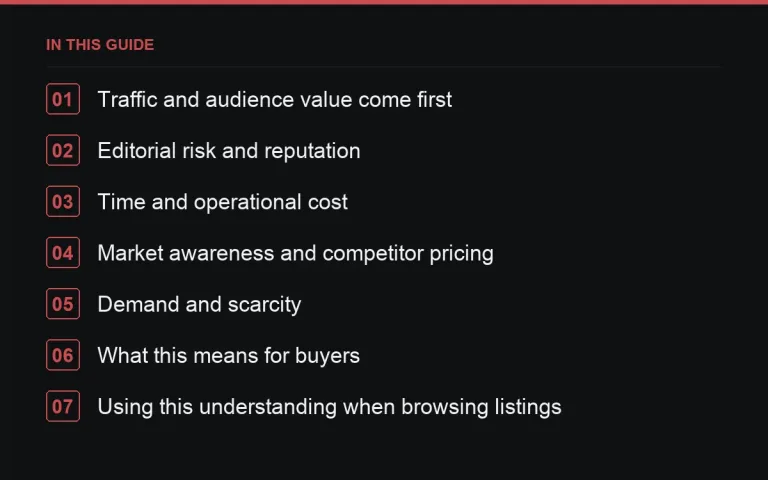
Traffic and audience value come first
A publisher with genuine, growing organic traffic knows that traffic has real value beyond just SEO metrics — it’s an audience advertisers in other channels would also pay to reach. Publishers who understand this tend to price closer to what a comparable advertising placement would cost, rather than treating the link as an isolated, low-value add-on.
Editorial risk and reputation
Publishers with an established reputation have more to lose by accepting low-quality or clearly promotional content. That risk gets priced in: stricter editorial review, more revision requests, and a higher price reflect a publisher protecting something valuable. A newer or less established site has less reputational risk at stake and may price accordingly lower, accepting more placements with less scrutiny.
Time and operational cost
- Reviewing pitches and content takes real staff time, which scales with how many requests a publisher fields.
- Sites with a formal advertising or partnerships process often have higher minimum prices simply to make the administrative overhead worthwhile.
- Publishers who write content themselves as part of the price are factoring in a writer’s time directly.
Market awareness and competitor pricing
Many publishers watch what similar sites in their space charge and adjust their own pricing to stay roughly competitive, particularly once they’ve been running paid placements for a while and have a sense of demand at different price points. This is part of why prices for genuinely comparable sites tend to cluster, even without any formal coordination between publishers.
Demand and scarcity
A publisher who receives far more pitch requests than they can reasonably accept has room to raise prices or become more selective, while one with fewer inbound requests may keep prices lower or be more open to negotiation to secure the order. This is one reason the same site’s price can shift over time even without any change in traffic or authority.
What this means for buyers
When you see a price, you’re seeing the outcome of a publisher weighing their traffic value, editorial risk, operational cost, and current demand. A quote that seems high relative to a basic authority score might simply reflect real traffic and editorial standards that the score alone doesn’t capture; a quote that seems surprisingly low is worth checking carefully for weak traffic or loose editorial standards before assuming it’s just a good deal.
| Publisher consideration | Effect on price |
|---|---|
| Genuine traffic value | Higher |
| Reputational risk of loose standards | Higher, if the publisher protects their reputation carefully |
| High volume of inbound pitch requests | Higher, publisher can be selective |
| Low overhead, minimal review process | Often lower |
Using this understanding when browsing listings
Rather than judging a quote in isolation, use DA, DR, and traffic filters together at https://successtoroad.com/marketplace/ to compare a specific publisher’s price against genuinely similar sites, which gives you a much better sense of whether that publisher’s pricing logic lines up with what they’re actually offering.
How publisher pricing evolves as a site grows
A newer site typically starts with lower prices to attract initial advertisers and build a track record, then raises prices gradually as traffic grows and demand for placements increases. Recognising this pattern helps explain why a site you worked with cheaply a year ago may now quote a noticeably higher price, without anything having gone wrong in the relationship — it simply reflects the site’s own growth and increased demand.
Why some publishers avoid a fixed price list at all
Publishers who quote case by case, rather than publishing a fixed rate card, are often factoring in variables like content quality, topic relevance, and current demand on a per-request basis. This can feel less transparent than a fixed price list, but it also means there may be more room to discuss terms for a particularly strong pitch than a rigid rate card would allow.
What this means for long-term planning
Since publisher pricing responds to their own growth and demand, budget some room for prices to shift over the life of an ongoing relationship, rather than assuming a quote from your first order will remain valid indefinitely. Revisit pricing periodically as part of maintaining any long-term publisher relationship.
Where to go next
For reasoning through what a fair price looks like for a specific type of site, read https://successtoroad.com/blog/fair-price-for-mid-authority-site/, and for how to approach a publisher whose price seems worth discussing, see https://successtoroad.com/blog/negotiating-publisher-prices/.
Frequently asked questions
Do publishers price based mainly on domain authority?
Not usually in isolation; real traffic, editorial risk, and current demand for placements typically matter as much or more than a single authority score.
Why might a publisher's price change over time without any site changes?
Demand fluctuates — a publisher receiving more pitch requests than they can accept may raise prices or become more selective, even without any change in their own traffic or authority.
Is a high price always justified by high quality?
Usually there's a real reason behind it, but it's still worth verifying traffic and relevance yourself rather than assuming price alone confirms quality.
Put it into practice
Filter 54,483 websites by DR, traffic, niche and price, and order with escrow — you pay only after the link is live.
Browse the marketplace