The Hidden Costs of Link Building Beyond the Placement Fee
The costs that don't show up on a publisher's price list but still eat into your real link building budget.
Teams that only track placement fees consistently underestimate what link building actually costs them, sometimes by a meaningful margin, which distorts both budgeting decisions and any attempt to calculate genuine return on the investment over time.
The placement fee is usually the most visible line in a link building budget, but it’s rarely the whole story. Content, revisions, and the time spent managing outreach and communication all cost real money, even when they don’t appear as a separate invoice. Budgeting only for the placement fee is one of the most common ways teams end up overspending relative to plan. See https://successtoroad.com/blog/link-building-costs/ for the broader pricing context these hidden costs sit within.
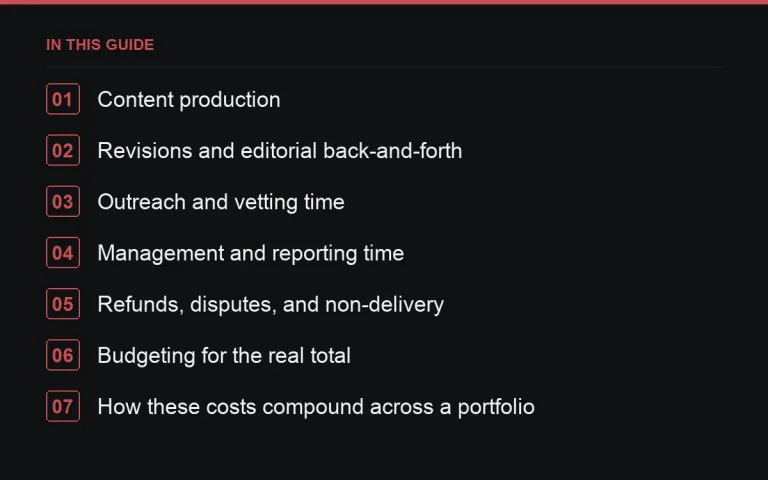
Content production
If a publisher requires you to supply the article rather than writing it themselves, you’re either paying a writer or spending your own team’s time on drafting. https://successtoroad.com/blog/paying-for-content-vs-writing-your-own/ walks through how to weigh those two options directly, but either way, the cost is real and should be part of your budget, not treated as free because it doesn’t come as a separate publisher invoice.
Revisions and editorial back-and-forth
Publishers with genuine editorial standards will often ask for changes: tone adjustments, removing overly promotional language, restructuring for readability, or trimming links. Each round takes time from whoever wrote the piece, and delays your placement going live. Budgeting a buffer for at least one or two revision rounds, in both time and any per-round fees a publisher might charge, avoids nasty surprises partway through a campaign.
Outreach and vetting time
- Researching and shortlisting sites that fit your niche, authority, and traffic requirements.
- Messaging publishers, negotiating terms, and following up when responses are slow.
- Checking site metrics and spam signals before committing to a placement.
- Confirming a link actually went live and stays live over time.
A marketplace that centralises filtering, messaging, and order tracking in one place significantly cuts this time compared to cold outreach one publisher at a time, which is one of the practical reasons teams move from manual link building to a marketplace model.
Management and reporting time
Someone has to track which placements are live, which are pending, and how the campaign is performing against budget and goals. For a solo marketer or small in-house team, this is time taken away from other work; for an agency, it’s time that needs to be reflected somewhere in the client rate even if it’s not itemised on the invoice. https://successtoroad.com/blog/link-building-budget-for-agency-clients/ discusses how agencies typically fold this into their pricing.
Refunds, disputes, and non-delivery
Occasionally a placement falls through, gets removed after publication, or doesn’t match what was agreed. Time spent handling disputes and, where applicable, requesting refunds is itself a cost, even when the marketplace’s escrow and dispute process protects your money. https://successtoroad.com/blog/refunds-and-disputes-in-link-buying/ and https://successtoroad.com/blog/escrow-and-your-link-building-budget/ cover how these protections work and what they do and don’t cover.
| Hidden cost | Why it’s easy to miss |
|---|---|
| Content writing | Doesn’t appear on the publisher’s invoice |
| Revisions | Time cost rather than a cash cost |
| Vetting and outreach | Spread across many small actions |
| Reporting | Ongoing, easy to underestimate |
Budgeting for the real total
A more honest budget adds a reasonable percentage on top of raw placement fees to cover these items, rather than assuming the placement fee is the whole cost. Filtering sites by DA, DR, traffic, and price at https://successtoroad.com/marketplace/ still saves considerable vetting time compared to manual outreach, which itself reduces one of these hidden costs directly.
How these costs compound across a portfolio
Individually, a bit of extra revision time or an hour spent vetting a site might look negligible, but across dozens of placements a month, these small hidden costs add up to a meaningful share of total programme spend. Treating them as rounding errors in individual instances, while ignoring their cumulative weight across a whole campaign, is one of the more common ways budgets quietly run over plan without anyone noticing until much later.
Building a simple internal rate that reflects reality
Rather than pricing your own time or a client’s budget purely on placement fees, calculate a fully loaded per-placement cost that folds in a reasonable estimate for content, revisions, and management time, even if some of that time is your own rather than a separate invoice. This fully loaded figure is a far more honest basis for comparing your actual efficiency over time than tracking placement fees in isolation.
Reviewing hidden costs periodically
As your process matures, some hidden costs shrink — you get faster at vetting sites, revision cycles get shorter as you learn what specific publishers expect. Periodically revisiting your fully loaded cost estimate, rather than assuming it stays fixed, keeps your budget planning grounded in how efficiently your programme is actually running today rather than how it ran when you first started out.
Where to go next
For a metric that captures total spend more honestly, see https://successtoroad.com/blog/cost-per-referring-domain/, and for translating all of this into a number a client or finance team will approve, read https://successtoroad.com/blog/presenting-link-building-budget-to-cfo/.
Frequently asked questions
What's the most commonly forgotten cost in a link building budget?
Content production time, whether that's paying a writer or using internal staff time, is the cost most often left out of budgets that only account for the publisher's placement fee.
Should I budget for revisions separately?
It's wise to build in a buffer for at least one or two revision rounds, since most publishers with real editorial standards request some changes before publishing.
Does using a marketplace reduce these hidden costs?
It can meaningfully cut vetting and outreach time by centralising filtering and communication, though content production and reporting time still apply regardless of sourcing method.
Put it into practice
Filter 54,483 websites by DR, traffic, niche and price, and order with escrow — you pay only after the link is live.
Browse the marketplace