When to Say No to a Link Building Client
Five situations where declining a client request protects the engagement more than accommodating it would.
Agencies default to accommodation, often reasonably, but there are recurring situations in link building where saying no protects both the client’s outcomes and the agency’s long-term margin and reputation. Knowing which requests to push back on — and how to do it without sounding difficult — is a skill worth developing deliberately.
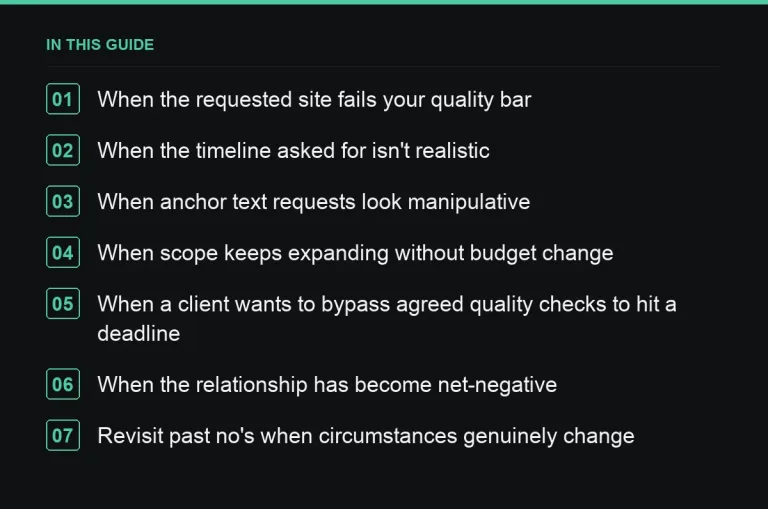
When the requested site fails your quality bar
A client naming a site with low real traffic, a high spam score, or an off-topic audience should get a clear, data-backed no, not a quiet accommodation. See our specific-site request guide for how to frame this. Saying yes here erodes the quality standard you use to justify every other decision in the engagement.
When the timeline asked for isn’t realistic
“Can we get ten links live by Friday” is a request outreach mechanics simply can’t guarantee. Rather than agreeing and quietly missing the date, explain why — publisher response times aren’t within your control — and offer the fastest realistic alternative. Our timeline expectations guide covers the language for this.
When anchor text requests look manipulative
A client pushing for exact-match commercial anchors across every placement is asking for something that carries real algorithmic risk. Explain the risk plainly, propose a more natural anchor mix, and hold the line even if the client is initially unconvinced — see our anchor planning approach for the reasoning to share with them.
When scope keeps expanding without budget change
Extra reporting formats, additional site requests, rush jobs — each small ask seems reasonable alone, but unchecked scope creep quietly destroys margin, as covered in our margin models guide. A polite “happy to do this as an add-on for X” keeps the relationship positive while protecting the numbers.
When a client wants to bypass agreed quality checks to hit a deadline
Pressure to skip your QA process to “just get something live” should be declined even under deadline pressure. A rushed placement that turns out to be a poor fit costs more in reputation than the delay would have cost in patience.
When the relationship has become net-negative
Occasionally the right “no” is to the entire engagement — a client who consistently disputes invoices, demands guarantees you can’t ethically give, or treats staff poorly. See our churn guide for how to think about proactive offboarding versus letting a bad-fit account limp along.
Revisit past no’s when circumstances genuinely change
A request declined a year ago might be worth reconsidering if the client’s budget, goals or the site in question has changed materially since. Don’t let a past decision calcify into a permanent rule if the underlying facts have actually shifted — periodically revisiting old no’s, briefly, keeps the relationship responsive rather than rigid.
Separate a firm no from an unhelpful one
There’s a difference between declining a request outright and declining it in a way that leaves the client stuck. Even when the answer is no, aim to leave the client with a next step — an alternative site, a revised timeline, a different way to reach their underlying goal — so the conversation ends with forward motion rather than a dead end.
When a client compares you unfavorably to a much cheaper option
If a client is pushing for your price to match a bulk, unvetted link seller, that’s usually a sign of a values mismatch rather than something to solve with a discount. Explaining the difference clearly, as covered in our positioning guide, is the right first move — but if the client still insists on treating the two options as interchangeable after that explanation, it’s reasonable to decline the account rather than lower your standards to compete on price alone.
Train the whole team to recognize these moments, not just leadership
Junior staff often feel they lack the authority to say no, and will quietly accommodate a bad request rather than escalate it. Make clear in your SOPs which categories of request should always be escalated rather than accommodated on the spot, so the decision to push back doesn’t depend on whichever team member happens to answer the client that day.
How to say no without damaging the relationship
- Lead with the reason, backed by data where possible, not just a policy statement
- Offer an alternative in the same message, not as a separate follow-up
- Keep the tone collaborative — “here’s what I’d suggest instead” rather than a flat refusal
- Document the decision so it’s consistent if the request resurfaces
A quick decision table
| Request | Response |
|---|---|
| Low-quality site | Decline with data, suggest alternatives |
| Unrealistic deadline | Explain mechanics, offer realistic range |
| Aggressive exact-match anchors | Explain risk, propose natural mix |
| Constant scope creep | Offer as paid add-on |
| Pressure to skip QA | Hold the line, explain the cost of getting it wrong |
Where to go next
Most of these situations are easier to handle when the underlying standards were set clearly during scoping, and when your sourcing already runs through a marketplace with transparent quality data to back up your reasoning.
Frequently asked questions
Won't saying no risk losing the client?
Occasionally, but a client who leaves over a well-reasoned no was usually already a poor fit. Most clients respect a firm, data-backed answer more than a vague yes they later regret.
How do we say no without sounding difficult?
Lead with the reasoning and immediately offer an alternative. A no with a next step reads as helpful; a no on its own reads as obstruction.
Should juniors be empowered to say no, or only account leads?
Juniors should be able to say no to clear quality-bar violations using documented rules; escalate anything involving scope, budget or relationship tone to an account lead.
What if the client is right and we should say yes?
Then say yes, clearly and without resentment. The point isn't to refuse by default — it's to have a considered answer instead of an automatic one.
Put it into practice
Filter 54,483 websites by DR, traffic, niche and price, and order with escrow — you pay only after the link is live.
Browse the marketplace