Scoping a Link Building Engagement: A Practical Checklist
A step-by-step checklist for scoping link building work before you send a proposal, so scope creep doesn't show up in month two.
Bad scoping is the root cause of most agency-client link building disputes: a client expects weekly reporting and gets monthly, or assumes every link will be on a site above a certain traffic level and finds out otherwise in month three. Scoping properly, before a contract is signed, prevents almost all of this. It takes an hour of structured questions up front and saves weeks of friction later.
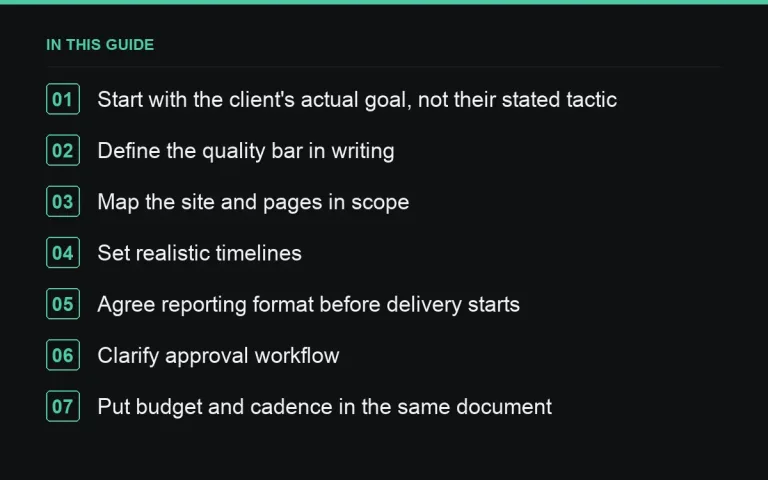
Start with the client’s actual goal, not their stated tactic
Clients frequently ask for “20 links a month” when what they actually want is a ranking improvement for a set of target pages. Ask what business outcome the links are meant to support — new organic traffic to a product line, recovery after a ranking drop, or entering a new market — because the answer changes which target pages, anchors and site niches matter. A scope built around a vague volume target is much harder to defend later than one tied to a stated business goal.
Define the quality bar in writing
Every proposal should specify, in numbers, what counts as an acceptable placement: minimum organic traffic, DA/DR range, spam score ceiling, and niche relevance rules. Vague language like “high-quality sites” invites disputes. If you’re sourcing through a marketplace, you can set these thresholds directly as filters and reuse them as a saved search, which also gives the client a transparent standard to hold you to.
Map the site and pages in scope
Confirm which domains and specific URLs are eligible link targets, and whether competitor or partner sites are off-limits for any reason (existing relationships, legal concerns, direct competitors as guest post hosts). Ask for a list of pages the client most wants supported, and a list of anchor text preferences or brand guidelines, so you’re not guessing during outreach.
Set realistic timelines
Link placement timelines depend on outreach response rates and publisher turnaround, not on your delivery calendar. Build in the actual lag between first contact and a live link, and communicate a range rather than a single date — our timeline expectations guide covers how to phrase this so it doesn’t read as an excuse later.
Agree reporting format before delivery starts
Decide, at the scoping stage, whether the client gets a monthly summary document, a live dashboard, or both, and what fields it includes (URL, DA/DR, traffic, anchor, publish date, status). See our reporting templates guide for formats that work well. Agreeing this early avoids the awkward mid-contract request for a report format you never built tooling for.
Clarify approval workflow
Some clients want to approve every site before outreach; others want to review only the final placement before it goes live; others want no approval step at all and just a report. Each model has different implications for turnaround time and headcount, and needs to be fixed at scoping stage — our approval workflows post walks through the trade-offs.
Put budget and cadence in the same document
State the monthly budget, what it buys (link volume and tier), and how unspent or rolled-over budget is handled. If you manage client funds through an escrow-style wallet, note in the scope document how funds are drawn down per placement and what happens if a placement is never completed — see our note on managing client budgets via a wallet.
Scoping checklist
| Item | Why it matters |
|---|---|
| Business goal | Drives target pages, anchors, niche selection |
| Quality thresholds | Prevents disputes over “low quality” links |
| Excluded domains | Avoids conflicts of interest |
| Timeline range | Sets realistic expectations, not fixed dates |
| Reporting format | Avoids mid-contract tooling requests |
| Approval workflow | Fixes turnaround time and staffing needs |
Write the scope document so both sides can point back to it
A scope document only earns its keep if it’s specific enough to settle a disagreement months later without an argument about what was “really” meant. Avoid soft language like “high-quality sites” or “regular reporting” in favor of numbers and named formats — minimum traffic, a named reporting cadence, an explicit approval model. Share the document with the client for sign-off, even informally by email, rather than treating it as an internal planning tool only the agency sees. This single step prevents a large share of the disputes covered in our contracts guide, since most contract disputes are really scoping disputes that were never pinned down clearly enough in the first place.
Revisit scope at renewal, not just at kickoff
Client goals shift — a new product launch, a change in priority markets, a new competitor worth tracking — and a scope document written a year ago can quietly stop matching what the engagement is actually delivering against. Build a short scope review into every renewal conversation, alongside the value reporting covered in proving value beyond link counts, so pricing, package tier and target pages get refreshed deliberately rather than drifting unnoticed.
Where to go next
A tight scope makes every later stage — onboarding, approval workflows, reporting and renewal — easier to run. Once scope is fixed, use the API or a saved search on the marketplace to source sites against the agreed thresholds without re-litigating quality every month.
Frequently asked questions
How long should a scoping conversation take?
Usually one structured call of thirty to forty-five minutes, backed by a written scope document the client signs off on. Rushing this to save time nearly always costs more time later in disputes.
Should quality thresholds be negotiable per client?
The floor shouldn't be, but the ceiling and mix can flex by budget. Never let a client negotiate you below your minimum traffic or spam score bar just to win the deal.
What if the client doesn't know their own goal?
Ask about the page or keyword set they're most concerned about and work backwards from there. A vague brief is a sign to slow down the scoping call, not skip it.
Should scope be revisited during the engagement?
Yes, quarterly is reasonable. Goals and priority pages shift, and a scope document that's a year stale usually means reporting no longer matches what the client actually cares about.
Put it into practice
Filter 54,483 websites by DR, traffic, niche and price, and order with escrow — you pay only after the link is live.
Browse the marketplace