Positioning Your Agency Against Cheap Link Sellers
How to hold your ground on price without disparaging the cheap alternative a prospect is comparing you to.

Almost every link building sales conversation eventually runs into a prospect who’s seen a much cheaper option — a marketplace seller, a fiverr-style gig, a bulk-link package — and wants to know why your price is higher. Handling this well means explaining the real difference in what’s being bought, not disparaging the cheaper option or getting defensive about price.
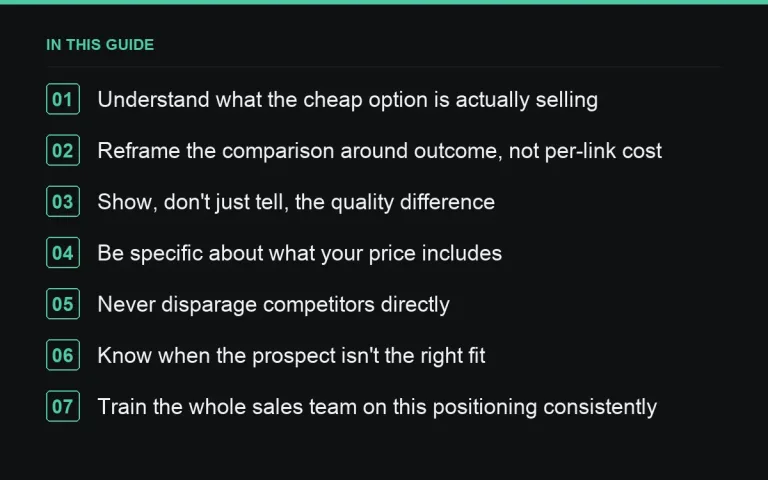
Understand what the cheap option is actually selling
Very low-cost link offers are often selling volume on unvetted or low-traffic sites, with little to no strategic input on which pages or anchors to target, and usually no ongoing monitoring or reporting. This isn’t necessarily “fake” — the sites may be real — but the lack of qualification and strategy is the actual gap, and it’s a factual, specific thing you can explain rather than a vague quality claim.
Reframe the comparison around outcome, not per-link cost
A prospect comparing price per link in isolation is comparing the wrong unit. Reframe the conversation around cost per placement that’s actually likely to help — a smaller number of well-targeted, real-traffic placements is a fairer comparison to a larger number of low-relevance ones than the raw per-link price suggests.
Show, don’t just tell, the quality difference
Use the compare tool to show real traffic and relevance data for the kind of sites your process would pursue, side by side with what a bulk cheap offer typically includes (even illustratively, without naming a specific competitor or seller). Concrete numbers are more persuasive than a general claim about being “higher quality.”
Be specific about what your price includes
Break down what the prospect is actually paying for beyond the link itself: site qualification and vetting, strategic anchor and target page planning, content quality control, ongoing link monitoring, and reporting. A prospect who only sees “link” as the product will always find a cheaper “link”; a prospect who understands the full scope has a fairer basis for comparison.
Never disparage competitors directly
Explain the difference in approach and quality standards factually, without naming or directly attacking specific cheap sellers or marketplaces. This keeps the conversation professional and is also simply more persuasive — prospects are often more swayed by a calm, specific explanation than a defensive or dismissive one.
Know when the prospect isn’t the right fit
Some prospects genuinely only want the cheapest possible volume regardless of relevance or risk, and that’s a legitimate (if risky) choice that isn’t your agency’s model to serve. Rather than discounting to match, it’s often better to acknowledge honestly that you’re not the right fit for that specific requirement — see our guide on saying no.
Train the whole sales team on this positioning consistently
If one salesperson holds firm on price while another quietly discounts under pressure, prospects who compare notes (which happens more than agencies expect) will notice the inconsistency and use it as leverage. Agree on the positioning language and pricing flexibility rules as a team, so the response to a cheap-competitor comparison doesn’t depend on which salesperson happens to take the call, and every prospect hears a consistent, confident answer regardless of who they speak with first, which itself is a subtle signal of the operational discipline the agency is trying to sell.
Acknowledge price is a legitimate factor, without conceding the argument
Dismissing a prospect’s price sensitivity entirely can come across as tone-deaf, especially for smaller businesses genuinely working with a tight budget. Acknowledge that price matters, then pivot to helping them understand what a smaller, well-targeted engagement at your standard would look like, rather than either matching the cheap price or ignoring the concern altogether.
Use your own sourcing process as evidence, not just a claim
Rather than simply asserting a higher standard, walk a skeptical prospect through the actual thresholds you apply — the same ones covered in our bulk domain check guide — and how consistently they’re enforced. Specifics about traffic minimums, spam score ceilings and niche relevance rules are far more persuasive than a general assurance of quality, because they’re falsifiable and checkable, which builds more credibility than a vague promise ever could.
Remember that not every client cares equally about this comparison
Some prospects were never comparing you to a cheap alternative in the first place — they came in already valuing a considered process. Don’t over-rotate your entire pitch around defending against the cheap-seller comparison if it hasn’t actually come up; save the detailed positioning for the conversations where it’s genuinely relevant.
A comparison framing that works
| What’s compared | Better framing |
|---|---|
| Price per link | Cost per placement likely to actually help the target page |
| “Quality” (vague) | Specific traffic, relevance and vetting data |
| Volume | Fit to the client’s actual goal, not raw count |
Where to go next
Strong positioning depends on having a genuinely differentiated process to point to — see our productizing guide and QA checklist — backed by real sourcing from a vetted marketplace rather than a claim of quality with nothing concrete behind it.
Frequently asked questions
Should we ever match a cheap competitor's price?
Rarely, and only if you can do so without compromising your quality thresholds — matching price by cutting corners undermines the whole basis of your positioning.
Is it fair to say cheap link sellers are always bad?
No — some offer real, if unvetted, placements. The honest critique is about lack of qualification, strategy and monitoring, not a blanket claim that cheap links are fake.
How do we handle a client who already bought cheap links elsewhere?
Offer to audit the existing links as part of onboarding, rather than assuming the worst — this also naturally surfaces any quality or risk issues worth flagging.
Does this positioning work for freelancers too, not just agencies?
Yes — the same reasoning about cost-per-outcome versus cost-per-link applies regardless of team size.
Put it into practice
Filter 54,483 websites by DR, traffic, niche and price, and order with escrow — you pay only after the link is live.
Browse the marketplace