Using Bulk Domain Check to Qualify Client Prospect Lists
How to turn a long, unqualified list of prospect domains into a ranked shortlist in minutes instead of hours.
A common starting point for a new client engagement is a long list of prospective sites — pulled from a competitor’s backlink profile, a client’s own suggestions, or an old outreach spreadsheet from a previous agency. Manually checking each one individually for traffic, authority and spam signals is slow and error-prone. A bulk domain check turns this into a fast, consistent qualification pass.
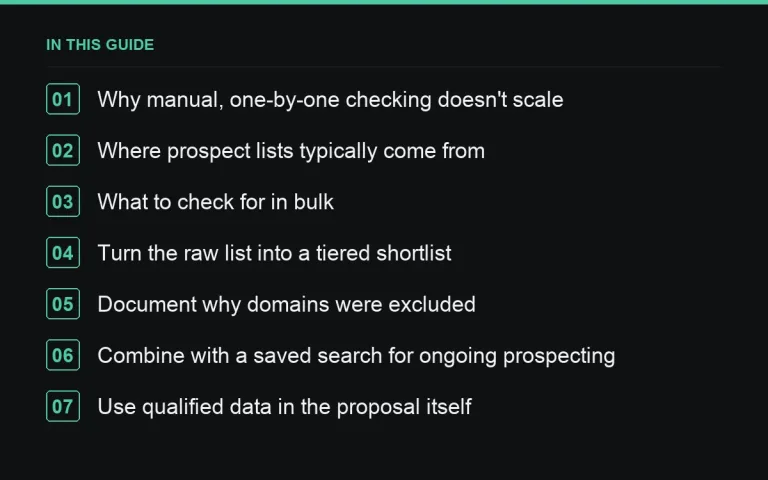
Why manual, one-by-one checking doesn’t scale
Checking fifty domains individually across multiple tools takes hours and invites inconsistency — a tired reviewer applies a slightly different bar to domain forty than to domain three. A bulk domain check applies the same thresholds uniformly across the whole list in one pass, which is both faster and more defensible when a client asks why a particular site was excluded.
Where prospect lists typically come from
- A client’s own list of sites they’d like to be featured on
- Competitor backlink profiles pulled during discovery
- Leftover lists from a previous agency or in-house effort
- Cold outreach lists built from niche directories or search
Whatever the source, the qualification process should be identical — apply the same traffic, authority and spam thresholds regardless of where the domain came from.
What to check for in bulk
| Signal | What it flags |
|---|---|
| Organic traffic | Sites with authority metrics but little real traffic |
| DA/DR | Baseline authority comparison across the list |
| Spam score | Sites with signs of indiscriminate link selling |
| Niche/topic match | Relevance to the client’s industry |
| Language and country | Audience fit for geographically targeted clients |
Turn the raw list into a tiered shortlist
Rather than a flat pass/fail, sort qualifying domains into tiers — premium, standard, filler — based on how far above your minimum thresholds they sit. This gives account managers a ready-made structure for building a client proposal or planning which sites to pursue first, rather than treating every qualifying domain as interchangeable.
Document why domains were excluded
Keep a short reason code next to excluded domains (low traffic, high spam score, off-topic, duplicate of an existing relationship) rather than just deleting them from the list. This is useful both for client transparency — see our specific-site request guide — and for refining your qualification thresholds over time if you notice a pattern in what’s getting excluded.
Combine with a saved search for ongoing prospecting
Once a one-off prospect list has been qualified, set up a saved search matching the same thresholds and niche so new matching sites surface automatically going forward, rather than needing a fresh bulk check exercise every time the pipeline runs dry.
Use qualified data in the proposal itself
A shortlist with real metrics attached is a stronger sales tool than a vague description of “high-quality sites we’ll pursue.” Pull two or three example domains with their traffic and authority numbers into the proposal, alongside the compare tool if you want to show relative standing against a competitor’s existing profile.
Use the same process for internal prospecting lists too
The same bulk qualification discipline should apply to lists your own team builds internally, not just client-supplied ones. It’s tempting to assume internally sourced lists are automatically higher quality since your own team built them, but the same checks catch the same issues regardless of where a list originated, and consistency here is what makes the whole qualification standard credible rather than selectively applied depending on which source a given prospect domain happened to come from.
Communicate the qualification pass rate back to the client
If a client-provided list of forty domains only yields twelve qualifying sites, tell them that plainly, with the reasoning, rather than silently pursuing only the twelve and letting the other twenty-eight quietly disappear from view. Transparency about the qualification rate builds confidence that a thorough process happened, rather than raising the question of what happened to the rest of the list.
Re-run the check periodically, not just once
A list qualified six months ago can go stale — sites lose traffic, change ownership, or start showing spam signals they didn’t have before. For clients with an ongoing, large prospect list, schedule a periodic re-check rather than treating the original qualification as permanent, especially before pursuing a site that’s been sitting unused on a shortlist for a long stretch.
Train the whole team to trust the same qualification pass
Once a bulk check has been run and documented, avoid having individual team members re-litigate site quality informally based on gut feeling. Consistency matters more here than any single person’s intuition — if the thresholds need adjusting, change them explicitly and re-run the check, rather than letting different people apply silently different personal standards to the same qualified list.
Where to go next
Bulk qualification is the foundation for good scoping and honest client reporting. Pair it with marketplace filters to go from a raw list to a workable shortlist in one sitting rather than a multi-day research task.
Frequently asked questions
How large a list is worth bulk-checking versus doing manually?
Anywhere above ten to fifteen domains is usually faster to check in bulk than one by one, and the consistency benefit applies even to smaller lists.
What should we do with domains that fail every check?
Discard them, but keep a note of why, since it's useful evidence if a client or a previous agency's list keeps resurfacing the same low-quality domains.
Should client-provided site suggestions get special treatment?
No — apply the same thresholds. If a client-suggested site fails the bar, that's exactly the situation covered in our specific-site request guide, and it should be explained, not quietly waived.
Can a qualified shortlist be reused across similar clients?
Only the general quality tier information; niche relevance still needs to be re-evaluated per client, since a site relevant to one client's industry may be off-topic for another.
Put it into practice
Filter 54,483 websites by DR, traffic, niche and price, and order with escrow — you pay only after the link is live.
Browse the marketplace